Home
Class 12
PHYSICS
Using Gauss's law in electrostatics, obt...

Using Gauss's law in electrostatics, obtain an expression for electric field due to a uniformly charged thin spherical shell at a point
(i) Outside the shell and
(ii) Inside the shell

Text Solution

Verified by Experts
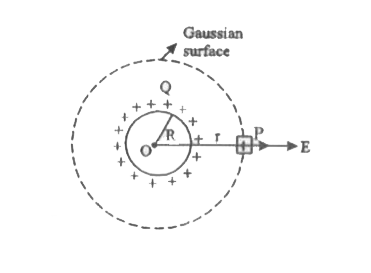
Gauss.s theorem : The total outward electric flux passing through a closed surface in air is `(1/epsilon_0)` times the total charge enclosed by it . .

Let .+Q. be the charge enclosed by a hollow conductor of radius .R..
Let .p. be a point at a distance .r. from the centre of the conductor and .ds. be a small element of area surrounding the point . A normal drawn from the point coincides with the direction of `vecE`. Hence cos `0^@=1`.
From Gauss.s theorem ,
`TOEF=phi=(1/epsilon_0)Q`...(1)
by definition f=E cos q Sds.
where, `ads=4pr^2 , cos q=cos 0^@ =1`
hence, f=E . `4pr^2`...(2)
Comparing (1) & (2)
we write `E=(1/(4piepsilon_0))Q/r^2`
For a point on the surface , r =R
`E=(1/(4piepsilon_0))(Q/R^2)`
This electric field intensity is maximum . Since electric flux depends on the charge enclosed and electric field intensity depends on the electric flux , electric field remains zero at all points inside the spherical hollow conductor.
Promotional Banner

Topper's Solved these Questions

  • SUPER MODEL QUESTION PAPER -5

    SUBHASH PUBLICATION|Exercise PART -D|8 Videos
  • SUPPLEMENTARY EXAMINATION QUESTION PAPER (WITH ANSWER) JULY-2018

    SUBHASH PUBLICATION|Exercise PART-D|12 Videos

Similar Questions

Explore conceptually related problems

State Gauss's theorem. Obtain an expression for elactric field at any point outside a charged spherical hollow conductor (shell).

Obtain an expression for Magnetic field inside a solenoid by using Ampere's Circuital Law.

Write the expression for electric field intensity at any point outside and inside due to a charged spherical shell.

Derive an expression for the electric field at a point due to an infinitely long thin charged straight wire using Gauss Law.

SUBHASH PUBLICATION-SUPPLEMENTARY EXAM QUESTION PAPER JUNE 2018-QUESTION
  1. Write any three properties of magnetic field lines.

    Text Solution

    |

  2. Obtain an expression for effective Capacitance of two Capacitors Conne...

    Text Solution

    |

  3. Distinguish between diamagnetic and paramagnetic substances.

    Text Solution

    |

  4. Describe the coil and barmagnet experiment to demonstrate the phenomen...

    Text Solution

    |

  5. Derive the expression for effective focal length of two thin lenses ke...

    Text Solution

    |

  6. Write any three experimental observations of photoelectric effect

    Text Solution

    |

  7. Explain the working of a zener diode as a voltage regulator.

    Text Solution

    |

  8. What is the function of 'receiver' in communication system ? Draw the ...

    Text Solution

    |

  9. Using Gauss's law in electrostatics, obtain an expression for electric...

    Text Solution

    |

  10. Derive sigma = (n e^(2) tau)/(m) where the symbols have their usual ...

    Text Solution

    |

  11. Obtain an expression for the force between two straight parallel condu...

    Text Solution

    |

  12. Obtain the expression for fringe width in the case of interference of ...

    Text Solution

    |

  13. Describe with suitable block diagrams, action of pn-junction dioid...

    Text Solution

    |

  14. Assuming the expression for radius of the orbit, derive an expression ...

    Text Solution

    |

  15. The plates of a parallel plate capacitor have an area of 100 cm^(2) e...

    Text Solution

    |

  16. The plates of a parallel plate capacitor have an area of 100 cm^2 ...

    Text Solution

    |

  17. In the given circuit diagram , calculate : The main current thr...

    Text Solution

    |

  18. A 20 Omega resistor, 1.5 H inductor and 35 mu H capacitor are connecte...

    Text Solution

    |

  19. The radii of curvatore of two surfaces of a convex lens is 0.2 m and 0...

    Text Solution

    |

  20. The half life of ""(38) Sr^(90) isotope is 28 years. What is the rate ...

    Text Solution

    |

