Home
Class 12
PHYSICS
Derive th lens maker's formula....

Derive th lens maker's formula.

Text Solution

Verified by Experts
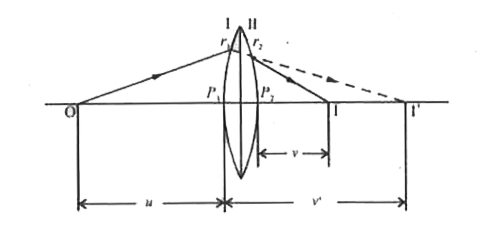
Lens maker.s formula
Let `r_(1) and r_(2)` be the radii of curvature of the thin lens .

Let O be the point at a distance u from the pole of the first curved surface of the lens . Real image is formed at I. at a distance v. from the pole `P_(1)` this image is formed in the denser medium .
We know that from the refraction formula ,
`(n_1)/(-u )+(N_2)/(v)=(n_2-n_1)/(r )i.e., (n_1)/(-u)+(n_2)/(v.)=(n_2-N_(1))/(r_1)`
Where `n_1` is the refractive index of rarer medium and ` n_(2)` that of the denser medium `(n_(2) gt n_(1))` , FOr the second surface , real image at I. will serve as - ve . The object space is the lens me - dium for refractive through the second curved surface . final image is formed in air at I and at a distance of .v. from ` P_(2)`
` (n_1)/(-u)+(n_2)/(v)=(n_2-n_1)/(r )`
` i.e., (n_2)/(-v)+(n_1)/(v)=(n_(2)-n_(1))/(-r_2)`
Adding (1) and (2) we get
` (n_1)/(-u ) +(n_1)/(v)=(n_2-n_1)((1)/(r_(1))-(1)/(r_(2)))`
` or (1)/(-u ) +(1)/(v) =(n_(2)-n_(1))/(n_(1))((1)/(r_(1))-(1)/(r_(2)))`
when `u= oo , v= f`
when `u=f , v=oo`
` therefore ` The term on the L.H.S can be replaced by ` (1)/(f)` where f is the focal length of lens .
`i.e., (1)/(f) =((n_2-n_1)/(n_1))((1)/(r_1)-(1)/(r_(2)))`
The equation (4) is called the lens maker.s formula
Note :(1) using the equation (4) , it can be shown that
`""_(1) N_(2) = 1 -[(r_1r_2)/(f(r_1-r_(2)))]` where ` ""_(1) N_(2) =(n_(2))/(n_(1))`
(2) for radius of curvature the letter .R. may be used .
Promotional Banner

Topper's Solved these Questions

  • ANNUAL EXAM QUESTION PAPER -MARCH -2017

    SUBHASH PUBLICATION|Exercise PART -C|8 Videos
  • ALTERNATING CURRENT

    SUBHASH PUBLICATION|Exercise NUMERICALS WITH SOLUTIONS|34 Videos
  • ANNUAL EXAM QUESTION PAPER MARCH 2018

    SUBHASH PUBLICATION|Exercise QUESTION|38 Videos

Similar Questions

Explore conceptually related problems

(a) A point object is placed in front of a double convex lens ( of refractive index n = n_(2) // n_(1) with respect to air ) with its spherical faces of radii of curvature R_(1) and R_(2) . Show the path of rays due to refraction at first and subsequently at the second surface to obtain the formation of the real image of the object. Hence obtain the lens-maker's formula for a thin lens. A double convex lens having both faces of the same radius of curvature has refractive index 1.55. Find out the radius of curvature of the lens required to get the focal length of 20cm.

Draw a ray diagram showing the formation of the image by a point object on the principal axis of a spherical convex surface separating two media of refractive indices n_(1) and n_(2) , when a point source is kept in rarer medium of refractive index n_(1) . Derive the relation between object and image distance in terms of refractive index of the medium and radium of curvature of the surface. Hence obtain the expression for lens-maker's formula in the case of thin convex lens.

Derive the quadratic formula from the standard form (ax^(2)+bx+c=0) of a quadratic equation.

Derive the section formula for the internal division in three dimensions.

Write the molecular formula of alcohol which can be derived from butane.
