Home
Class 12
PHYSICS
A bi-convex lens is formed with two thin...

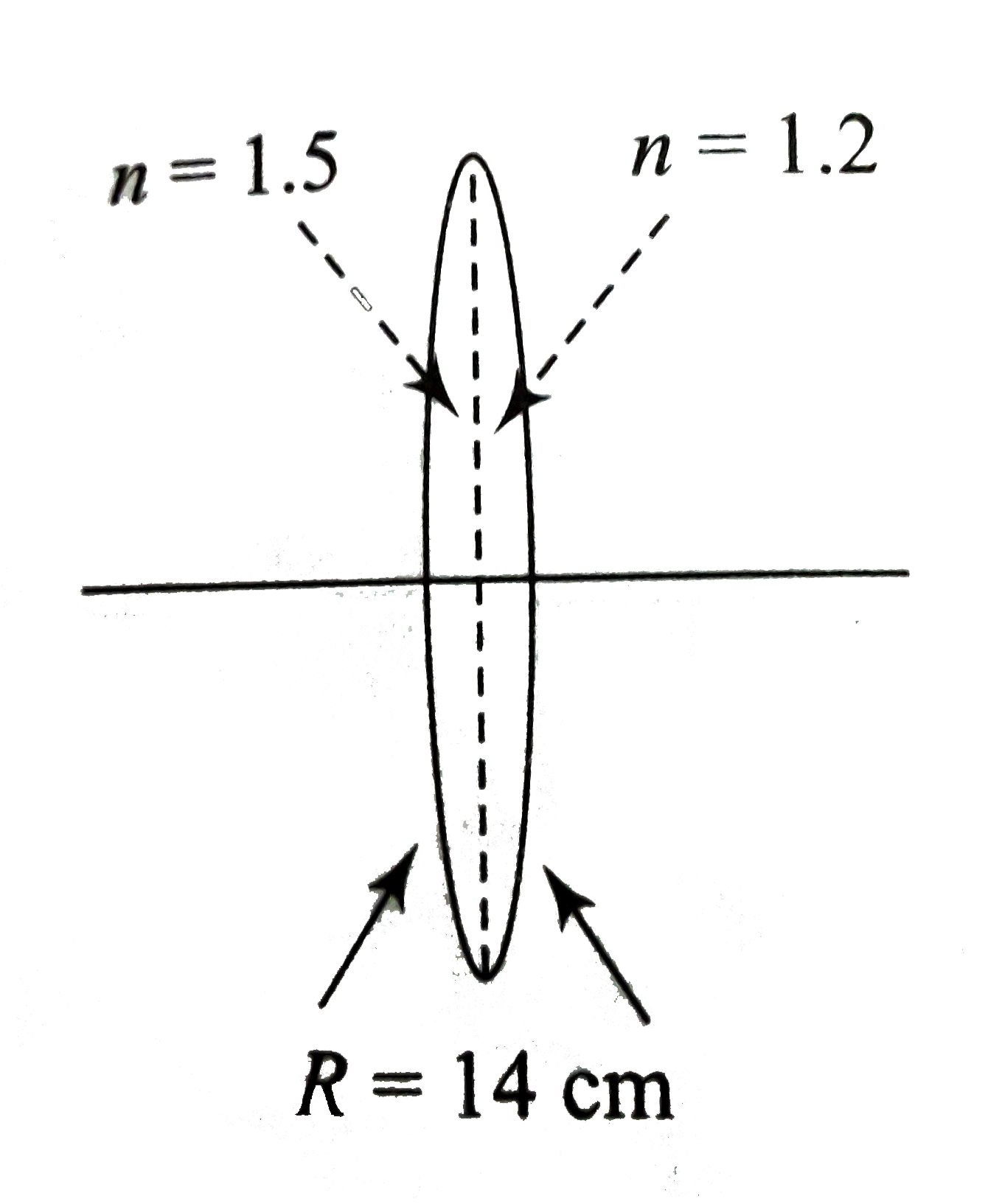
A bi-convex lens is formed with two thin plano-convex lenses as shown in the figure. Refractive index n of the first lens is 1.5 and that of the second lens if 1.2 Both the curved surfaces are of the same radius of curvature `R=14cm. ` For this bi-convex lens, for an object distance of 40cm, the image distance will be

A

`-280.0 cm`

B

`40.0cm`

C

`21.5 cm`

D

`13.3 cm`

Text Solution

Verified by Experts

The correct Answer is:
B

According to lens maker's formula
`1/f = (n-1)((1)/(R_(1)) - 1/(R_(2)))`
For the first lens,
`n = 1.5, R_(1) = +14 cm, R_(2) = oo`
`:. 1/(f_(1)) = (1.5-1) ( 1/14 - 1/(oo)) = (0.5)/(14)`
For the second lens, `n = 1.2, R_(1) = oo , R_(2) = - 14 cm`
`:. (1)/(f_(2)) = (1.2-1) (1/oo - 1/(-14)) = (0.2)/(14)`
The focal length of the bi-convex lens is
`1/f = (1)/(f_(1)) + 1/(f_(2)) = (0.5)/(14) + (0.2)/(14) = (0.7)/(14) = (1)/(20)`
According to thin lens formula, `1/v - 1/u = 1/f`
Here, `u = - 40 cm, f = 20 cm`
`:. 1/v - (1)/(-40) = (1)/(20)` or `(1)/(v) = (1)/(20) - (1)/(40)` or `v = 40 cm`
Promotional Banner

Topper's Solved these Questions

  • RAY OPTICS AND OPTICAL INSTRUMENTS

    NCERT FINGERTIPS|Exercise NCERT Exemplar|11 Videos
  • RAY OPTICS AND OPTICAL INSTRUMENTS

    NCERT FINGERTIPS|Exercise Assertion And Reason|15 Videos
  • RAY OPTICS AND OPTICAL INSTRUMENTS

    NCERT FINGERTIPS|Exercise Miscellaneous|9 Videos
  • PRACTICE PAPPER

    NCERT FINGERTIPS|Exercise Practice Paper 3|50 Videos
  • SEMICONDUCTOR ELECTRONICS : MATERIALS , DEVICES AND SIMPLE CIRCUITS

    NCERT FINGERTIPS|Exercise Assertion And Reason|15 Videos

Similar Questions

Explore conceptually related problems

A bi-convex lens is formed with two thin plano-convex lenses as shown in the figure. Refractive index n of the first lens is 1.5 and that of the second lens is 1.2. Both the curved surface are of the same radius of curvature R=14 cm. For this bi-convex lens, for an object distance of 40 cm, the image distance will be

A plano-convex lens P and a concavo-convex lens Q are in contact as shown in figure. The refractive index o fthe material of the lens P and Q is 1.8 and 1.2 respectively. The radius of curvature of the concave surface of the lens Q is double the radius of curvature of the convex surface. The convex surface of Q is silvered. An object is placed on the placed on the principal axis at a distance 10 cm form the plane surface. The image is formed at a distance 40 cm from the plane surfaces on the same side. The focal length of the system is

A plano-convex lens P and a concavo-convex lens Q are in contact as shown in figure. The refractive index o fthe material of the lens P and Q is 1.8 and 1.2 respectively. The radius of curvature of the concave surface of the lens Q is double the radius of curvature of the convex surface. The convex surface of Q is silvered. The radius of curvature of common surface is

The radius of curvature of the convex surface of a thin plano-convex lens is 15 cm and the refractive index of its material is 1.6. The power of the lens is

The radius of curvature of the convex surface of a thin plano-convex lens is 12 cm, and the refractive index of its material is 1.6. What is the power of lens ?

A plano-convex lens has refractive index 1.6 and radius of curvature 60 cm. What is the focal length of the lens?

If in a plano-convex lens, the radius curvature of the convex surface is 10 cm and the focal length of the lens is 20 cm , then the refractive index of the material of lens will be

The radius of curvature of the convex face of a plano convex lens is 12cm and the refractive index of the material of the lends 1.5. Then, the focal length of the lens is

