

Home
Class 11
PHYSICS
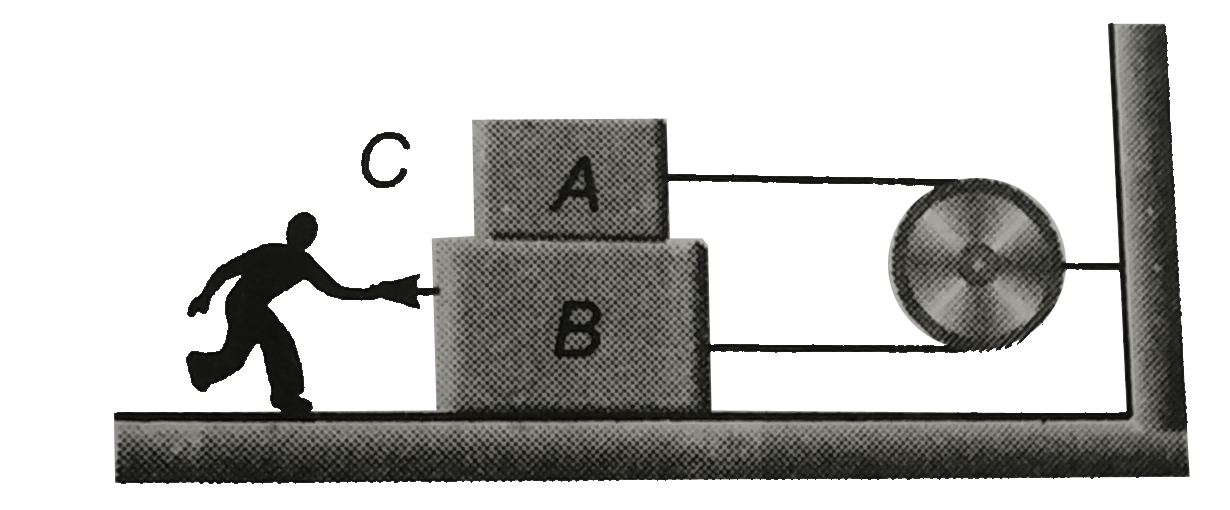
In the figure m(A) = m(B) = m(C) = 60 kg...

In the figure `m_(A) = m_(B) = m_(C) = 60 kg`. The coefficient of friction between `C` and ground is `0.5 B` and ground is `0.3, A` and `B` is `0.4. C` is pulling the string with the maximum possible force without moving. Then the tension in the string connected to `A` will be

Promotional Banner

Similar Questions

Explore conceptually related problems

In the figure shown m_(1)=5 kg,m_(2) = 10 kg & friction coefficient between m_(1) & m_(2) is mu=0.1 and ground is frictionless then :

In the figure, m_(1)=m_(2)=10 kg . The coefficients of friction between A, B and B , surface are 0.2 . Find the maximum value of m_(3) so that no block slips ( All the pullies are ideal and strings are massless).

M_(A) = 3 kg ,M_(B) = 4 kg ,M_(C) = 8 kg . Coefficient of friction between any two surface is 0.25 pulley is frictionless and string is massless .A is connected to wall through a massless right rod.

M_(A) = 3 kg ,M_(B) = 4 kg ,M_(C) = 8 kg . Coefficient of friction between any two surface is 0.25 pulley is frictionless and string is massless .A is connected to wall through a massless right rod.

In the figure shown coefficient of friction between block A and ground is 0.4 and that between wedge and block B is zero. Wedge is fixed. Find tension is string and acceleration of block A if F = 28 N.

In the figure shown coefficient of friction between block A and ground is 0.4 and that between wedge and block B is zero. Wedge is fixed. Find tension is string and acceleration of block A if F = 28 N.

In the figure , masses m_(1) , m_(2) and M are 20 kg , 5 kg and 50 kg respectively . The coefficient of friction between M and ground is zero . The coefficient of friction between m_(1) and M and that between m_(2) and ground is 0.4 . The pulleys and the string are massless . The string is perfectly horizontal between P_(1) and m_(1) and also between P_(2) and m_(2) . The string is perfectly vertical between P_(1) and P_(2) . An external horizonal force F is applied to the mass M . (Take g = 10 m //s^(2)) (a) Draw a free body diagram for mass M , clearly showing all the forces . (b) Let the magnitude of the force of friction between m_(1) and M be f_(1) and that between m_(2) and ground be f_(2) . For a particular F it is found that f_(1) = 2f_(2) . Find f_(1) and f_(2) . Write down equation of motion of all the masses . Find F , tension in the string and acceleration of the masses .

Two block A and B of mass m_(A)= 10 kg and m_(A) = 20 kg are place on rough horizontal surface . The blocks are connected with a string. If the coefficient of fraction between block A and ground is mu _(A) = 0.9 and between block B and ground is mu _(B) = 0.3 and the tension in the string in situation as shown in fig force 120 N and 100 N start acting when the system is at rest?

Two block A and B of mass m_(A)= 10 kg and m_(A) = 20 kg are place on rough horizontal surface . The blocks are connected with a string. If the coefficient of fraction between block A and ground is mu _(A) = 0.9 and between block B and ground is mu _(B) = 0.3 and the tension in the string in situation as shown in fig force 120 N and 100 N start acting when the system is at rest?