Home
Class 12
PHYSICS
Figure depicts two circular motions. The...


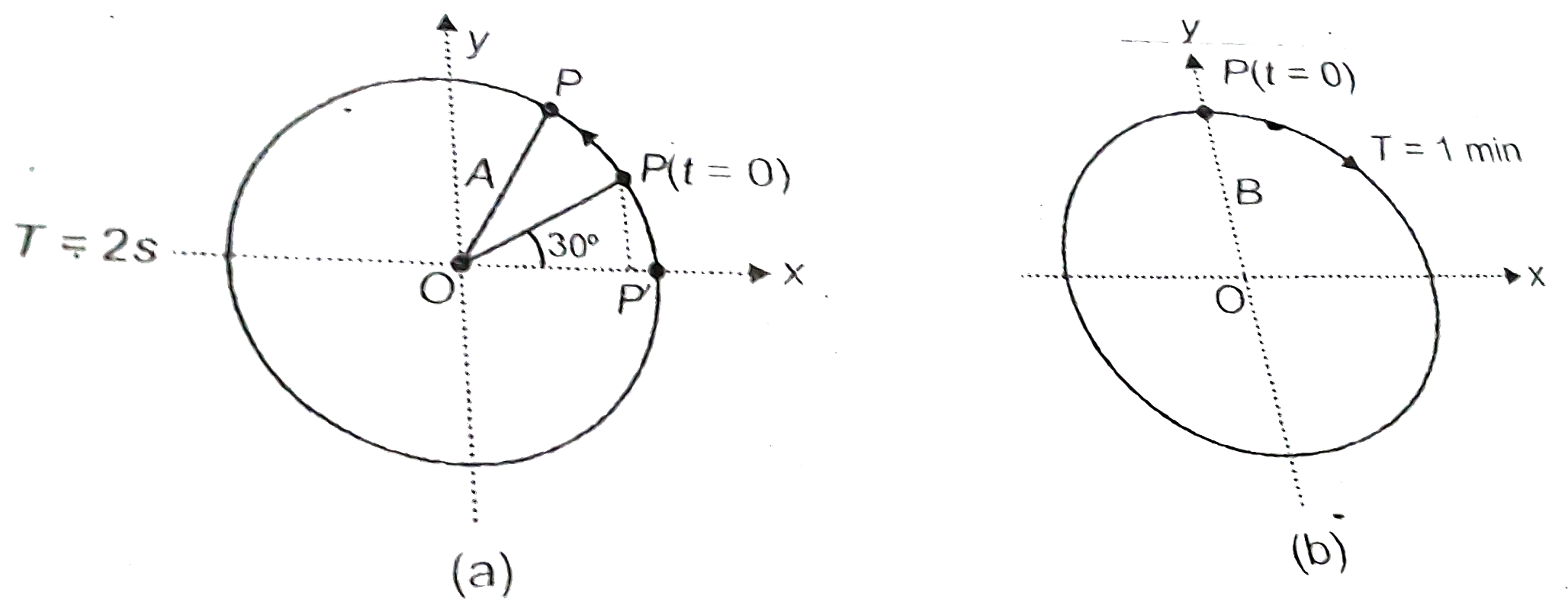
Figure depicts two circular motions. The radius of the circle, the period of revolution, the initial position and the sense of revolution are indicated on the figure. Obtain the SHMs of the x-projection of the radius vector of the rotating particle P in each case.

Text Solution

Verified by Experts

(a) At `t=0` , OP makes anangleof `30^(@) = (pi)/( 6)` rad with the positive direction of x-axid. After time t, it covers an angle `( 2pi)/(T)t` in anticlockwise direction, and makes an angle of `(2pi)/(T)t+(pi)/(6) ` with the x-axis.
The projection of OP on the x-axis at time t is given by `x(t) = A cos ((2pi)/(T)t+ (pi)/(6))`
For`t=2s`
`x(t) = Acos((2pi)/(2)t + (pi)/(6))`
Which is an SHM of amplitude A, period 2s, and an initial phase `= (pi)/(6)`
(b) At `t=0`, OP makes an angle of `90^(@) = (pi)/(2)` with the x-axis . After time t, it covers anangle of `(2pi)/(T)t`, in the clockwise direction and makes an angle of `((pi)/(2) - (2pi)/(T)t)` with the x-axis . The projection of OP on x-axis at time t, is given by
`x(t) = B cos ((pi)/(2) - (2pi)/(T) t)`
`= B sin ((2pi)/(T)t)`
For T= 1 min = 60s
`x(t) = B sin((pi)/(30)t)`
Writing this as `x(t) = Bcos ((pi)/(30t)-(pi)/(2))` ( as ` cos ( - theta) = cos theta` and `cos ( 90^(@)- theta) = sintheta )` and comparing it with equation (ii),`x(t) = A cos ( omega t + phi t)`, we find that this represents SHM of amplitude B, period 60s , and initial phase of `(-(pi)/(2))`
Promotional Banner

Topper's Solved these Questions

  • OSCILLATIONS

    AAKASH INSTITUTE|Exercise Exercise|20 Videos
  • OSCILLATIONS

    AAKASH INSTITUTE|Exercise Assignment (Section - A) (OBJECTIVE TYPE QUESTIONS)|60 Videos
  • OSCILLATIONS

    AAKASH INSTITUTE|Exercise ASSIGNMENT ( SECTION-J )|8 Videos
  • NUCLEI

    AAKASH INSTITUTE|Exercise ASSIGNMENT (SECTION-D)|10 Videos
  • PHYSICAL WORLD

    AAKASH INSTITUTE|Exercise ASSIGNMENT (Section-B)|5 Videos

Similar Questions

Explore conceptually related problems

The following figure depicts two circular motions. The radius of the circle, the period of revolutin the initial position and the sense of revolution are indicated on the figure. Obtain the simple harmoic motion of the x-projection of the radius vector of the rotating particle P in each case.

depict two circulat mothions. The radius of the circle, the period of revolution, the initial position and sense of revolution are indicated in the figures. Obtain the simple harmonic motinosof the x-projection of the radius vector of the rotating particle P in each case.

the circular motion of a particle. The radius of the circle, the period, sense of revolution and the initial position are indicated on the figure. The simple harmonic motion of the x-projection of the radius vector of the rotating particle P is

The radius of cirlcue, the period of revolution, initial position and sense of revolution are indicated in the figure. y-projection of the radius vector of rotating particle P is :

Figure shows the circular motion of a particle. The radius of the circle, the period, same of revolution and the initial position are indicated on the figure. The simple harmonic motion of the x-projection of the radius vector the rotating particle P is

Figure shows the circular motion of a particle. The radius of the circle, the period, sense of revolution and the initial position are indicated in the · figure. The simple harmonic motion of the X-projection of the radius vector of the rotating particle Pis

Figure shows the circular motion of a particle. The radius of the circle, the period, sense of revolution and the initial positionn are indicated in the figure. The simple harmonic motion off the x-projection of the radius vector of the rotating particle P is

Figures,. Correspond to two circular motions. The radius of the circle, the peirod of revolution, the initial position, and the sense of revolution (i.e. clockwise or anticlockwise) are indicated on each. Obtain the corresponding equations of simple harmonic motions of the revolving particle P in each case.

Figure below correspond to two circular motions. The radius of the circle, the period of revolution, the initial position, and the sense of revolution (i.e. clockwise or anticlockwise) are indicated on each figure. Obtain the corresponding simple harmonic motions of the x-projection of the radius vector of the revolving particle P in each case.

AAKASH INSTITUTE-OSCILLATIONS-EXAMPLE
  1. A nurse in a hospital , noted for a patient that heart was beating 75 ...

    Text Solution

    |

  2. Which of the following functions of time represented (a) periodic an...

    Text Solution

    |

  3. Categorise the following function of time : sin omega t + sin 3 omega ...

    Text Solution

    |

  4. Categories the following function of time 3 sin ( 2 omegat - (pi)/( 4)...

    Text Solution

    |

  5. Figure depicts two circular motions. The radius of the circle, the per...

    Text Solution

    |

  6. In the figure, dots and arrows show the position and the velocity of a...

    Text Solution

    |

  7. Plot the corresponding reference circle for given SHM, indicate the in...

    Text Solution

    |

  8. Find the time taken by the paritcle in going from x=0 to x= (A)/(2) wh...

    Text Solution

    |

  9. A particle executes SHM with a time period of 2s and amplitude 10 cm ....

    Text Solution

    |

  10. A particle of mass 2 kg executing SHM has amplitude 10 cm and time per...

    Text Solution

    |

  11. The speed of a particle executing SHM with amplitude of displacement 5...

    Text Solution

    |

  12. Two identical springs of spring constant k are attached to a block of ...

    Text Solution

    |

  13. How does the huge ball ( 5.4 xx 10^(5) kg ) hanging on the 22^(nd) flo...

    Text Solution

    |

  14. A block whose mass is 2 kg is fastened on a spring whose spring consta...

    Text Solution

    |

  15. A particle executes SHM with amplitude A and time period T. When the d...

    Text Solution

    |

  16. A particle of mass 0.2 kg is excuting SHM of amplitude 0.2 m. When it ...

    Text Solution

    |

  17. A 2.5 kg collar is attached to a spring of spring constant 250 Nm^(-...

    Text Solution

    |

  18. Calculate the length of a Second's pendulum ( the pendulum which ticks...

    Text Solution

    |

  19. If the length of a simple pendulum of a clock incrreases by 2% how mu...

    Text Solution

    |

  20. For the damped oscillator shown in previous Figure, the mass m of the ...

    Text Solution

    |
