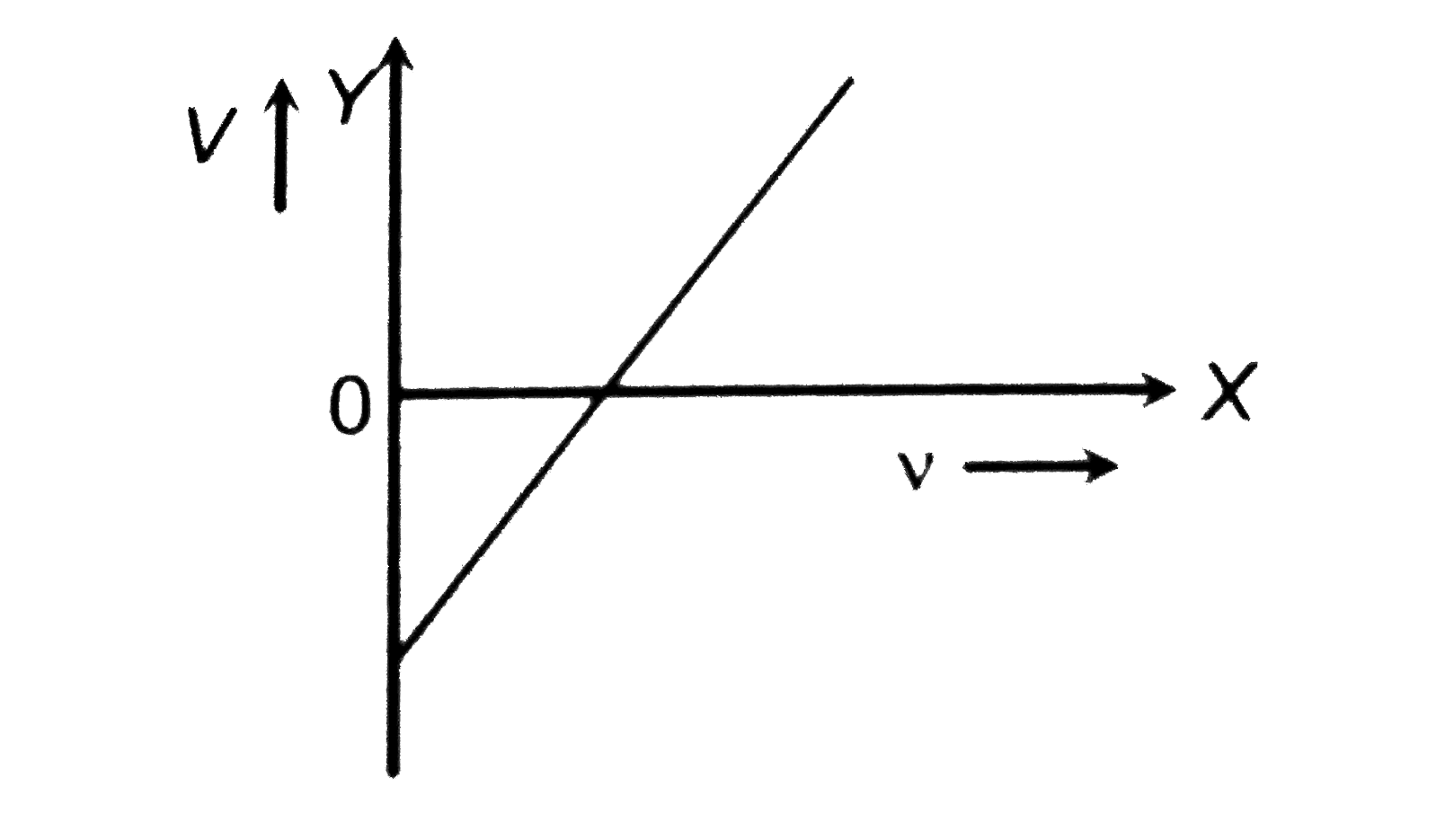
The stopping potential `V` for photoelectric emission from a metal surface is plotted along Y - axis and frequency `v` of incident light along X - axis . A straight line is obtained as shown . Planck's constant is given by
A
Slope of the line
B
Product of slope on the line and charge on the electron
C
Product of intercept along Y-axis and mass of then electron
D
Product of slope and mass of electron
Text Solution
Verified by Experts
The correct Answer is:
B
Topper's Solved these Questions
ALTERNATING CURRENT
AAKASH INSTITUTE|Exercise Try Yourself|15 Videos
ALTERNATING CURRENT
AAKASH INSTITUTE|Exercise Assignment (Section - A) ( Objective Type Questions ( One option is correct))|34 Videos
For a zero order reaction a plot of rate (along Y-axis) and concentration (along X-axis) is
In a photoelectric experiment, the graph of frequency v of incident light (in Hz) and stopping potential V (in V) is as shown in the figure. Planck's constant is (e is the elementary charge)
The stopping potential for photoelectrons from a metal surface is V_(1) when monochromatic light of frequency upsilon_(1) is incident on it. The stopping potential becomes V_(2) when monochromatic light of another frequency is incident on the same metal surface. If h be the Planck’s constant and e be the charge of an electron, then the frequency of light in the second case is:
For a photoelectric cell, the graph shown the variation of cut off voltage ( V_0 ) with frequency (v) of incident light is
In photoelectric effect the slope of straight line graph between stopping potential (V_(s)) and frequency of incident light (v) gives
In a photoelectric experiment , the stopping potential V_s is plotted against the frequency v of the incident light . The resulting curve is a straight line which makes an angle theta with the v - axis. Then tan theta will be equal to (Here E_0 = work function of the surface_
In photoelectric effect the slope of stop of stopping potential versus frequency of incident light for a given surface will be
AAKASH INSTITUTE-ALTERNATING CURRENT -Assignment (Section-J) (Aakash Chailengers Questions)