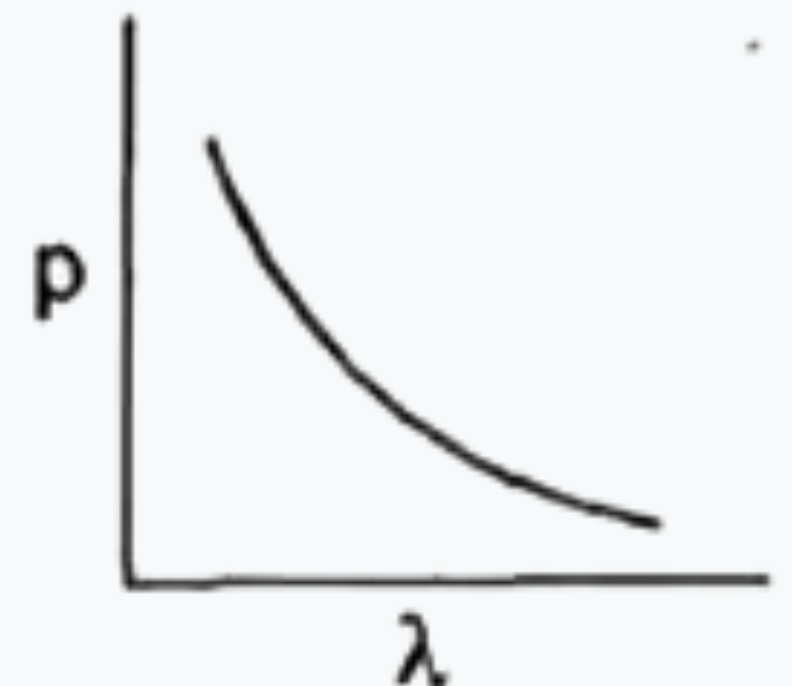
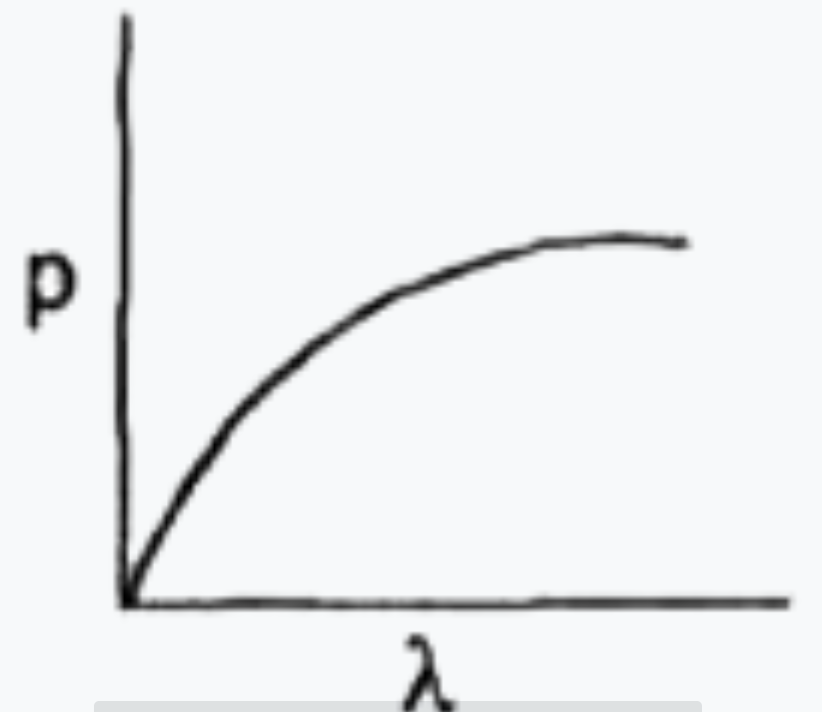
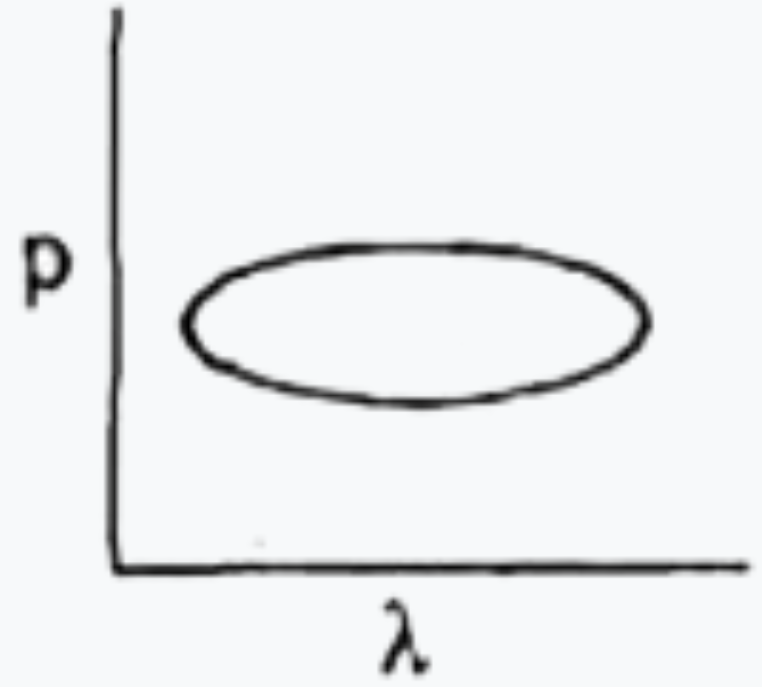
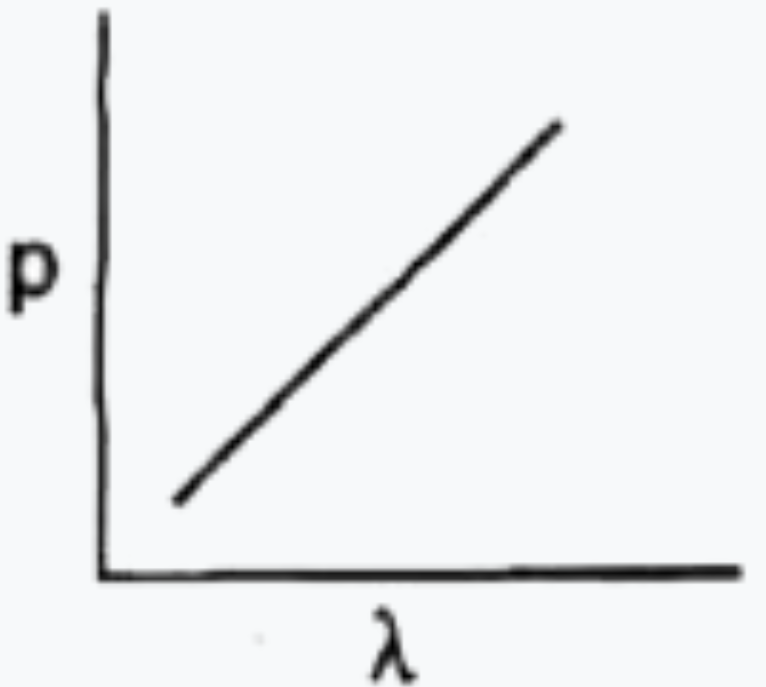
Veriation of momentum of perticle (p) with associated de-Broglie wavelength `(lambda) ` is shown correctly by
A
B
C
D
Text Solution
AI Generated Solution
The correct Answer is:
To solve the problem of how the momentum \( p \) of a particle varies with its associated de-Broglie wavelength \( \lambda \), we can follow these steps:
### Step 1: Understand the Relationship
The de-Broglie wavelength \( \lambda \) of a particle is given by the formula:
\[
\lambda = \frac{h}{p}
\]
where \( h \) is Planck's constant and \( p \) is the momentum of the particle.
### Step 2: Rearranging the Formula
From the de-Broglie wavelength formula, we can express momentum in terms of wavelength:
\[
p = \frac{h}{\lambda}
\]
### Step 3: Analyze the Relationship
From the equation \( p = \frac{h}{\lambda} \), we can see that:
- As the wavelength \( \lambda \) increases, the momentum \( p \) decreases.
- Conversely, as the wavelength \( \lambda \) decreases, the momentum \( p \) increases.
### Step 4: Plotting the Graph
If we were to plot this relationship:
- The x-axis would represent the de-Broglie wavelength \( \lambda \).
- The y-axis would represent the momentum \( p \).
The graph would show a hyperbolic relationship, indicating that as \( \lambda \) increases, \( p \) decreases.
### Step 5: Conclusion
From our analysis, we can conclude that the correct variation of momentum \( p \) with the associated de-Broglie wavelength \( \lambda \) is that momentum decreases as wavelength increases. Therefore, the correct option is the one that reflects this inverse relationship.
Topper's Solved these Questions
ALTERNATING CURRENT
AAKASH INSTITUTE|Exercise Try Yourself|15 Videos
ALTERNATING CURRENT
AAKASH INSTITUTE|Exercise Assignment (Section - A) ( Objective Type Questions ( One option is correct))|34 Videos