

Home
Class 9
MATHS
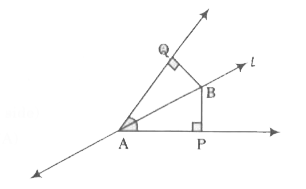
Line l is the bisector of an angle angle...

Line l is the bisector of an angle `angleA` and B is any point on li. BP and BQ are perpendicular forms B to the arms of `angleA`. Show that:
`triangleAPB ~= triangleAQB`
(ii) BP = BQ or B is equidisitant from the arms of `angleA`.

Promotional Banner

Topper's Solved these Questions

  • TRIANGLES

    CPC CAMBRIDGE PUBLICATION|Exercise EXERCISE 5.2|8 Videos
  • TRIANGLES

    CPC CAMBRIDGE PUBLICATION|Exercise EXERCISE 5.3|5 Videos
  • SURFACE AREAS AND VOLUMES

    CPC CAMBRIDGE PUBLICATION|Exercise EXERSICE 13.8|10 Videos

Similar Questions

Explore conceptually related problems

triangleABC and triangleDBC are two isosceles triangles on the same base BC and vertices A and D are on the same side of BC. If AD is extended to intersect BC at P, show that: (i) triangleABD ~= triangleACD (ii) triangleABP ~= triangleACP (iii) AP bisects angleA as well as angleD (iv) AP is the perpendicular bisector of BC.

AB is a line segment and line l is its perpendicular bisector. If a point P lies on l, show that P is equidistant from A and B.

AB is a line - segment. P and Q are points on either side of AB such that each of them is equidistant from the points A and B (See Fig ). Show that the line PQ is the perpendicular bisector of AB.

A man wishes to estimate the distance of a nearby tower from him. He stands at a point A in front of the tower C and spots a very distant object O in line with AC. He then walks perpendicular to AC up to B, a distance of 100 m, and looks at O and C again. Since O is very distant , the direction BO is practically the same as AO, but he finds the line of sight of C shifted from the original line of sight by an angle theta = 40^(@) ( theta is known as 'Parallax') estimate the distance of the tower C from his original position A.

Two congruent circles intersect each other at points A and B. Through A any line segment PAQ is drawn so that P, Q lie on the two circles. Prove that BP = BQ.

Draw any angle with vertex O. Take a point A on one of its arms and B on another such that OA = OB, Draw the perpendicular bisectors of O̅A and O̅B. Let them meet at P. Is PA = PB?

Consider the two 'postulates' gives below: (i) Given any two distinct points A and B, there exists a third point C, which is between A and B. (ii) There exist at least three points that are not on the same line. Do these postulates contain any undefined terms? Are these postulates consistent? Do they follow from Euclid's postulates? Explain.