Home
Class 12
PHYSICS
In the above question what will be the d...

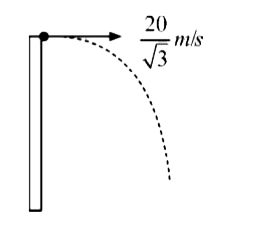
In the above question what will be the displacement of particle in x-direction when its velocity makes `60^(@)` angle with initial velocity?

A

`(20)/(sqrt(3))m`

B

`(40)/(sqrt(3))m`

C

`(50)/(sqrt(3))m`

D

`(10)/(sqrt(3))m`

Text Solution

Verified by Experts

The correct Answer is:

B
Promotional Banner

Similar Questions

Explore conceptually related problems

The displacement x of a particle at the instant when its velocity is v is given by v=sqrt(3x+16) . Its initial velociyt is

What is the displacement of a SHM particle of amplitude 3 cm, where its velocity is (1)/(3) of its maximum velocity ?

A particle is projected horizontally with a speed of (40)/(sqrt3)m//s , from some height t = 0 . At what time its velocity makes 60^(@) angle with initial velocity. (g=10m//s^(2))

A particle is projected horizontally with speed (20)/(sqrt(3))m//s , from some height at t=0. At what time its velocity will make 60^(@) angle with initial velocity ?

The displacement x of a particle varies as sqrt(x)=t-2 (i) What is the velocity and acceleration of the particle at t=0? (ii) When will the velocity of the particle become zero? (iii) What is the displacement of the particle when its velocity is zero? (iv) Is the motion of the particle uniformly accelerated or not?

A particle is projected at an angle of 60^(@) above the horizontal with a speed of 10m//s . After some time the direction of its velocity makes an angle of 30^(@) above the horizontal. The speed of the particle at this instant is s

A particle moves along the x-axis obeying the equation x=t(t-1)(t-2) , where x is in meter and t is in second a. Find the initial velocity of the particle. b. Find the initial acceleration of the particle. c. Find the time when the displacement of the particle is zero. d. Find the displacement when the velocity of the particle is zero. e. Find the acceleration of the particle when its velocity is zero.

In the above problem the direction of the initial velocity with the x-axis is
