Home
Class 12
PHYSICS
A network of resistors is connected to a...

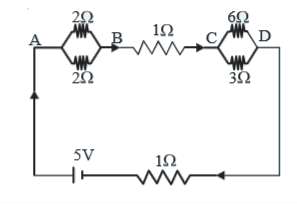
 A network of resistors is connected to a 5 V battery with internal resistance of `1Omega`  as shown in Fig. (a) Compute the equivalent resistance of the network. (6) Obtain the current in each resistor. (c) Obtain the voltage drops `V_(BC)` and `V_(CD)`

Text Solution

Verified by Experts

(a) The network is a simple series and parallel combination of resistors. First two `2Omega` resistors in parallel are equivalent to a resistor   =`(2x2)/(2+2)`=`1Omega`.
In the same way, the `3Omega` and `6Omega` resistors in parallel are equivalent to a resistor of ,
=`(6xx3)/(6+3)`=2Omega`
The equivalent resistance R of the network is obtained by combining these resistors `(2Omega and 4omega)` with `1Omega` in series, that is,
1+1+2+1=`5Omega`
(b) The total current I in the circuit is
I=`(E)/(R)`=`(5)/(5)`=1A
Consider the resistors between A and B. If `I_(1)` is the current in one of the `2Omega` resistors and `I_(2)` the current in the other, `I_(1)xx 2`=`1_(2) xx2` that is, `I_(1)` = `I_(2)` which is otherwise obvious from the symmetry of the two arms. But `I_(1)+1_(2)`=I=1 A. Thus, `1_(1)`= `I_(2)` =`(1)/(2)`  A that is current in each `2Omega` resistor is`(1)/(2) A`. Current in `1Omega` resistor between B and C would be 1 A. Now, consider the resistances between C and D. If `I_(3)` is the current in the `6Omega` resistor, and `I_(4)` in the `3Omega` resistor,`I_(3)xx6`=`I_(4)xx3`i.e, `I_(4)`=`2I_(3)`
But , `I_(3)+I_(4)`=I=1A
Thus, `I_(3)`=`((1)/(3))A`, `I_(4)`=`((2)/(3))A`   
(c ) The voltage drop across AB is `V_(AB)`=`I_(1)xx2=(1)/(2)Axx2Omega`=IV
The voltage drop across BC is `V_(BC)`= `1Axx1Omega`=1V  
Finally , the voltage across CD is `V_(CD)`=`6OmegaxxI_(3)`=`6Omrgaxx((1)/(3))0A`=2V
Promotional Banner

Similar Questions

Explore conceptually related problems

A network of resistances is connected to a 16 V battery with internal resistance of 1 Omega as shown in figure. (a) Compute the equivlaent resistance of the network. (b) Obtain the current in each resistor and (c ) obtain the voltage drop V_(AB), V_(BC) and V_(CD) .

A network of resistances is connected to a 16 V battery with internal resistance of 1 Omega , as shown in Fig. 4.33. (a) Compute epuivalent resistance of the network, (b) obtain the current In in each resistor, and (c ) obtain the voltage drops V_(AB), V_(BC) " and " V_(CD) .

The equivalent resistance of network of three 2Omega resistors can not be

The equivalent resistance of network of three 4Omega resistors can not be

The equivalent resistance of network of three 4 Omega resistors can not be

A resistor is connected to a battery of emf 10 V and internal resistance 0.3 Omega . What is the resistance of the resistor to be inserted in the circuit for the circuit current 1.2A?

Three resistors each of 4 Omega are connected together to form a network. The equivalent resistance of the network cannot be

Three resistors having resistances of 1.60 Omega, 2.40 Omega and 4.80 Omega are connected in parallel to a 28.0 V battery that has negligible internal resistance. Find (a) the equivalent resistance of the combination. (b) the current in each resistor. (c) the total current through the battery. (d) the voltage across each resistor. (e) the power dissipated in each resistor. (f) which resistor dissipates the maximum power the one with the greatest resistance or the least resistance? Explain why this should be.

7 V battery with internal resistance 2Omega and 3V battery with internal resistance 1Omega are connected to a 10Omega resistors as shown in figure, the current in 10Omega resistor is
