Home
Class 12
PHYSICS
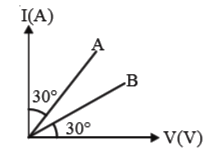
Figure shows graph between I and V for t...

Figure shows graph between I and V for two conductors A and B. Their respective resistances are in the ratio.

A

`1:1`

B

`1:3`

C

`3:1`

D

`1:2`

Text Solution

Verified by Experts

The correct Answer is:

B
Promotional Banner

Similar Questions

Explore conceptually related problems

Two conductors, one having resistance R and another 3R are connected in turn across a d.c. source. If the rate of heat produced in the two conductors is Q_(1) and Q_(2) respectively, then find their ratio.

Figure shows a parabolic graph between T and 1/V for a mixture of a gases undergoing an adiabatic process. What is the ratio of V_(nms) of molecules and speed of sound in mixture?

The velocity - time graph for two bodies A and B are shown in figure. Then, the acceleration of A and B are in the ratio

The resistance of all the wires between any two adjacent dots is R . Then, equivalent resistance between A and B as shown in figure is

Figure shows position-time graph of two cars A and B.

The following figure shows the displacement versus time graph for two particles A and B executing simple harmonic motions. The ratio of their maximum velocities is

Graphs between electric current and potential difference across two conductors A and B are as shown in (Fig. 3.49). Which of the two conductors has more resistance ? .

A conductor having resistivity rho is bent in the shape of a half cylinder as shown in the figure. The inner and outer radii of the cylinder are a and b respectively and the height of the cylinder is h . A potential difference is applied across the two rectangular faces of the conductor. Calculate the resistance offered by the conductor.

Let V and I respresent, respectively, the readings of the voltmeter and ammetre shows in Fig. 6.34 , and let R_(V) and R_(V) be their equivalent resistances. Because of the resistances of the meters, the resistnce R is not simply equal to V//I . (a) When the circuit is connected as shows in Fig. 6.34 (a), shows that R = (V)/(I) - R_(A) Explain why the true resistance R is always less than V//I . (b) When the connections are as shows in Fig. 6.34 (b) Show that R = (V)/(I - (V//R_(V))) Explain why the true resistance R is always greater than V//I . (c ) Show that the power delivered to the resistor in part (i) is IV - I^(2) R_(A) and that in part (ii) is IV - (V^(2)//R_(V))
