Home
Class 12
PHYSICS
Three long, straight and parallel wires ...

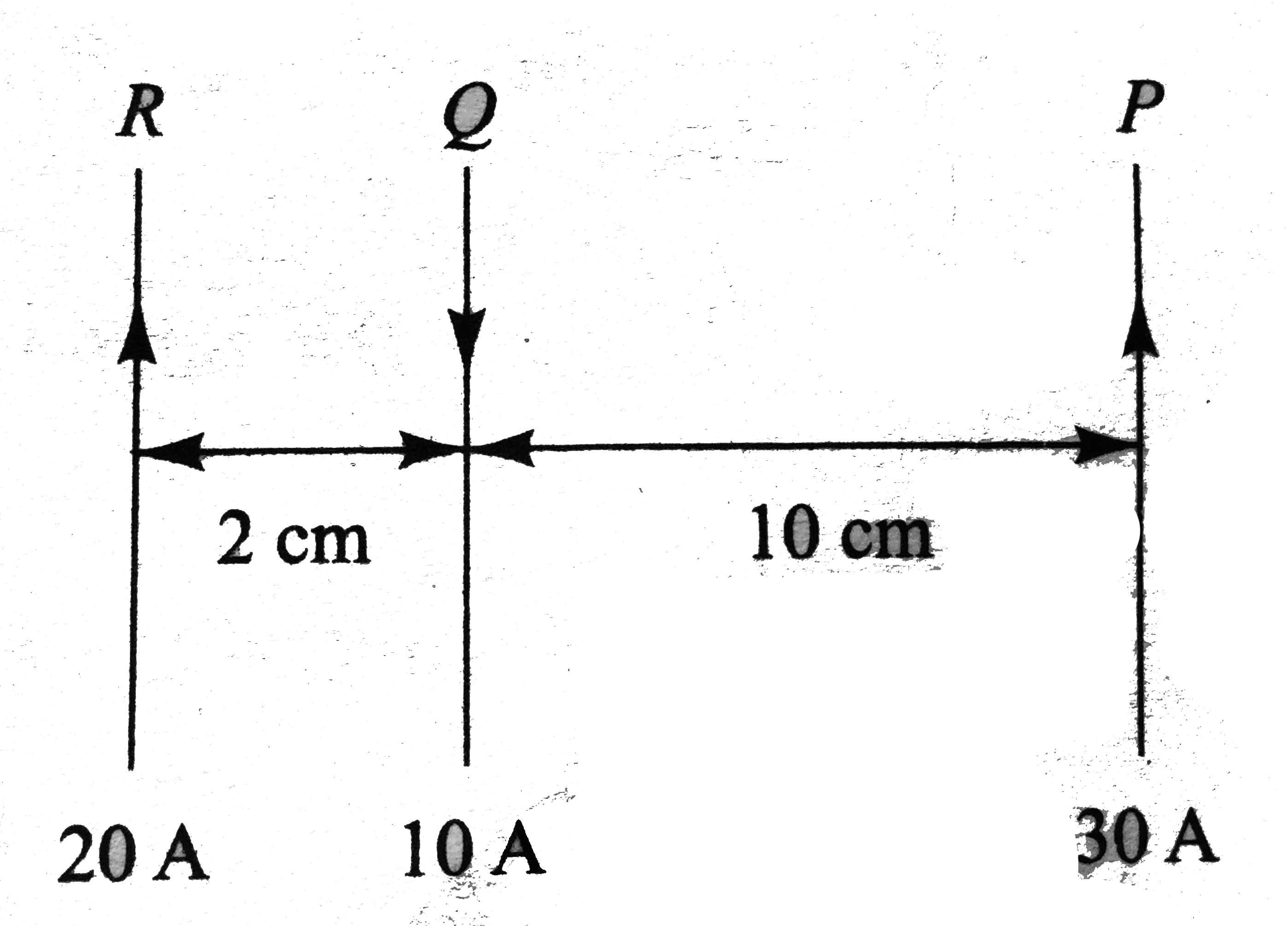
Three long, straight and parallel wires are arranged as shown in Fig. The forces experienced by 10 cm length of wire Q is

A

`1.4 xx 10^(-4)` N towards the right

B

`1.4xx10^(-4)` N towards the left

C

`2.6 xx 10^(-4)` N to the right

D

`2.6 xx 10^(-4)`to the left

Text Solution

Verified by Experts

The correct Answer is:

1

Force on wire Q due to R,
`F_(R)=10^(-7)xx 2xx20xx10/(2xx10^(-2)) xx(10xx10^(-2))=2xx10^(-4) m` (Repulsive)
Force on wire Q due to P,
`F_(P)=10^(-7)xx2xx 10xx30/(10xx10^(-2)) xx(10xx10^(-2))=0.6 xx 10^(-4)N` (Repulsive)
Hence net force `F_(net)=F_(R)-F_(P) =2 xx 10^(-4)-0.6 xx 10^(-4) = 1.4 xx 10^(-4)` N (towards right i.e. in the direction of `vec F_(R)`)
Promotional Banner

Similar Questions

Explore conceptually related problems

Three long, straight parallel wires carrying current, are arranged as shown in figure. The force experienced by a 25cm length of wire C is

Consider three long straight parallel wire as shown in figure. Find the force experienced by a 25 cm length of wire C .

Three long straight and parallel wires carrying currents are arranged as shown in the figure. The wire C which carreis a current of 5.0 amp is so placed that it experiences no force. The distance of wire C from D is then

Two long, straight, parallel wires are 1.00m apart (as shown in Fig). The upper wire carries a current I_1 of 6.00A into the plane of the paper. What is the magnitude of the net field at Q?

Two long, straight, parallel wires are 1.00m apart (as shown in Fig). The upper wire carries a current I_1 of 6.00A into the plane of the paper. What is the magnitude of the net field at S?

A segment AB of wire carrying current I_1 is placed perpendicular to a long straight wire carrying current I_2 as shown in figure. The magnitude of force experieced by the straight wire AB is

P, Q and R are long straight wires in air, carrying currents as shown. The force on Q is directed

A straight wire carrying current is parallel to the y-axis as shown in Fig. The
