Home
Class 12
PHYSICS
A wire of length l, mass m and resistanc...

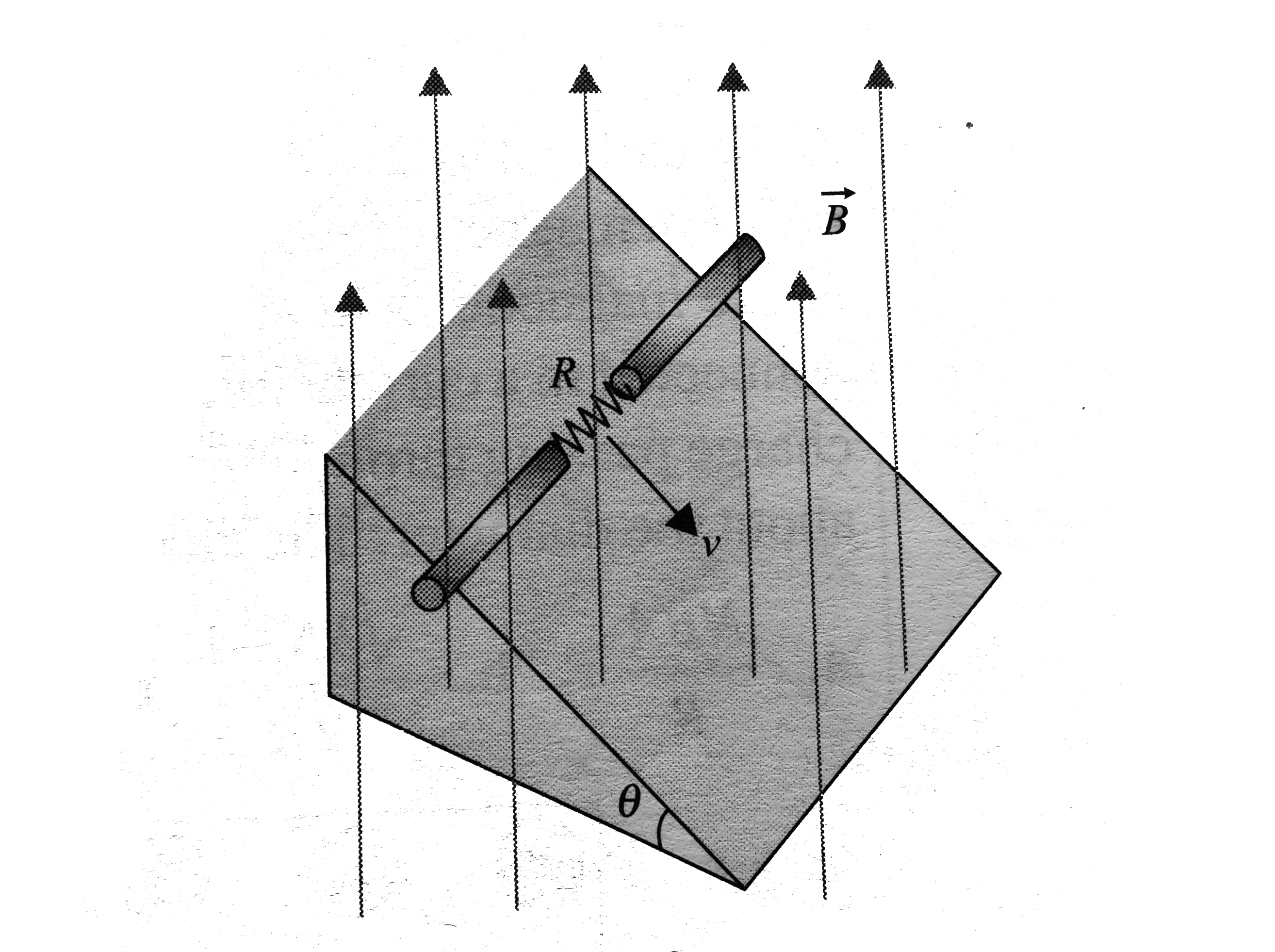
A wire of length `l`, mass `m` and resistance `R` slides without any friction down the parallel conducting rails of negligible resistance . The rails are connected to each other at the bottom by a resistanceless rail parallel to the wire so that the wire and the rails form a closed rectangualr conducting loop. The plane of the rails makes an angle `theta` with the horizontal and a uniform vertical magnetic field of the inducetion `B` exists throughout the rregion. Find the steady state velocity of the wire.

Text Solution

Verified by Experts

Force down the plane = mg sintheta At any instant if the velocity is v the induced
Current in the loop -`(IB cos thetav)/(R)`
Force on the conductor in the horizontal direction  =`(nuBlcostheta)/(R)xxBxxl`
Component parallel to the incline =` (B^(2)l^(2)costheta)/(R)xxvxxcostheta`
If v is constant this force should be angle to mg sin thetatherefoer `v=(mRgsintheta)/B^(2)l^(2)cos^(2)theta)`
Promotional Banner

Similar Questions

Explore conceptually related problems

A wire ab of length l, mass m and resistance R slides on a smooth thick pair of metallic rails joined at the bottom as shown in fig. The plane of the rails makes an angle theta with the horizontal. A vertical magnetic field B exist in the region. If the wire slides on the rails at a constant speed v, then the value of B is -

A wire cd of length l and mass m is sliding without friction on conducting rails ax and by as shown. The verticle rails are connected to each other with a resistance R between a and b . A uniform magnetic field B is applied perpendicular to the plane abcd such that cd moves with a constant velocity of

A conducting wire of length l and mass m can slide without friction on two parallel rails and is connected to capacitance C . The whole system lies in amagnetic field B and a constant force F is applied to the rod . Then

A pair of parallel conducting rails lie at right angle to a uniform magnetic field of 2.0T as shown in the fig. two resistor 10Omega and 5Omega are to slide without friction along the rail. The distance between the conducting rails is 0.1m . Then

A rod of mass m and resistance r is placed on fixed, resistanceless, smooth conducting rails (closed by a resistance R ) and it is projected with an initial velocity u .Find its velocity as a function of time.
