

Home
Class 10
MATHS
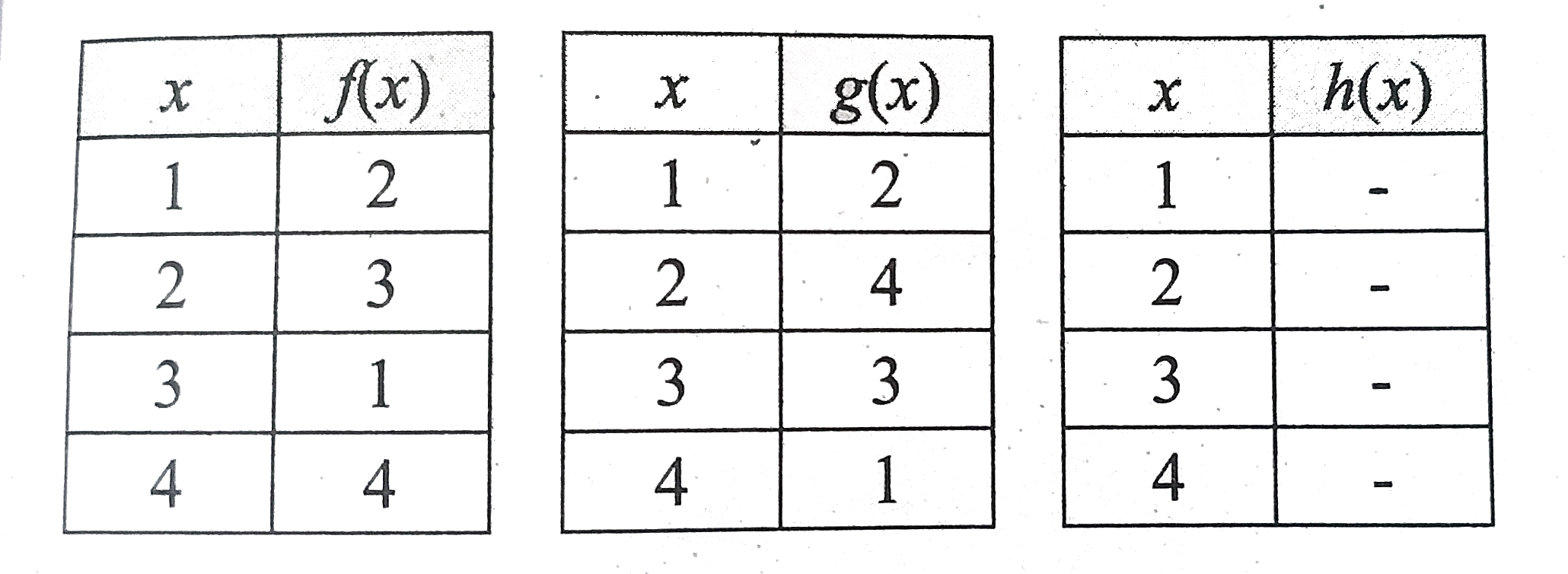
Given that h(x) =f^(@) g(x) , fill in t...

Given that `h(x) =f^(@) g(x)` , fill in the table for h (x) `

Promotional Banner

Topper's Solved these Questions

  • RELATIONS AND FUNCTION

    PREMIERS PUBLISHERS|Exercise OTHER IMPORTANT OBJECTIVE TYPE QUESTIONS|25 Videos
  • RELATIONS AND FUNCTION

    PREMIERS PUBLISHERS|Exercise SOLUTION TO PROGRESS CHECK ( yes or no )|5 Videos
  • NUMBERS AND SEQUENCES

    PREMIERS PUBLISHERS|Exercise OTHER IMPORTANT OBJECTIVE TYPE QUESTIONS|23 Videos
  • STATISTICS AND PROBABILITY

    PREMIERS PUBLISHERS|Exercise OTHER IMPORTANT OBJECTIVE TYPE QUESTIONS|23 Videos

Similar Questions

Explore conceptually related problems

Suppose that f(x) is differentiable invertible function f^(prime)(x)!=0a n dh^(prime)(x)=f(x)dot Given that f(1)=f^(prime)(1)=1,h(1)=0 and g(x) is inverse of f(x) . Let G(x)=x^2g(x)-x h(g(x))AAx in Rdot Which of the following is/are correct? G^(prime)(1)=2 b. G^(prime)(1)=3 c. G^(1)=2 d. G^(1)=3

Given f (x) = x^(2) - 3 , g(x) = 3x + 2 , h (x) = x - 7 . Show that the composition of function is associative .

Consider the function f(x) , g(x) ,h(x) as given below , Show that (f^(@) g) ^(@) h =f^(@) (g^(@) h) in each case. f(x) =-x-1 ,g(x) =3x+ 1 and h (x) =x+4

If find g are polynomials of derrees m and n respectively, and if h(x) = (f^@ g ) (x), then the degree of h is

Let f be a differentiable function such that f(1) = 2 and f'(x) = f (x) for all x in R . If h(x)=f(f(x)), then h'(1) is equal to

If f(x-y)=f(x).g(y)-f(y).g(x) and g(x-y)=g(x).g(y)+f(x).f(y) for all x in R . If right handed derivative at x=0 exists for f(x) find the derivative of g(x) at x =0

If f(x),g(x)a n dh(x) are three polynomial of degree 2, then prove that varphi(x)=|f(x)g(x)h(x)f'(x)g'(x h '(x)f' '(x)g' '(x h ' '(x)| is a constant polynomial.

f is a continous function in [a, b] ; g is a continuous function in [b,c]. A function h(x) is defined as h(x)=f(x) for x in [a,b) , g(x) for x in (b,c] if f(b) =g(b) then

Given f(x) = x^(2) + 4 : g(x) = 3x - 2 : h(x) = x - 5, show that the composition of functions is associative.