

Home
Class 10
MATHS
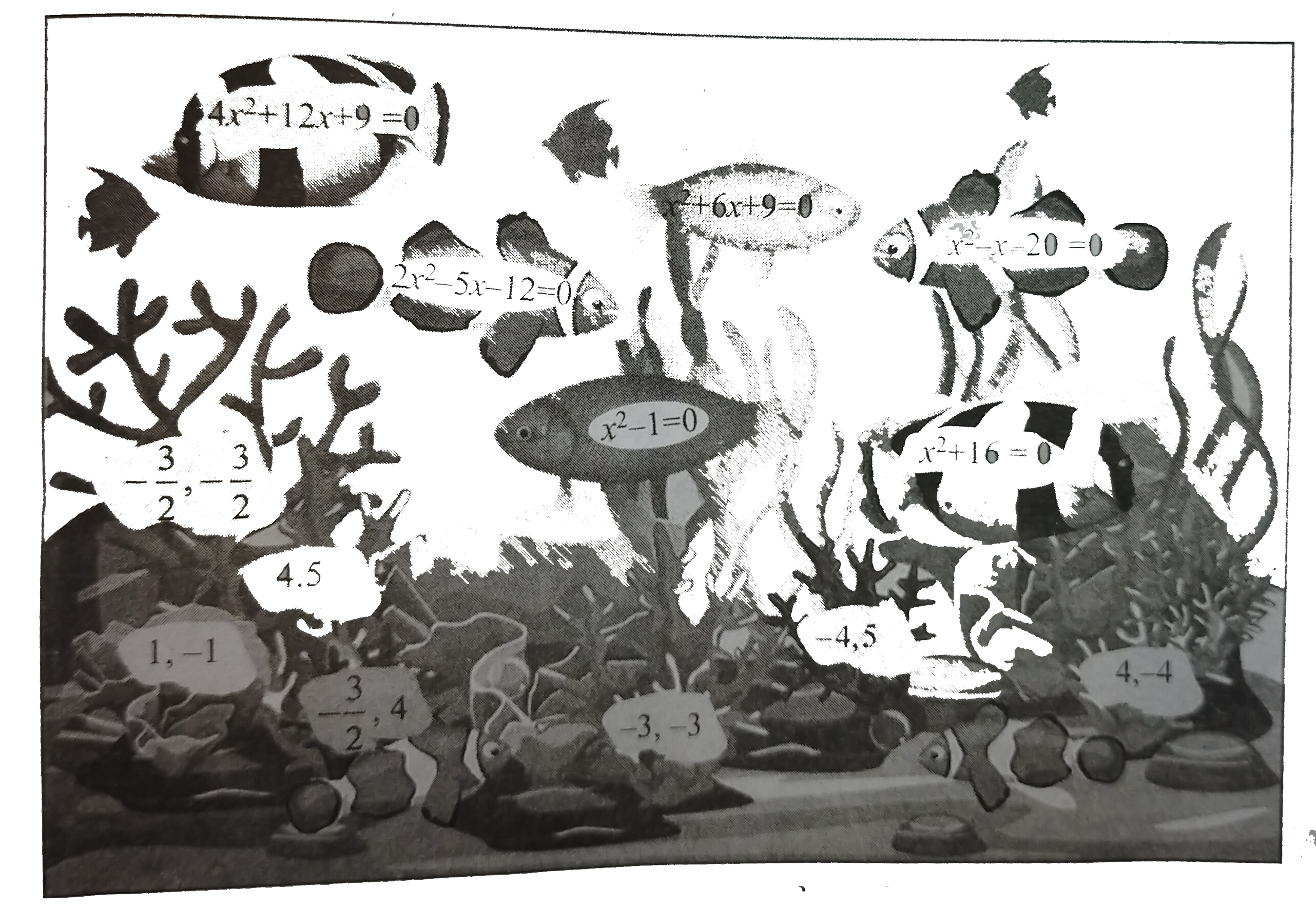
Serve the fishes (Equations) with its ap...

Serve the fishes (Equations) with its appropriate food (roots). Identify a fish which cannot be served ?

Promotional Banner

Topper's Solved these Questions

  • ALGEBRA

    PREMIERS PUBLISHERS|Exercise OTHER IMPORTANT OBJECTIVE TYPE QUESTIONS|28 Videos
  • ALGEBRA

    PREMIERS PUBLISHERS|Exercise OTHER IMPORTANT OBJECTIVE TYPE QUESTIONS (Match the following)|4 Videos
  • ALGEBRA

    PREMIERS PUBLISHERS|Exercise SOLUTION TO PROGRESS CHECK|22 Videos
  • CO-ORDINATE GEOMETRY

    PREMIERS PUBLISHERS|Exercise Other Important Objective|25 Videos

Similar Questions

Explore conceptually related problems

a. Growing fish or other aquatic animals and plants together in an integrated system. The fish wastes provides nutrients for the plants and the plants filter the water. Additionally bacteria break down by-products such as ammonia. b. Growing plants in a nutrient solution instead of soil. Fish kept in the water provide the required nutrients. Write the appropriate scientific terms for above (a) and (b) and differentiate between them.

____ is a species of fish which can give electric shocks.

Identify the species which is not a total root parasite.

Form the quadratic equation if its roots are "(i) " 0 and -4 "

Which of the following equations has maximum number of real roots ?

Which of the following is not a freshwater fish ?

An element A occupies group number 15 and period number 3, exhibits allotropy and it is tetra atomic. A reacts with caustic soda to give B which is having rotten fish odour. A reacts with chlorine to give C which has a pungent odour. Identify A, B and C. Write the reactions.

Find quadratic equation such that its roots are square of sum of the roots and square of difference of the roots of equation 2x^(2)+2(p+q)x+p^(2)+q^(2)=0

Identify the correct pair from the following statements: (i)For an odd degree reciprocal equation of Type II x=1 is a solution . (ii)For an even degree reciprocal equation of Type II, the middle term must be zero. (iii) The no. of positive roots of a polynomial p(x) cannot be less than the no. of the sign changes in coefficients of P(x). (iv)Polynomial of degree 4 is called cubic equation.