Home
Class 10
MATHS
The adjacent figure shows a cylindrical ...

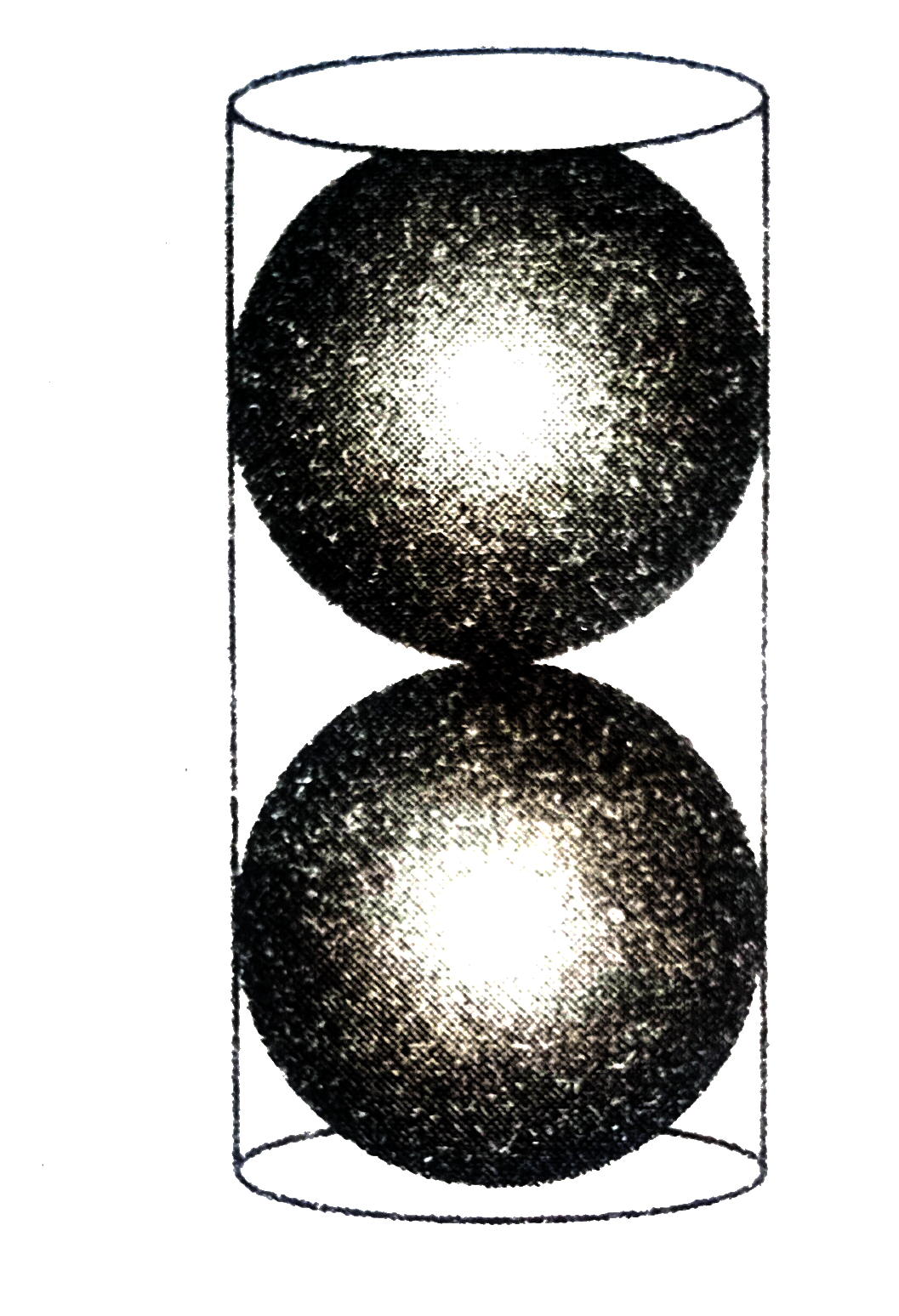
The adjacent figure shows a cylindrical can with two balls. The can is just large enough so that two balls will fit inside with the lid on. The radius of each tennis ball is 3 cm. Calculate the following

volume of the cylinder.

Text Solution

Verified by Experts

The correct Answer is:

3 cm
Promotional Banner

Topper's Solved these Questions

  • MENSURATION

    PREMIERS PUBLISHERS|Exercise OTHER IMPORTANT OBJECTIVE TYPE QUESTIONS|16 Videos
  • MENSURATION

    PREMIERS PUBLISHERS|Exercise SOLUTION TO PROGRESS CHECK|23 Videos
  • GEOMETRY

    PREMIERS PUBLISHERS|Exercise OTHER IMPORTANT OBJECTIVE TYPE QUESTIONS|22 Videos
  • NUMBERS AND SEQUENCES

    PREMIERS PUBLISHERS|Exercise OTHER IMPORTANT OBJECTIVE TYPE QUESTIONS|23 Videos

Similar Questions

Explore conceptually related problems

The adjacent figure shows a cylindrical can with two balls. The can is just large enough so that two balls will fit inside with the lid on. The radius of each tennis ball is 3 cm. Calculate the following volume of two balls.

The adjacent figure shows a cylindrical can with two balls. The can is just large enough so that two balls will fit inside with the lid on. The radius of each tennis ball is 3 cm. Calculate the following radius of the cylinder.

The adjacent figure shows a cylindrical can with two balls. The can is just large enough so that two balls will fit inside with the lid on. The radius of each tennis ball is 3 cm. Calculate the following height of the cylinder.

The adjacent figure shows a cylindrical can with two balls. The can is just large enough so that two balls will fit inside with the lid on. The radius of each tennis ball is 3 cm. Calculate the following percentage of the volume occupied by the balls.

Show a vertical cylindrical vessel separated in two parts by a frictionless piston free to move along the length of vessel. The length of the cylinder is 90 cm and the piston divides the cylinder in the ratio of 5:4. Each of the two parts of the vessel contains 0.1 mole of an ideal gas. The temperature of the gas is 300K in each part. Calculate the mass of the piston.

In how many ways can 2t+1 identical balls be placed in three distinct boxes so that any two boxes together will contain more balls than the third?

Figure shows a cylindridcal tube with a adibatic walls and fitted with an adiabatic separtor. The separator can be slid into the tube by an external mechanism. An ideal gas (gamma=1.5) is injected in the two sides at equal pressures and temperatures . The separator remains in equilibrium at the middel. It is now slid to a position where it divides the tube in the ratio 1:3 Find the ratio of the tempertures in the two parts of the vessel.

Two balls having masses m and 2m are fasrtened to two light strings of same length (figure). The other ends of the strings are fixed at O. The strings are kept in the same horizontal line and the system is released from rest. The collision between the balls is elastic. Point A is the lowest point at which either ball can reach The speed of ball of mass 2m just after collision (for the first time) is over

Let theta=(a_(1),a_(2),a_(3),...,a_(n)) be a given arrangement of n distinct objects a_(1),a_(2),a_(3),…,a_(n) . A derangement of theta is an arrangment of these n objects in which none of the objects occupies its original position. Let D_(n) be the number of derangements of the permutations theta . There are 5 different colour balls and 5 boxes of colours same as those of the balls. The number of ways in which one can place the balls into the boxes, one each in a box, so that no ball goes to a box of its own colour is

Two friends A and B (each weighing 40 kg ) are sitting on a frictionless platform some distance d apart. A rolls a ball of mass 4 kg on the platform towards B which B catches. Then B rolls the ball towards A and A catches it. The ball keeps on moving back and forth between A and B . The ball has a fixed speed of 5 m//s on the platform. a. Find the speed of A after he rolls the ball for the first time. b. Find the speed of A after he catches the ball for the first time. c. Find the speed of A and B after the ball has made five round trips and is held by A . d. How many times can A roll the ball? e. Where is the centre of mass of the system A + B + ball at. the end of the nth trip?
