

Home
Class 9
PHYSICS
(a) What happens to the passengers trav...

(a) What happens to the passengers travelling in the bus when the bus takes a sharp turn ? Give reasons for your answer.
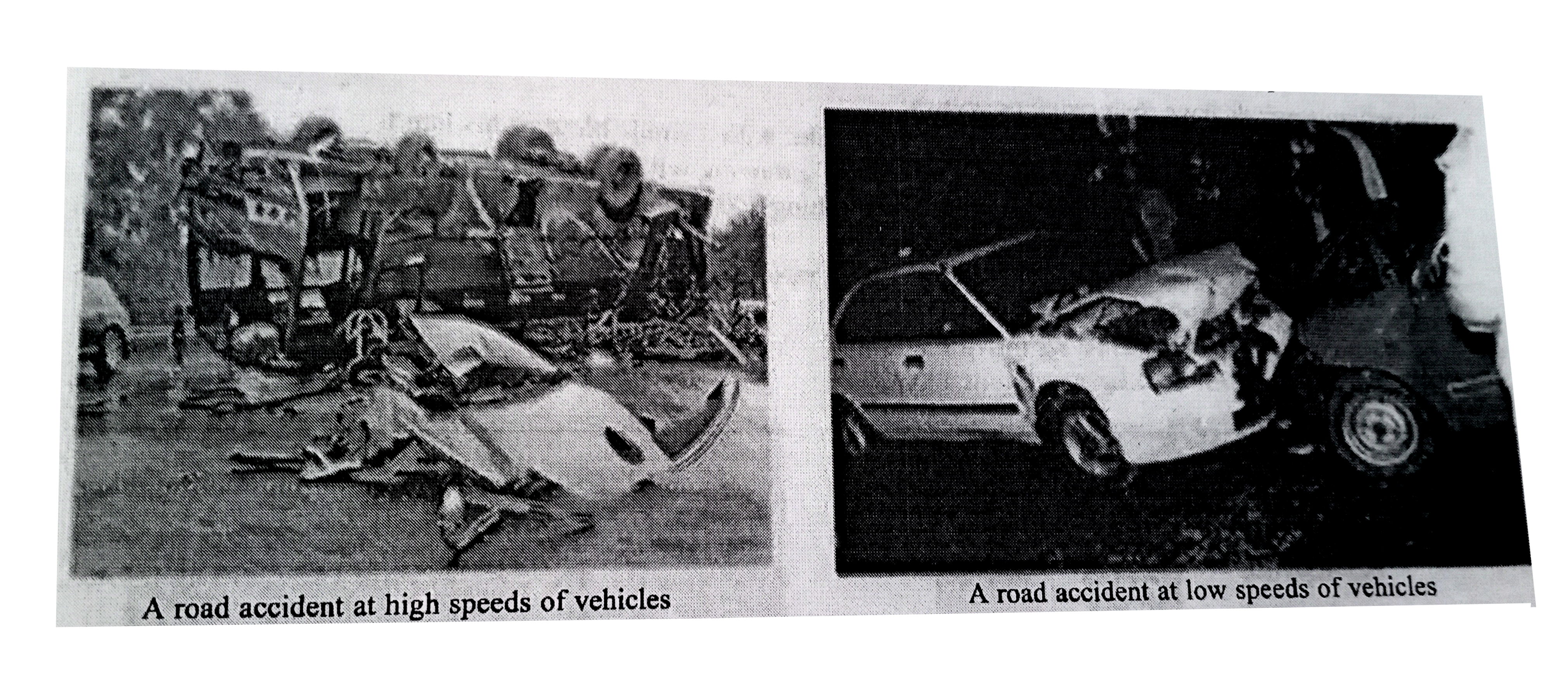
(b) Why are road accidennts at high speeds very much worse than road accidents at low speeds ?

Promotional Banner

Similar Questions

Explore conceptually related problems

Why are road accidents at high speeds very much worse than accidents at low speeds?

What happens to a person travelling in a bus when the bus takes a sharp turn? Give reason.

What would happen if high speed winds blow over a house having weak roof? Give reason for your answer.

What happens to the position of an element in the periodic table when its nucleus emits (a) an alpha -particle, (b) a beta -particle and (c ) gamma radiation ? Give reason for your answer.

Answer the following questions: why do we fall sideways when we are sitting in a bus and it takes a sharp turn?

A train(T) is running uniformly on a straight track. A car is travelling with constant speed along section AB of the road which is parallel to the rails. The driver of the car notices that the train is having a speed of 7 m//s with respect to him. The car maintains the speed but takes a right turn at B and travels along BC. Now the driver of the car finds that the speed of train relative of him is 13 m//s . Find the possible speeds of the car.

A car is moving along a banked road laid out as a circle of radius r . (a) What should be the banking angle theta so that the car travelling at speed v needs no frictional force from tyres to negotiate the turn ? (b) The coefficient of friction between tyres and road are mu_(s) = 0.9 and mu_(k) = 0.8 . At what maximum speed can a car enter the curve without sliding toward the top edge of the banked turn ?

A car is moving along a banked road laid out as a circle of radius r . (a) What should be the banking angle theta so that the car travelling at speed v needs no frictional force from tyres to negotiate the turn ? (b) The coefficient of friction between tyres and road are mu_(s) = 0.9 and mu_(k) = 0.8 . At what maximum speed can a car enter the curve without sliding toward the top edge of the banked turn ?

A car is moving along a banked road laid out as a circle of radius r . (a) What should be the banking angle theta so that the car travelling at speed v needs no frictional force from tyres to negotiate the turn ? (b) The coefficient of friction between tyres and road are mu_(s) = 0.9 and mu_(k) = 0.8 . At what maximum speed can a car enter the curve without sliding toward the top edge of the banked turn ?

The table below shows the distance in cm, travelled by the objects A, B and C during each second. (i) Which object is moving with constant speed ? Give a reason for your answer. (ii) Which object is moving with a constant acceleration? Give a reason. (iii) Which object is moving with irregular acceleration?