Home
Class 11
PHYSICS
A particle is projected at an angle of t...

A particle is projected at an angle of `theta` with respect to the horizontal direction. Match the following for the above motion.
(a) `V_(x)" "-" decrease and increases"`
(b) `V_(y)" "-" remains constant"`
(c) `"Acceleration - varies"`
(d) `"Position vector "-" remains downward"`

Text Solution

Verified by Experts
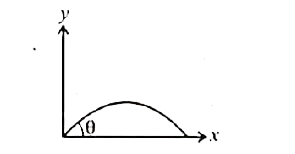
(a) `v_(x) - ` Remains constant
(b) `v_(y) -` Decreases and increases
(c) Acceleartion (a) - Remains downward
(d) Position vector (r) - Varies
Promotional Banner

Topper's Solved these Questions

  • KINEMATICS

    PREMIERS PUBLISHERS|Exercise Other important questions & answers (I.Multiple choice questions).|236 Videos
  • KINEMATICS

    PREMIERS PUBLISHERS|Exercise Other important questions & answers (II. Very short answer questions).|112 Videos
  • KINEMATICS

    PREMIERS PUBLISHERS|Exercise Textbook questions & answers (III. Long answer questions).|16 Videos
  • GRAVITATION

    PREMIERS PUBLISHERS|Exercise OTHER IMPORTANT QUESTION & ANSWERS (CONCEPTUAL QUESTIONS)|34 Videos
  • KINETIC THEORY OF GASES

    PREMIERS PUBLISHERS|Exercise OTHER IMPORTANT QUESTIONS & ANSWERS (VI. Conceptual Questions.)|8 Videos

Similar Questions

Explore conceptually related problems

A rectangular box lies on a rough inclined surface. The coefficient of friction between the surface and the box is mu . Let the mass of the box be m. (a) At what angle of inclination theta of the plane to the horizontal will the box just start to slide down the plane? (b) What is the force acting on the box down the plane, if the angle of inclination of the plane is increased to a gt theta . (c) What is the force needed to be applied upwards along the plane to make the box either remain stationary or just move up with uniform speed? (d) What is the force needed to be applied upwards along the plane to mu_k kgf make the box move up the plane with acceleration a?

A particle of unit mass undergoes one -dimensional motion such that its velocity varies according to v(x)= betax^(-2n) where beta and n are constants and x is the position of the particle.The acceleration of the particle as a function of x, is given by:

Describe schematically the equipotential surfaces corresponding to a. a constant electric field in the z-direction. b. a field that uniformly increases in magnitude but remains in a constant (say,z) direction. c. a single positive charge at the origin, and d. a uniform grid consisting of long equally spaced parallel charged wires in a plane.

A conducting wire ab of length l, resistance r and mass m starts sliding at t = 0 down a smooth, vertical, thick pair of connected rails as shown in . A uniform magnetic field B exists in the space in a diraction perpendicular to the plane of the rails. (a) Write the induced emf in the loop at an instant t when the speed of the wire is v. (b) what would be the magnitude and direction of the induced current in the wire? (c) Find the downward acceleration of the wire at this instant. (d) After sufficient time, the wire starts moving with a constant velocity. Find this velocity v_m. (e) Find the velocity of the wire as a function of time. (f) Find the displacement of the wire as a functong of time. (g) Show that the rate of heat developed inte wire is equal to the rate at which the gravitational potential energy is decreased after steady state is reached.

Figure. gives a speed-time graph of a particle in motion along a constant direction. Three equal intervals of time are shown. In which interval is the average acceleration greatest in magnitude ? In which interval is the average speed greatest ? Choosing the positive direction as the constant direction of motion, give the signs of v and a in the three intervals. What are the accelerations at the points A, B, C and D ?

If a line makes an angle of pi/4 with the positive direction of each of x-axis and y-axis, then the angel that the line makes with the positive direction of the z-axis is a. pi/3 b. pi/4 c. pi/2 d. pi/6

PREMIERS PUBLISHERS-KINEMATICS -Textbook questions & answers (IV. Numerical problems).
  1. The following graphs represent velocity- time graph. Identify what kin...

    Text Solution

    |

  2. The following velocity-time graph represents a particle moving in the ...

    Text Solution

    |

  3. A particle is projected at an angle of theta with respect to the horiz...

    Text Solution

    |

  4. A water fountain on the ground sprinkles water all around it. If the s...

    Text Solution

    |

  5. The following table gives the range of a particle when thrown on diffe...

    Text Solution

    |

  6. The resultant of two vectors A and B is perpendicular to vector A and ...

    Text Solution

    |

  7. Compare the components for the following vector equations (a) Th...

    Text Solution

    |

  8. Calculate the area of the triangle for which two of its sides are give...

    Text Solution

    |

  9. If Earth completes one revolution in 24 hours, what is the angular dis...

    Text Solution

    |

  10. An object is thrown with initial speed 5ms^(-1) with an angle of proje...

    Text Solution

    |

  11. A foot - ball player hits tha ball with speed 20ms^(-1) with angle 30...

    Text Solution

    |

  12. If an object is thrown horizontally with an initial speed "10 ms"^(-1)...

    Text Solution

    |

  13. An object is executing uniform circular motion with an angular speed o...

    Text Solution

    |

  14. Consider the x - axis as representing east, the y - axis as north and ...

    Text Solution

    |

  15. Consider the x - axis as representing east, the y - axis as north and ...

    Text Solution

    |

  16. Consider the x - axis as representing east, the y - axis as north and ...

    Text Solution

    |

  17. The moon is orbiting the Earth approximately in 27 days, what is the a...

    Text Solution

    |

  18. An object of mass m has angular acceleration alpha =0.2" rad s"^(-2). ...

    Text Solution

    |

  19. The position vectors particle has length 1m and makes 30^(@) with the ...

    Text Solution

    |

  20. A particle has its position moved from vec(r(1))=3hati+4hatj to vec(r(...

    Text Solution

    |

