Home
Class 11
PHYSICS
If a particle elastically collides obliq...

If a particle elastically collides obliquely with a particle of same mass at rest then show that they move perpendicular to each other after collision in two dimension.

Text Solution

Verified by Experts
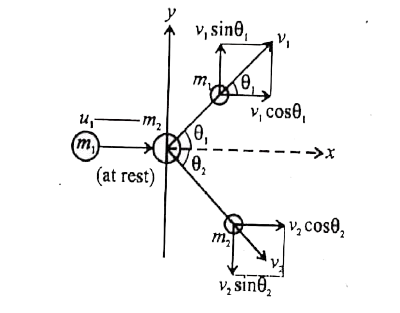

After the collision, the rectangular components of the momentum of `m_(1)` are
(i) `m_(1)v_(1)costheta`, along positive x axis
(ii) `m_(1)v_(1)sintheta`, along positive y axis
After the collision, the rectangular components of the momentum of `m_(2)` are
(i) `m_(2)v_(2)costheta`, along positive x axis
`m_(2)v_(2)sintheta`, along positive y axis
Applying the law of conservation of momentum along x axis we get,
`m_(1)u_(1)=m_(1)v_(1)costheta_(1)+m_(2)v_(2)costheta_(2)" "...(1)`
The initial momentum of `m_(1)` or `m_(2)` along y axis is zero. Applying the principle of conservation of momentum along y axis we get,
`0=m_(1)thetasintheta_(1)+m_(2)v_(2)sintheta_(2)....(2)`
In this problem, a particle elastically collides obliquely with a particle of same mass at rest. So the two particles are identical.
`therefore m_(1)=m_(2)=m` (say)
By conservation of kinetic energy for elastic collision we get,
`(1)/(2)m u_(1)^(2)=(1)/(2)mv_(1)^(2)+(1)/(2)mv_(2)^(2)[becauseu_(2)=0]`
Dividing by `(1)/(2)m_(2)` we get
`therefore u_(1)=v_(1)^(2)+v_(2)^(2)" "...(3)`
By conservation of linear momentum we get
`mvecu_(1)=mvecv_(1)+mvecv_(2)`
Dividing by m we get
`vecu_(1)=vecv_(1)+vecv_(2)" "...(4)`
Then `vecu_(1).vecu_(1)=(vecv_(1)+vecv_(2))(vecv_(1)+vecv_(2))`
`=vecv_(1).vecv_(1)+vecv_(1).vecv_(2)+vecv_(2).vecv_(1)+vecv_(2).vecv_(2)`
or `u_(1)^(2)=v_(1)^(2)+v_(2)^(2)+2vecv_(1)vecv_(2)" "...(5)`
But from (3)
`v_(1)^(2)+v_(2)^(2)=u_(1)^(2)`
`therefore` Equation (5) becomes
`u_(1)^(2)=u_(1)^(2)+2vecv_(1)vecv_(2)`
`therefore vecv_(1)vecv_(2)=0`
This shows that the angle between `vecv_(1) and vecv_(2)` is `90^(@)`.
Hence two identical particles move perpendicular to each other after collision in two dimensions.
Promotional Banner

Topper's Solved these Questions

  • WORK, ENERGY AND POWER

    PREMIERS PUBLISHERS|Exercise CONCEPTUAL QUESTIONS|34 Videos
  • WORK, ENERGY AND POWER

    PREMIERS PUBLISHERS|Exercise MULTIPLE CHOICE QUESTIONS (OTHER IMPORTANT QUESTIONS & ANSWERS)|124 Videos
  • WORK, ENERGY AND POWER

    PREMIERS PUBLISHERS|Exercise LONG ANSWER QUESTIONS|38 Videos
  • WAVES

    PREMIERS PUBLISHERS|Exercise OTHER IMPORTANT & QUESTIONS ANSWERS ( NUMERICAL PROBLEMS. )|48 Videos

Similar Questions

Explore conceptually related problems

A body of mass m makes an elastic collision with another identical body at rest. Show that if the collisionis not head on the bodiese to at right to each other after the collision.

A particle of mass 100 g moving at an initial speed u collides with another particle of same mass kept initially at rest. If the total kinetic energy becomes 0.2 J after the collision what could be minimum and the maximum value of u.

A body of rest mass m_0 collides perfectly inelastically at a speed of 0.8c with another body of equal rest mass kept at rest . Calculate the common speed of the bodies after the collision and the rest mass of the combined body .

A particle of mass m moving with velocity v strikes a particle of mass 2m at rest and sticks to it. The speed of the combined mass is

A particle of mass 'm' moving with velocity 'v' collides with a mass m_(2) at rest, then they get embedded. At the instant of collision, velocity of the system

A block of mass m moving at speed upsilon collides with another block of mass 2 m at rest. The lighter block comes to rest after the collision. Find the coefficient of restitution.

A uniform rod of mass M and length a lies on a smooth horizontal plane. A particle of mass m moving at a speed v perpendicular to the length of the rod strikes it at a distance a/4 from the centre and stops after the collision. Find a. the velocity of the cente of the rod and b. the angular velocity of the rod abut its centre just after the collision.

A lighter particle moving with a speed of 10 ms^(-1) collides with an object of double its mass moving in the same direction with half its speed. Assume that the collision is a one dimensional clastic collision. What will be the speed of both particles after the collision?

After perfectly inelastic collision between two identical particles moving with same speed in different directions, the speed of the particles become half the initial speed. Find the angle between the two before collision.

PREMIERS PUBLISHERS-WORK, ENERGY AND POWER -NUMERICAL PROBLEMS
  1. A body of mass 0.3 kg is taken up an inclined plane of length 10 m and...

    Text Solution

    |

  2. A ball of mass 0.1 kg collides elastically with a ball of unknown mass...

    Text Solution

    |

  3. If a particle elastically collides obliquely with a particle of same m...

    Text Solution

    |

  4. Calculate work done from the graph.

    Text Solution

    |

  5. What is the stopping distance for a vehicle of mass m moving with spee...

    Text Solution

    |

  6. A gardener pushes a lawn roller through a distance of 20m. If he appli...

    Text Solution

    |

  7. A particle moves along the x-axis from x=0 to x=5m under the influence...

    Text Solution

    |

  8. A bullet weighing 10g is fined with a velocity of 800ms^(-1). After pa...

    Text Solution

    |

  9. A vehicle of mass 15 quintal climbs up a hill 200m high. It then moves...

    Text Solution

    |

  10. A body of mass 2kg is resting on a rough horizontal surface. A force o...

    Text Solution

    |

  11. A body of mass 2kg is resting on a rough horizontal surface. A force o...

    Text Solution

    |

  12. A bolt of mass 0.3 kg falls from the ceiling of an elevator moving dow...

    Text Solution

    |

  13. The potential energy of a spring when stretched through a distance x i...

    Text Solution

    |

  14. A man weighing 60 kg climbs up a staircase carrying a 20 kg load on hi...

    Text Solution

    |

  15. A 10kg ball and 20kg ball approach each other with velocities 20ms^(-1...

    Text Solution

    |

  16. A railway carriage of mass 9000 kg moving with a speed of 36kmh^(-1) c...

    Text Solution

    |

  17. Two ball bearing of mass m each moving in opposite directions with equ...

    Text Solution

    |

  18. A ball falls under gravity from a height of 10m with an initial downwa...

    Text Solution

    |

  19. Calculate the velocity of the bob of a simple pendulum at its mean pos...

    Text Solution

    |

  20. If the KE of a body increases by 300% by what percent will the linear ...

    Text Solution

    |

