Home
Class 11
PHYSICS
The maximum height attained by a project...

The maximum height attained by a projectile when thrown at an angle `theta` with the horizontal is found to be half the horizontal range.Then `theta =`

Text Solution

Verified by Experts
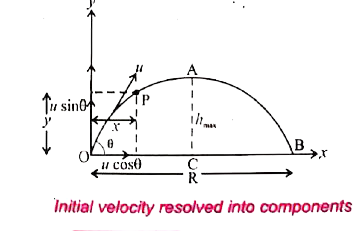
Let us consider an object thrown with initial velocity `vec(u)` an angle `theta` with the horizontal as in figure
`vec(u) = u_(z) hat(i) +u_(y) hat(j)`
The horizontal component of velocity `u_(x) = u cos theta` . The vertical component of velocity `u_(y) = u sin theta` .
Since the acceleration due to gravity is in the direction opposite to the direction of vertical component `u_(y)` this component will gradually reduce to zero at the maximum height of the projectile. At this maximum height, the same gravitational force will push the projectile to move downward . It falls to the ground. there isno acceleration along the x direction throughout the motion. Hence, the horizontal component of the velocity `(u_(x)=u cos theta)` remains the same till the object reaches the ground .
Hence after the time t , the velocity along horizontal motion `v_(x) = u_(x) + a_(x) t` [ `:' u_(x) = u cos theta` ]
The horizontal distance travelled by projectile in time t is `s_(x) = u_(x) t + (1)/(2) a_(x) t^(2)`
Here, `s_(x) = x, u_(x)= u cos theta, a_(x)=0`
Thus , x ` = u cos theta t or t = (x)/(u cos theta ) " ". . . (1)`
For the vertical motion `v_(y) = u_(y) + a_(y) t`
Here `u_(y) = u sin theta, a_(y) = - g` (acceleration due to gravity acts opposite to the motion) . Thus
`v_(y) = u sin theta - g t " ". . . (2)`
the vertical distance travelled by the projectile in the same time t is
`s_(y) = u_(y) t + (1)/(2) a_(y) t^(2)`
Here , `s_(y) = y, u_(y) = u sin theta , a_(x) = - g. ` Then
`y = u sin theta t - (1)/(2) g t^(2)" ". . . (3)`
Substitute the value of t from equation (1) in equation (3) , we have

`y = u sin theta (x)/(u cos theta) - (1)/(2) g (x^(2))/(u^(2) cos^(2) theta)`
`y = x tan theta -(1)/(2) g (x^(2))/(u^(2) cos^(2) theta) " ". . . (4)`
Thus the path followed by the projectile is an inverted parabola.
Maximum height `(h_("max"))` :
The maximum vertical distance travelled by the projectile during its journey is called maximum height
For the vertical part of the motion,
`v_(y)^(2) = u_(y)^(2) + 2a_(y^(s))`
Here, `u_(y) = u sin theta, a = - g, s = h_("max")` , and at t he maximum height `v_(y) = 0`
`:. (0) = u^(2) sin ^(2) theta = 2 gh_("max")`
or `h_("max") = (u^(2) sin^(2) theta)/(2g)`
Horinontal range (R) : The maximum horizontal distance between the point of projection and the point on the horizontal plane where the projectile hits the ground is called horizontal range (R) . It is found easily. Since the horizontal component of initial velocity remains the same.We can write `"Range R" = {{:("Horizontal component"),("of velocity" xx "time of flight"):}`
`= u cos theta xx T_(f)`
`R = u cos theta xx (2 u sin theta)/(g)`
` = (2 u^(2) sin theta cos theta)/(g)`
`rArr :. R = (u^(2) sin 2 theta)/(g)`
Promotional Banner

Topper's Solved these Questions

  • KINEMATICS

    PREMIERS PUBLISHERS|Exercise Textbook questions & answers (IV. Numerical problems).|48 Videos
  • KINEMATICS

    PREMIERS PUBLISHERS|Exercise Other important questions & answers (I.Multiple choice questions).|236 Videos
  • KINEMATICS

    PREMIERS PUBLISHERS|Exercise Textbook questions & answers (II. Short answer questions).|30 Videos
  • GRAVITATION

    PREMIERS PUBLISHERS|Exercise OTHER IMPORTANT QUESTION & ANSWERS (CONCEPTUAL QUESTIONS)|34 Videos
  • KINETIC THEORY OF GASES

    PREMIERS PUBLISHERS|Exercise OTHER IMPORTANT QUESTIONS & ANSWERS (VI. Conceptual Questions.)|8 Videos

Similar Questions

Explore conceptually related problems

The expression for maximum height attained when the body is projected at an angle with the horizontal is :

Derive the equation of motion, range and maximum height reached by the particle thrown at an oblique angle theta with respect to the horizontal direction.

Derive the equation of motion, range and maximum height reached by the particle thrown at an oblique angle theta with respect to the horizontal direction.

The expression for horizontal range when a body is projected at an angle with the horizontal is R =

Write the condition for the maximum horizontal range.

In oblique projection, maximum height attained by the projectile is

When does (i) height attained by a Projectile is maximum? and (ii) horizontal range is maximum?

In the horizontal projection, the range of the projectile is

A particle of mass m is projected with speed u at an angle theta with the horizontal. Find the torque of the weight of the particle about the point of projection when the particle is at the highest point.

