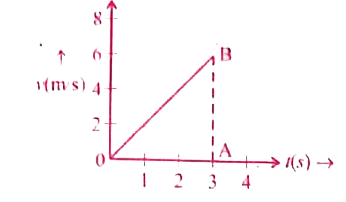
Text Solution
Verified by Experts



Topper's Solved these Questions
KINEMATICS
PREMIERS PUBLISHERS|Exercise Other important questions & answers (IV. Long answer questions).|34 VideosGRAVITATION
PREMIERS PUBLISHERS|Exercise OTHER IMPORTANT QUESTION & ANSWERS (CONCEPTUAL QUESTIONS)|34 VideosKINETIC THEORY OF GASES
PREMIERS PUBLISHERS|Exercise OTHER IMPORTANT QUESTIONS & ANSWERS (VI. Conceptual Questions.)|8 Videos
Similar Questions
Explore conceptually related problems
PREMIERS PUBLISHERS-KINEMATICS -Other important questions & answers (V. Numerical problems).
- A bus 150 m long is moving with a speedof 90 km/h . In what time shal...
Text Solution
|
- A girl travels along a straight road due east for the first half dista...
Text Solution
|
- Find the distance travelled by the particle during the time t = 0 to t...
Text Solution
|
- If the speed of a particle is v = 10t^(2) m//s then find out distance...
Text Solution
|
- The driver of a car travelling at 72 kmph observes the light 300 m ahe...
Text Solution
|
- The driver of a car travelling at 72 kmph observes the light 300 m ahe...
Text Solution
|
- A car starting from rest covers a distance of 100 m in 5 second . Assu...
Text Solution
|
- A car starting from rest covers a distance of 100 m in 5 second . Assu...
Text Solution
|
- A body falling freely descends 0.3m in 0.1 s and 0.398 m in the next 0...
Text Solution
|
- An woman walks on a straight road from her home to a market 2.5 km awa...
Text Solution
|
- A man walks on a straight road from his home to a market 2.5 km away w...
Text Solution
|
- What is meant by magnitude of Average velocity ?
Text Solution
|
- A car is moving along a straight line (OP). It moves from O→P in 18 se...
Text Solution
|
- A van is moving along x-axis . As shown in the figure , it moves from...
Text Solution
|
- The velocity of a particle is given by the equation, v = 2t^(2) + 5 c...
Text Solution
|
- The velocity of a particle is given by the equation, v = 2t^(2) + 5 c...
Text Solution
|
- The velocity of a particle is given by the equation, v = 2t^(2) + 5 c...
Text Solution
|
- A boy takes 2 second to reach the maximum speed of 18 km/h from rest....
Text Solution
|
- The speed of a car as a function of time as shown figure. Find the acc...
Text Solution
|
- A ball is thrown upward with an initial velocity of 100 ms^(-1) . Aft...
Text Solution
|