


Topper's Solved these Questions
KINEMATICS
PREMIERS PUBLISHERS|Exercise Other important questions & answers (IV. Long answer questions).|34 VideosGRAVITATION
PREMIERS PUBLISHERS|Exercise OTHER IMPORTANT QUESTION & ANSWERS (CONCEPTUAL QUESTIONS)|34 VideosKINETIC THEORY OF GASES
PREMIERS PUBLISHERS|Exercise OTHER IMPORTANT QUESTIONS & ANSWERS (VI. Conceptual Questions.)|8 Videos
Similar Questions
Explore conceptually related problems
PREMIERS PUBLISHERS-KINEMATICS -Other important questions & answers (V. Numerical problems).
- The velocity of a particle is given by the equation, v = 2t^(2) + 5 c...
Text Solution
|
- A boy takes 2 second to reach the maximum speed of 18 km/h from rest....
Text Solution
|
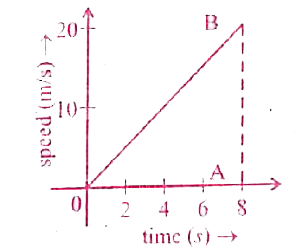
- The speed of a car as a function of time as shown figure. Find the acc...
Text Solution
|
- A ball is thrown upward with an initial velocity of 100 ms^(-1) . Aft...
Text Solution
|
- A ball is thrown upward with an initial velocity of 100 ms^(-1) . Aft...
Text Solution
|
- The velocity -time graph for a vehicle is shown in the figure . Draw ...
Text Solution
|
- A bullet going with speed 350 m/s enters in a concrete wall and penetr...
Text Solution
|
- On a foggy day two drivers spot each other when they are just 80 mts a...
Text Solution
|
- Given vec(a) = 3 hat(i) + 2 hat(j) - hat(k) and vec(b) = hat(i) + hat(...
Text Solution
|
- Given vec(a) = 3 hat(i) + 2 hat(j) - hat(k) and vec(b) = hat(i) + hat(...
Text Solution
|
- A force is inclined at 60^(@)to the horizontal. If the horizontal comp...
Text Solution
|
- Two equal forces are acting at a point with an angle of 60^(@) betwee...
Text Solution
|
- Given vec(B) = 2 hat (i) + 2 hat(j) . Find out magnitude and direction...
Text Solution
|
- Show that the resultant of two vectors vec(A) and vec(B) always lies ...
Text Solution
|
- If the resultant of two equal forces is sqrt(3) times a single . force...
Text Solution
|
- Find out unit vector of vector vec(A) = 3 hat(i) - 2 hat(j) + 4 hat(k...
Text Solution
|
- If vec(A) = 4 hat(i) - 3 hat(j) then obtain the scalar magnitude and ...
Text Solution
|
- Two vectors vec(A) = hat(i) + 2 hat(j) + 2 hat(k) and vec(B) = hat(i) ...
Text Solution
|
- Two vectors vec(A) = hat(i) + 2 hat(j) + 2 hat(k) and vec(B) = hat(i) ...
Text Solution
|
- Under what condition the sum and difference of two vectors will be equ...
Text Solution
|