Let us consider two elastic bodies of masses `m_(1)andm_(2)` moving in a straight line (along positive x direction) on a frictionless horizontal surface as shown in figure.
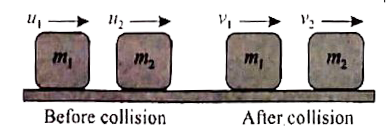

In order to have collision, let us assume that the mass `m_(1)` moves faster than mass `m_(2)` i.e., `u_(1)gtu_(2)`. For elastic collision, the total linear momentum and kinetic energies of the two bodies before and after collision must remain the same.
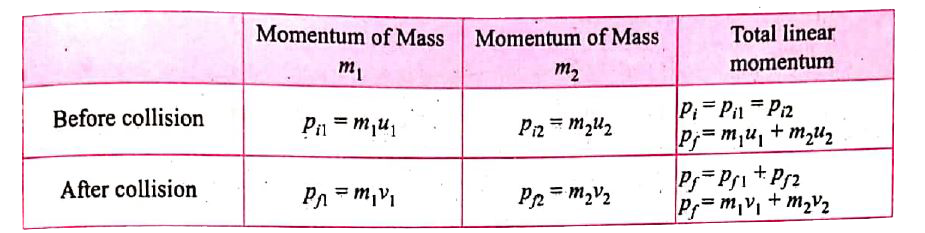
From the law of conservation of linear momentum,
total momentum before collision `(p_(i))`= Total momentum after collision `(p_(f))`
`m_(1)u_(1)+m_(2)u_(2)=m_(1)v_(1)+m_(2)v_(2)" "...(1)`
or `m_(1)(u_(1)-v_(1))=m_(2)(v_(2)-u_(2))" "...(2)`
Further,
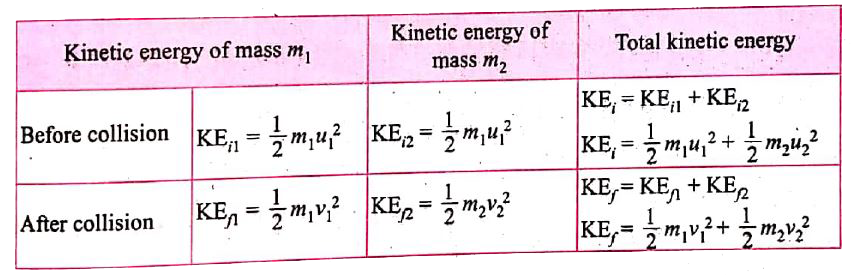
For elastic collision,
Total kinetic energy before collision `KE_(i)` = Total kinetic energy after collision `KE_(f)`
`(1)/(2)m_(1)u_(1)^(2)+(1)/(2)m_(2)u_(2)^(2)=(1)/(2)m_(1)v_(1)^(2)+(1)/(2)m_(2)v_(2)^(2)" "...(3)`
After simplifying and rearranging the terms,
`m_(1)(u_(1)^(2)-v_(1)^(2))=m_(2)(v_(2)^(2)-u_(2)^(2))`
Using the formula `a^(2)-b^(2)=(a+b)(a-b)`,
we can rewrite the above equation as,
`m_(1)(u_(1)+v_(1))(u_(1)-v_(1))=m_(2)(v_(2)+u_(2))(v_(2)-u_(2))`
Dividing equation (4) by (2) gives,
`(m_(1)(u_(1)+v_(1))(u_(1)-v_(1)))/(m_(1)(u_(1)-v_(1)))=(m_(2)(v_(2)+u_(2))(v_(2)-u_(2)))/(m_(2)(v_(2)-u_(2)))`
`u_(1)+v_(1)=v_(2)+u_(2)` Rearranging,
`u_(1)-u_(2)=v_(2)-v_(1)`
Equation (5) can be rewritten as `u_(1)-u_(2)=-(v_(1)-v_(2))`
This means that for any elastic head on collision, the relative speed of the two elastic bodies after the collision has the same magnitude as before collision but in opposite direction. Further note that this result in independent of mass. Rewriting the above equation for `v_(1)andv_(2)`,
`v_(1)=v_(2)+u_(2)-u_(1)" "...(6)`
or
`v_(2)=u_(1)+v_(1)-u_(2)" "...(7)`
To find the final velocities `v_(1)andv_(2)`: Substituting equation (7) in equation (2) gives the velocity of `m_(1)` as
`m_(1)(u_(1)-v_(1))=m_(2)(u_(1)+v_(1)-u_(2)-u_(2))`
`m_(1)(u_(1)-v_(1))=m_(2)(u_(1)+v_(1)-2u_(2))`
`m_(1)u_(1)-m_(1)v_(1)=m_(2)u_(1)+m_(2)v_(1)-2m_(2)u_(2)`
`m_(1)u_(1)-m_(2)u_(1)+2m_(2)u_(2)=m_(1)v_(1)+m_(2)v_(1)`
`(m_(1)-m_(2))u_(2)+2m_(2)u_(2)=(m_(1)+m_(2))v_(1)`
or `v_(1)=((m_(1)-m_(2))/(m_(1)+m_(2)))u_(1)+((2m_(2))/(m_(1)+m_(2)))u_(2)`
Similarly, by substituting (6) in equation (2) gives the final velocity of `m_(2)` as
`m_(1)(u_(1)-(v_(2)+u_(2)-u_(1)))=m_(2)(v_(2)-u_(2))`
`m_(1)u_(1)-m_(1)v_(2)-m_(1)u_(2)+m_(1)u_(1)=m_(2)v_(2)-m_(2)u_(2)`
`2m_(1)u_(1)-m_(1)u_(2)+m_(2)u_(2)=m_(1)v_(2)+m_(2)v_(2)`
`(m_(2)-m_(1))u_(2)+2m_(1)u_(1)=v_(2)(m_(1)+m_(2))`
`v_(2)=((2m_(1))/(m_(1)+m_(2)))u_(1)+((m_(2)-m_(1))/(m_(1)+m_(2)))u_(2)" " ...(9)`
Case 1: When bodies has the same mass i.e., `m_(1)=m_(2)`,
equation (8) `impliesv_(1)=(0)u_(1)+((2m_(2))/(2m_(2)))u_(2)`
`v_(1)=u_(2)" "...(10)`
equation (9) `v_(2)=((2m_(1))/(2m_(1)))u_(1)+(0)u_(2)`
`v_(2)=u_(1)" "...(11)`
The equations (10) and (11) show that in one dimensional elastic collision,when two bodies of equal mass collide after the collision their velocities are exchanged.
Case 2: When bodies have the same mass i.e., `m_(1)=m_(2)` and second body (usually called target) is at rest `(u_(2)=0)`, By substituting `m_(1)=m_(2)andu_(2)=0` in equations (8) and equations (9)
we get, from equation (8) implies `v_(1)=0" "...(12)`
from equation (9) implies `v_(2)=u_(1)" "...(13)`
Equations (12) and (13) show that when the first body comes to rest the second body moves with the intitial velocity of the first body.
Case 3: The first body is very much lighter than the second body `(m_(1)ltltm_(2),(m_(1))/(m_(2))ltlt1)` then the ratio `(m_(1))/(m_(2))~~0` and also if the target is at rest `(u_(2)=0)`
Dividing numerator and denominator of equation (8) by `m_(2)`, we get
`v_(1)=(((m_(1))/(m_(2))-1)/((m_(1))/(m_(2))+1))u_(1)+((2)/((m_(1))/(m_(2))+1))(0)`
`v_(1)=((0-1)/(0+1))u_(1)`
`v_(1)=-u_(1)" "...(14)`
Similarly,
Dividing numerator and denominator of equation (9) by `m_(2)`, we get
`v_(2)=((2(m_(1))/(m_(2)))/((m_(1))/(m_(2))+1))u_(1)+((1-(m_(1))/(m_(2)))/((m_(1))/(m_(2))+1))(0)`
`v_(2)=(0)u_(1)+((1-(m_(1))/(m_(2)))/((m_(1))/(m_(2))+1))(0)`
`v_(2)=0" "...(15)`
The equation (14) implies that the first body which is lighter returns back (rebounds) in the opposite direction with the same initial velocity as it has a negative sign. The equation (15) imlies that the second body that is heavier in mass continues to remain at rest even after collision. For example, if a ball is thrown at a fixed wall, the ball will bounce back from the wall with the same velocity with which it was thrown but in opposite direction.
Case 4: The second body is very much lighter than the first body `(m_(2)ltltm_(1),(m_(2))/(m_(1))ltlt1)` then the ratio `(m_(1))/(m_(2))~~0` and also if the target is at rest `(u_(2)=0)`
Dividing numerator and denominator of equation (8) by `m_(1)`, we get
`v_(1)=((1-(m_(2))/(m_(1)))/(1+(m_(2))/(m_(1))))u_(1)+((2(m_(2))/(m_(1)))/(1+(m_(2))/(m_(1))))(0)`
`v_(1)=((1-0)/(1+0))u_(1)+((0)/(1+0))(0)`
`v_(1)=u_(1)" "...(16)`
Similarly,
Dividing numerator and denominator of equation (13) by `m_(1)`, we get
`v_(2)=((2)/(1+(m_(2))/(m_(1))))u_(1)+(((m_(2))/(m_(1))-1)/(1+(m_(2))/(m_(1))))(0)`
`v_(2)=((2)/(1+0))u_(1)`
`v_(2)=2u_(1)" "...(16)`


