Home
Class 11
PHYSICS
An impulsive force gives an intial veloc...

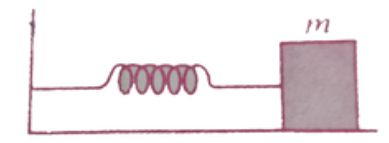
An impulsive force gives an intial velocity of `1.0 ms^(-1)` to the mass m in the unstretched spring position. What is the amplitude of motion ? Given that x is a function of time to for the oscillating mass. Give `m= 3kg and k=1200 Nm^(-1)`.

Text Solution

Verified by Experts

Here initial velocity in unstretched position.
`v=-1.0 ms^(-1)`
Clearly, `v_("max")=1.0 ms^(-1)`
Given `k=1200 Nm^(-1), m=3 kg`
Also `omega =sqrt((k)/(m))= sqrt((1200)/(3))= "rad" s^(-1)`
Amplitude `A=(v_("max"))/(omega)=(1.0)/(20)=(1)/(20)m=5 cm`
As the motion starts from the understand position, the expression for the displacement can be written as,
`x=A sin omega t=5 sin 20t`
As initial impulse is naegative, the displacement is towards negative X-axis, so,
`x=-5 sin 20t`
Promotional Banner

Topper's Solved these Questions

  • OSCILLATIONS

    PREMIERS PUBLISHERS|Exercise OTHER IMPORTANT QUESTIONS & ANSWERS ( CONCEPTUAL QUESTIONS.)|24 Videos
  • OSCILLATIONS

    PREMIERS PUBLISHERS|Exercise OTHER IMPORTANT QUESTIONS & ANSWERS ( LONG ANSWER QUESTIONS )|12 Videos
  • NATURE OF PHYSICAL WORLD AND MEASUREMENT

    PREMIERS PUBLISHERS|Exercise OTHER IMPORTANT QUESTIONS & ANSWERS (III. Short Answer Questions.)|24 Videos
  • PROPERTIES OF MATTER

    PREMIERS PUBLISHERS|Exercise OTHER IMPORTANT QUESTION & ANSWERS (NUMERICAL PROBLEMS)|56 Videos

Similar Questions

Explore conceptually related problems

Let us take the position of mass when the spring is unstreched as x = 0, and the direction from left to right as the positive direction of x-axis. Give x as a function of time t for the oscillating mass if at the moment we start the stopwatch (t = 0), the mass of the object is 3 kg, spring constant is 1200 N/m and the amplitude is 2 cm. (a) at the mean position, (b) at the maximum stretched position, and (c) at the maximum compressed position. In what way do these functions for SHM differ from each other, in frequency, in amplitude or the initial phase?

An object of mass 5 kg is moving with a velocity of 10 ms ^(-1). A force is aplied so that in 20 s, it attains a velocity of 25 ms ^(-1). What is the force aplied on the object ?

A block of mass m hangs from a vertical spring of spring constant k. If it is displaced from its equilibrium position, find the time period of oscillations.

If the units of force, energy and velocity are 20N, 200J and 5ms^(-1) , find the unit of length, mass time.

A force of 100 N gives a mass m_1 , an acceleration of 10 ms-2 and of 20 ms^(-2) to a mass m_2 . What acceleration must be given to it if both the masses are tied together?

An object of mass 2 kg attached to a spring is moved to a distance x = 10 m from its equilibrium position. The spring constant k= 1Nm^(-1) and assume that the surface is frictionless (a) When the mass crosses the equilibrium position, what is the speed of the mass? (b) What is the force that acts on the object when the mass crosses the equilibrium position

A mass of 2.0 kg is put on a flat pan attached to a vertical spring fixed on the ground as shown the figure.The mass of the spring and the pan is negligible.When pressed slightly and released the mass executes a simple harmonic motion. The spring constant is 200 N//m. What should be the minimum amplitude of the motion so that the mass gets detached from the pan (Take g = 10m//s^2)

PREMIERS PUBLISHERS-OSCILLATIONS -OTHER IMPORTANT QUESTIONS & ANSWERS ( NUMERICAL PROBLEMS )
  1. Which of the following functions represent SHM : sin^(2)omegat

    Text Solution

    |

  2. Which of the following functions represent SHM : sin 2 omega t

    Text Solution

    |

  3. Which of the following functions represent SHM : sin omega t+ 2 cos ...

    Text Solution

    |

  4. Which of the following functions represent SHM : sin omega t+ cos 2 ...

    Text Solution

    |

  5. The time -period of a simple pendulum is 2s and its can go to and fro ...

    Text Solution

    |

  6. For particle in SHM, the displacement x of the particle as a function ...

    Text Solution

    |

  7. A particle executing linear SHM has a maximum velocity of 40 cm s^(-1)...

    Text Solution

    |

  8. A block of mass on kg is fastened to a spring with a apring constant 5...

    Text Solution

    |

  9. A simple pendulum has time period T(1). The point of suspension is now...

    Text Solution

    |

  10. If the acceleration due to gravity on the moon is one-sixth of that on...

    Text Solution

    |

  11. A test tube weighing 10 g and external diameter 2 cm is floated vertic...

    Text Solution

    |

  12. A block is on horizontal slab which is moving horizontally. If block i...

    Text Solution

    |

  13. An impulsive force gives an intial velocity of 1.0 ms^(-1) to the mass...

    Text Solution

    |

  14. Two indentical springs each of force constant k are connected in serie...

    Text Solution

    |

  15. Two indentical springs each of force constant k are connected in paral...

    Text Solution

    |

  16. The identical spring of spring constant k are attached to a block of m...

    Text Solution

    |

  17. Two identical springs each of force constant k are connected in series...

    Text Solution

    |

  18. Two identical springs each of force constant k are connected in parall...

    Text Solution

    |

  19. Three springs are connected to a mass as shown in figure (a). When mas...

    Text Solution

    |

  20. The frequency of oscillations of a mass m suspended by spring is v(1)....

    Text Solution

    |
