

Home
Class 12
PHYSICS
A currrent I is passed through a silve...

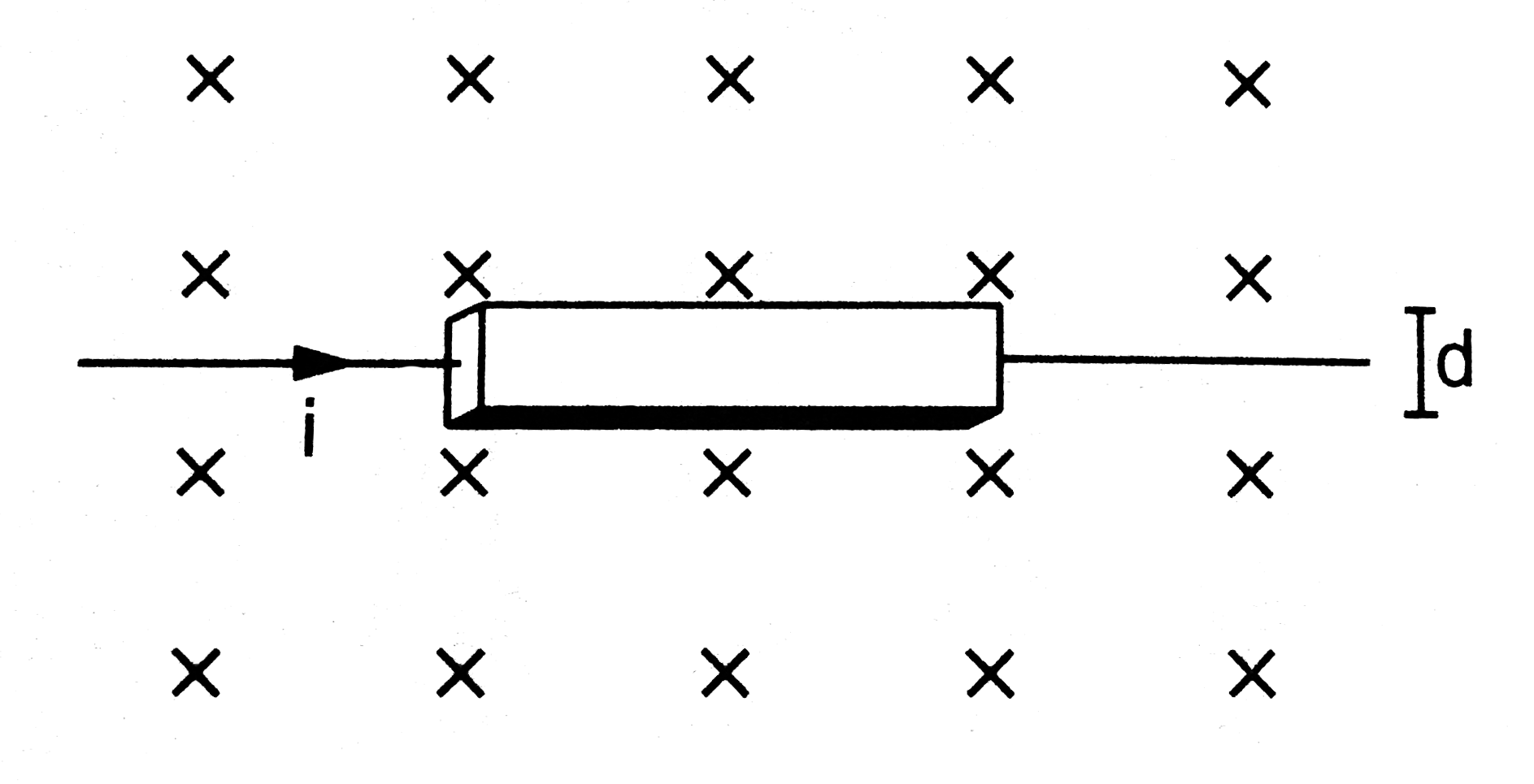
A currrent I is passed through a silver strip of width d and area of cross section A. The number of free electrons per unit volume is n. (a) Find the drift velocity v of the electrons. (b) If a magnetic field B exists in the region as shown in what is the average magnetic force on the free electrons? (c) Due to the magnetic force, the free electrons get accumulated on one side of the conductor along its length. This produces a transverse electric field in the conductor which opposes the magnetic force on the electrons. Find the magnitude of the electric field which will be the potential diference developed across the width of the conductor due to the electron- accumulation? The appearance of a transverse emf, when a current-carrying wire is placed in a magnetic field, is called hall effect.

Promotional Banner

Similar Questions

Explore conceptually related problems

A current I is passed through a silver strip of width d and area of cross-section A. The number of free electrons per unit volume is n Find the drift velocity v of the electrons.

Define 'drift velocity' of free electrons .

In a metallic conductor, the number of free electrons per unit volume is n and the drift velocity of those electrons is v_d . Then

A current I is passed through a silver strip of width d and area of cross-section A. The number of free electrons per unit volume is n If a magnetic field B exists in the region as shown in figure, what is the average magnetic force on the free electrons?

A current of 10 ampere passes through a wire having cross-sectional area 1mm^2 . The number of free electron peer 1m^3 of the conductor is 10^(28) . Find the drift velocity of electron.

There is a current of 40 A in a wire 10^(-6)m^(2) area of cross-section. If the number of free electrons per cubic metre is 10^(29) , then the drift velocity is :