

Home
Class 11
PHYSICS
A wedge of mass M = 2m rests on a smooth...

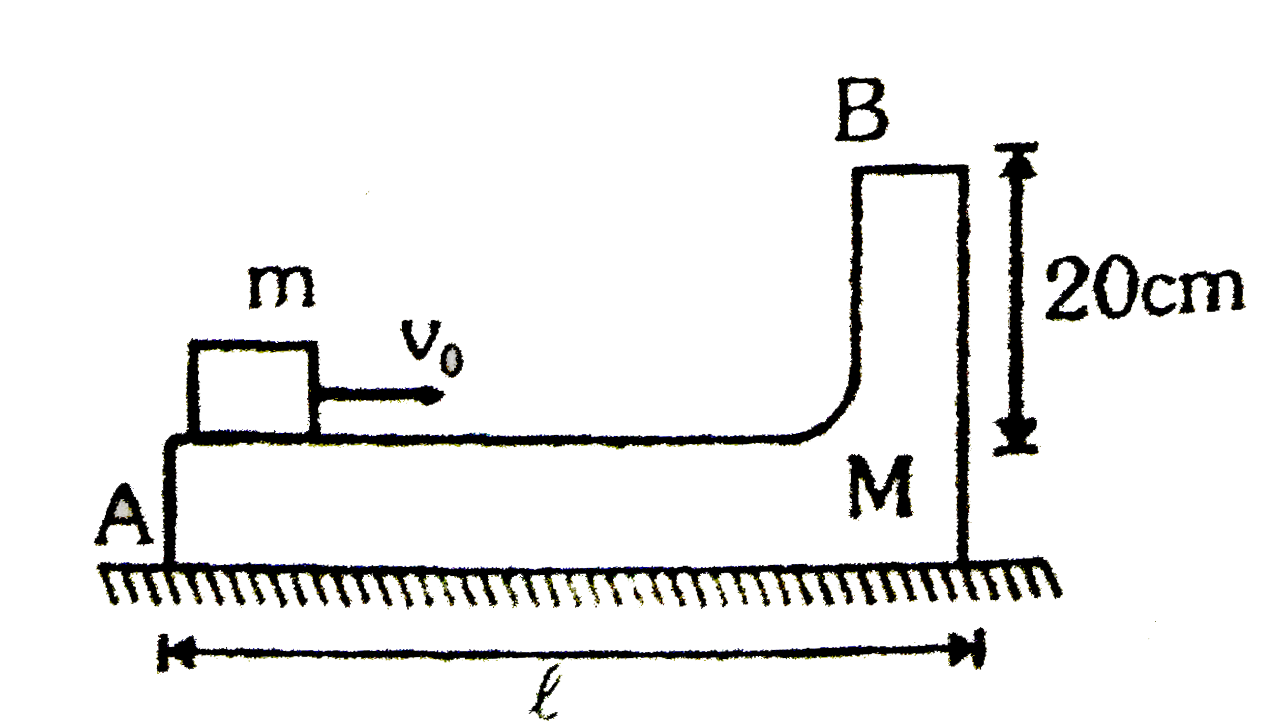
A wedge of mass `M = 2m` rests on a smooth horizontal plane. A small block of mass m rests over it at left end A as shown in figure. A sharp impulse is applied on the block, due to which it starts moving to the right with velocity `v_(0) = 6 ms^(-1)`. At highest point of its trahectory, the block collides with a particle of same mass m moving vertically downwards with velcoity `v = 2 ms^(-1)` and gets stuck with it. If the combined body lands at the end point A of body of mass M, calculate length `l`. Neglect frection `(g = 10 ms^(-2))`.

Promotional Banner

Similar Questions

Explore conceptually related problems

A wedge of mass M = 2m rests on a smooth horizontal plane. A small block of mass m rests over it at left end A as shown in figure. A sharp impulse is applied on the block, due to which it starts moving to the right with velocity v_(0) = 6 ms^(-1) . At highest point of its trajectory, the block collides with a particle of same mass m moving vertically downwards with velocity v = 2 ms^(-1) and gets stuck with it. If the combined body lands at the end point A of body of mass M, calculate length l . Neglect friction (g = 10 ms^(-2)) .

A wedge of mass M = 2m rests on a smooth horizontal plane. A small block of mass m rests over it at left end A as shown in figure. A sharp impulse is applied on the block, due to which it starts moving to the right with velocity v_(0) = 6 ms^(-1) . At highest point of its trajectory, the block collides with a particle of same mass m moving vertically downwards with velocity v = 2 ms^(-1) and gets stuck with it. If the combined body lands at the end point A of body of mass M, calculate length l . Neglect friction (g = 10 ms^(-2)) .

A wedge of mass M = 2m rests on a smooth horizontal plane. A small block of mass m rests over it at left end A as shown in figure. A sharp impulse is applied on the block, due to which it starts moving to the right with velocity v_(0) = 6 ms^(-1) . At highest point of its trajectory, the block collides with a particle of same mass m moving vertically downwards with velocity v = 2 ms^(-1) and gets stuck with it. If the combined body lands at the end point A of body of mass M, calculate length l . Neglect friction (g = 10 ms^(-2)) .

A block of mass m is at rest on a rough wedge as shown in figure. What is the force exerted by the wedge on the block?

A block of mass m is at rest on a rought wedge as shown in figure. What is the force exerted by the wedge on the block?

A block of mass m is at rest on a rought wedge as shown in figure. What is the force exerted by the wedge on the block?

A block of mass m is at rest on a rough wedge as shown in figure. What is the force exerted by the wedge on the block?

A smooth wedge of mass M rests on a smooth horizontal surface. A block of mass m is projected from its lowermost point with velocity v_(0) . What is the maximum height reached by the block?

A smooth wedge of mass M rests on a smooth horizontal surface. A block of mass m is projected from its lowermost point with velocity v_(0) . What is the maximum height reached by the block?

A smooth wedge of mass M rests on a smooth horizontal surface. A block of mass m is projected from its lowermost point with velocity v_(0) . What is the maximum height reached by the block?