

Home
Class 11
PHYSICS
A particle of charge+q eneters a region ...

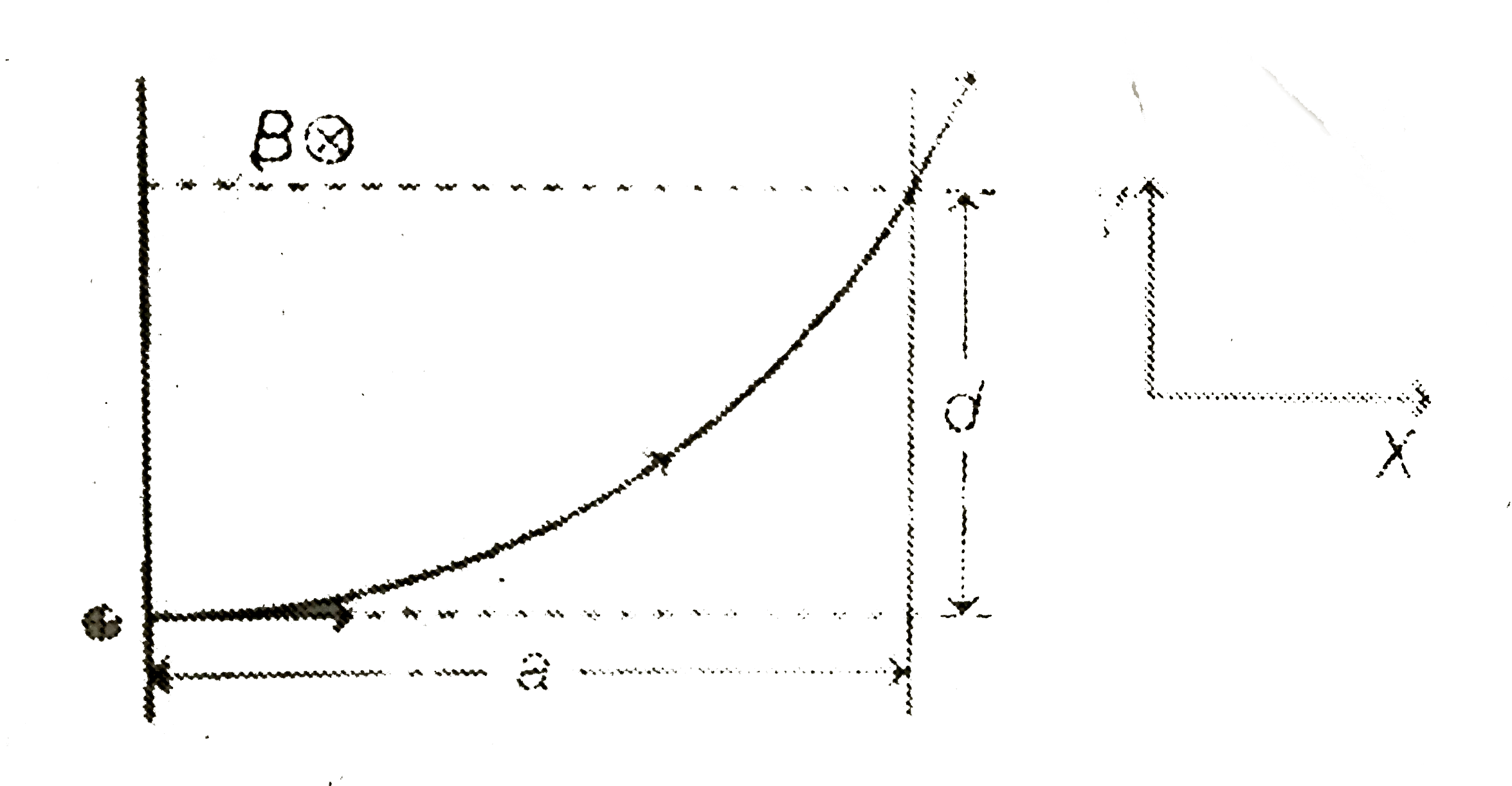
A particle of charge+q eneters a region of uniform magnetic field B (directed into the plane of paper) as shown in the figure. Particle is deflected by a distance d along y-axis after travelling a distance of a along x axis. Find magnitude of linear momentum of particle in Newton-sec. (Given: a=3m, d=4m, Bq=032c-Tesla)

Promotional Banner

Similar Questions

Explore conceptually related problems

A positively charged particle of charge 'q' enters in a uniform magnetic field B directed inward and is deflected a distance x after travelling a distance Y as shown in the figure. The magnitude of linear momentum of the particle is:

A positively charged particle of charge 'q' enters in a uniform magnetic field B directed inward and is deflected a distance x after travelling a distance Y as shown in the figure. The magnitude of linear momentum of the particle is:

A charged particle q enters a region of uniform magnetic field B (out of page) and is deflected distance d after travelling a horizontal distance a. The magnitude of the momentum of the particle is

A charged particle q enters a region of uniform magnetic field B (out of page) and is deflected distance d after travelling a horizontal distance a. The magnitude of the momentum of the particle is

A charge particle of mass m and charge q enters in a region of uniform magnetic field as shown in figure.The magnitude of change in linear momentum due to magnetic field will be

A charged particle is fired at an angle theta to a uniform magnetic field directed along the x-axis. During its motionalong a helical path, the particle will

A charged particle is fired at an angle "theta" to a uniform magnetic field directed along the "x" -axis.The resulting pitch of the helical path of the particle is equal to the maximum distance of the particle from the "x" -axis. The value of "theta" is?

A charged particle is fired at an angle theta to a uniform magnetic field directed along the x-axis. During its motion along a helical path, if the pitch of the helical path is equal to the maximum distance of the particle from the x- axis.