

Home
Class 10
MATHS
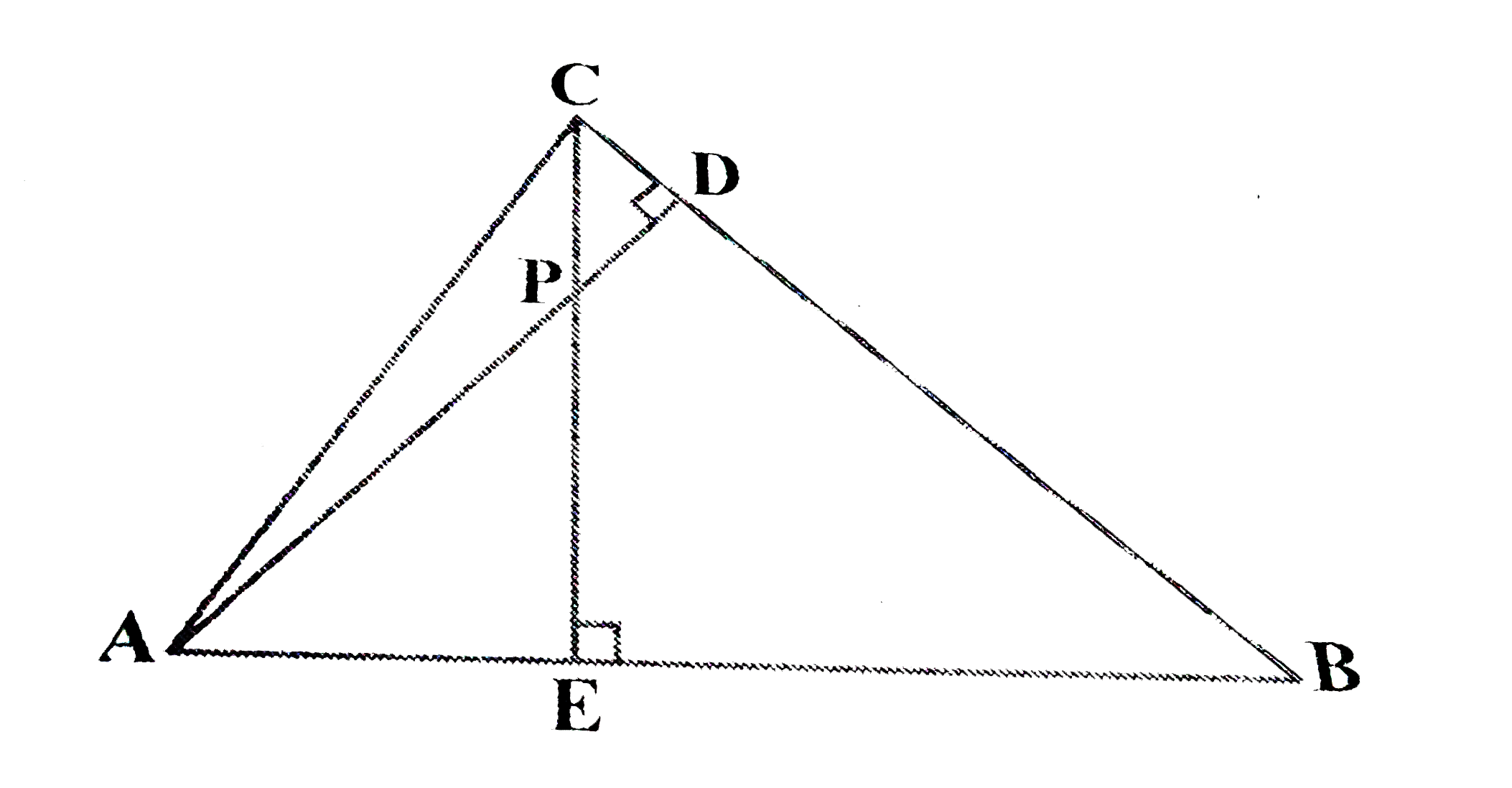
In Figure altitudes AD and CE of DABC ...

In Figure altitudes AD and CE of DABC intersect each other at the point P. Show that:
(i) `DeltaA E P~ DeltaC D P`
(ii) `DeltaA B D ~DeltaC B E`
(iii) `DeltaA E P~ DeltaA D B`
(iv) `DeltaP D C ~DeltaB E C`

Text Solution

Verified by Experts

Data: altitudes AD and CE of ABC Intersect each other at the point P.
To Prove: (i) ∆AEP ~ ∆CDP
(ii) ∆ABD ~ ∆CBE
(iii) ∆AEP ~ ∆ADB
(iv) ∆PDC ~ ∆BEC
(i) In ∆AEP and ∆CDP. ∠AEP = ∠CDP = 90° (data)
∠APE = ∠CPD (Vertically opposite angle)
∴ ∠PAE = ∠PCD
These are equiangular triangles.
Similarity criterion for ∆ is A.A.A
∴ ∆AEP ~ ∆CDP
(ii) In ∆ABD and ∆CBE. ∠ADB = ∠CEB = 90° (data)
∠ABD = ∠CBE (common)
∴ ∠DAB = ∠BCE
These are equiangular triangles.
∴ Similarity criterion for is A.A.A.
∴ ∆ABD ~ ∆CBE
(iii) In ∆AEP and ∆ADB.
∠AEB = ∠ADB = 90° (data)
∠PAE = ∠DAB (common)
∴ ∠APE = ∠ABD.
∴ These are equiangular triangles.
∴ Similarity criterion for is A.A.A.
∴ ∆AEP ~ ∆ADB
(iv) In ∆PDC and ∆BEC.
∠PDC = ∠BEC = 90° (data)
∠PCD = ∠BCE (common) ∴
∠CPD = ∠CBE
∴ These are equiangular angular triangles.
Similarity criterion for ∆ is A.A.A.
∴ ∆PDC ~ ∆BEC.
Promotional Banner

Topper's Solved these Questions

  • TRIANGLES

    NCERT|Exercise SOLVED EXAMPLES|14 Videos
  • TRIANGLES

    NCERT|Exercise EXERCISE 6.6|10 Videos
  • SURFACE AREAS AND VOLUMES

    NCERT|Exercise EXERCISE 13.2|8 Videos

Similar Questions

Explore conceptually related problems

In Figure, two chords AB and CD intersect each other at the point P. Prove that: (i) DeltaA P C~ DeltaD P B (ii) A P*P B=C P*D P

In Figure two chords AB and CD of a circle intersect each other at the point P (when produced) outside the circle. Prove that (i) DeltaP A C DeltaP D B (ii) P AdotP B=P CdotP D

In figure, if DeltaA B E~=DeltaA C D , show that DeltaA D E~ DeltaA B C .

DeltaA B C and DeltaD B C are two isosceles triangles on the same base BC and vertices A and D are on the same side of BC (see Fig. 7.39). If AD is extended to intersect BC at P, show that (i) \ DeltaA B D~=DeltaA C D (ii) DeltaA B P~=DeltaACP (iii) AP bisects ∠ A as well as ∠ D (iv) AP is the perpendicular bisector of BC

In figure Cm and RN are respectively the medians of DeltaA B C and DeltaP Q R . If DeltaA B C ~DeltaP Q R , prove that: (i) DeltaA M C ~DeltaP N R (ii) (C M)/(R N)=(A B)/(P Q) (ii) DeltaC M B ~DeltaR N Q

E is a point on the side AD produced of a parallelogram ABCD and BE intersects CD at F. Show that DeltaA B E DeltaC F B .

In quadrilateral ACBD, A C\ =\ A D and AB bisects /_A (see Fig. 7.16). Show that DeltaA B C~=DeltaA B D

In Fig. 4.101, A D and C E are two altitudes of A B C . Prove that A E F ~ C D F (ii) A B D ~ C B E (iii) A E F ~ A D B (iv) F D C ~ B E C (FIGURE)

In parallelogram ABCD, two points P and Q are taken on diagonal BD such that D P = B Q . Show that: (i) DeltaA P D~= DeltaC Q B (ii) A P = C Q (iii) DeltaA B C (iv) A Q = C P (v) APCQ is a parallelogram.

ABCD is a parallelogram and AP and CQ are perpendiculars from vertices A and C on diagonal BD . Show that (i) DeltaA P B~=\ DeltaC Q D (ii) A P\ =\ C Q