Fuel cells `:` Fuel cells are galvanic cells in which the chemical energy of fuel cell is directly converted into electrical energy. A type of fuel cell is a hydrogen `-` oxygen fuel cell. It consists of two electrodes made up of two porous graphite impregnated with a catalyst `(` platinum, silver, or metal oxide `).` The electrodes are placed in aqueous solution of `NaOH` . Oxygen and hydrogen are continuously fed into the cell. Hydrogen gets oxidized to `H^(o+)` which is neutralized by `overset(c-)(O)H, i.e.,` anodic reaction.
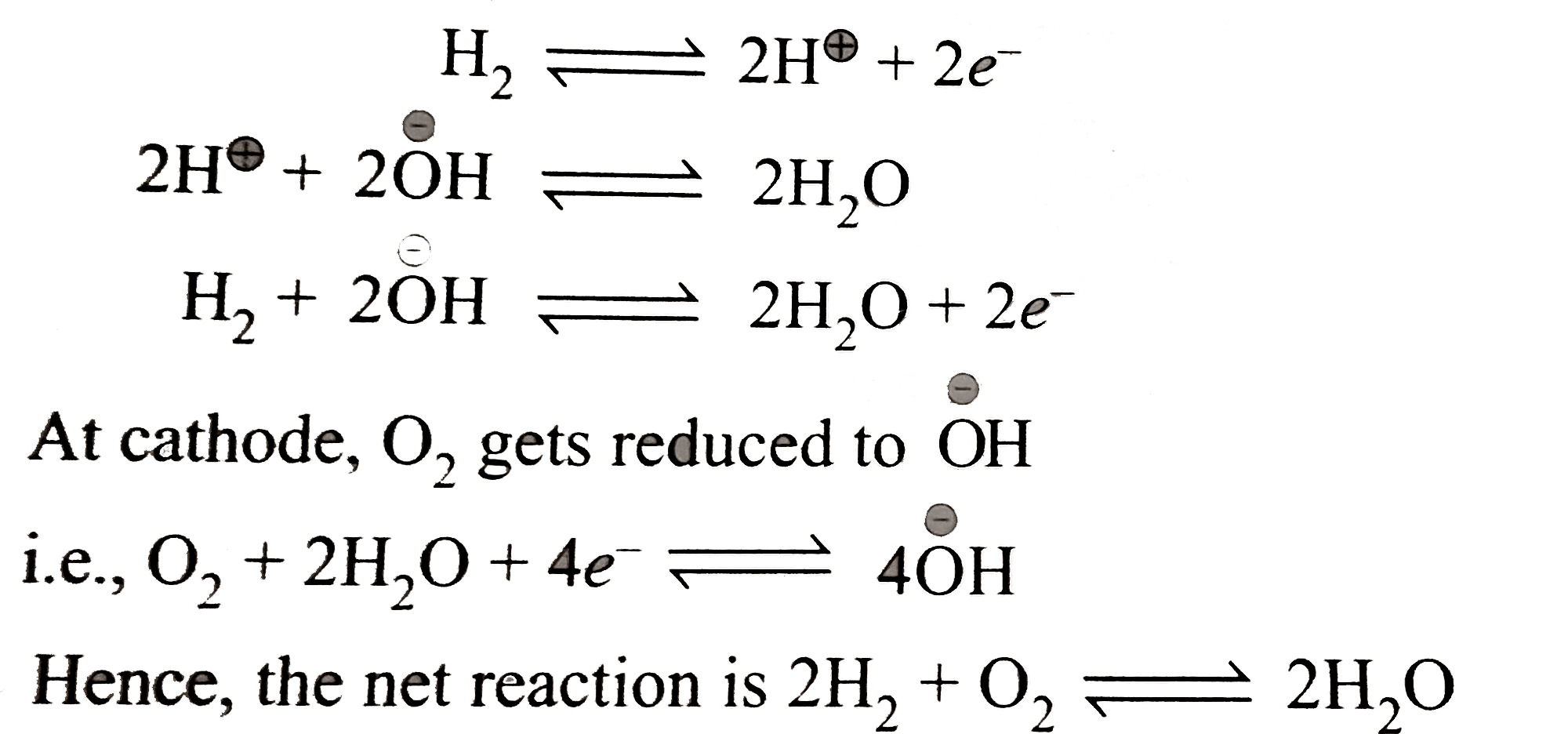
At cathode, `O_(2)` gets reduced to `overset(c-)(O)H`
Hence, the net reaction is
The overall reaction has
`DeltaH=-285.6 kJ mol^(-1)` and `DeltaG=-237.4 kJ mol^(-1)` at `25^(@)C`
What is the value of `DeltaS^(c-)` for the fuel cell at `25^(@)C`?
Fuel cells `:` Fuel cells are galvanic cells in which the chemical energy of fuel cell is directly converted into electrical energy. A type of fuel cell is a hydrogen `-` oxygen fuel cell. It consists of two electrodes made up of two porous graphite impregnated with a catalyst `(` platinum, silver, or metal oxide `).` The electrodes are placed in aqueous solution of `NaOH` . Oxygen and hydrogen are continuously fed into the cell. Hydrogen gets oxidized to `H^(o+)` which is neutralized by `overset(c-)(O)H, i.e.,` anodic reaction.
At cathode, `O_(2)` gets reduced to `overset(c-)(O)H`
Hence, the net reaction is
The overall reaction has
`DeltaH=-285.6 kJ mol^(-1)` and `DeltaG=-237.4 kJ mol^(-1)` at `25^(@)C`
What is the value of `DeltaS^(c-)` for the fuel cell at `25^(@)C`?
At cathode, `O_(2)` gets reduced to `overset(c-)(O)H`
Hence, the net reaction is
The overall reaction has
`DeltaH=-285.6 kJ mol^(-1)` and `DeltaG=-237.4 kJ mol^(-1)` at `25^(@)C`
What is the value of `DeltaS^(c-)` for the fuel cell at `25^(@)C`?



Similar Questions
Explore conceptually related problems
Fuel cells : Fuel cells are galvanic cells in which the chemical energy of fuel cell is directly converted into electrical energy. A type of fuel cell is a hydrogen - oxygen fuel cell. It consists of two electrodes made up of two porous graphite impregnated with a catalyst ( platinum, silver, or metal oxide ). The electrodes are placed in aqueous solution of NaOH . Oxygen and hydrogen are continuously fed into the cell. Hydrogen gets oxidized to H^(o+) which is neutralized by overset(c-)(O)H, i.e., anodic reaction. At cathode, O_(2) gets reduced to overset(c-)(O)H Hence, the net reaction is The overall reaction has DeltaH=-285.6 kJ mol^(-1) and DeltaG=-237.4 kJ mol^(-1) at 25^(@)C If the cell voltage is 1.23V for the H_(2)-O_(2) fuel cell and for the half cell :
Fuel cells : Fuel cells are galvanic cells in which the chemical energy of fuel cell is directly converted into electrical energy. A type of fuel cell is a hydrogen - oxygen fuel cell. It consists of two electrodes made up of two porous graphite impregnated with a catalyst ( platinum, silver, or metal oxide ). The electrodes are placed in aqueous solution of NaOH . Oxygen and hydrogen are continuously fed into the cell. Hydrogen gets oxidized to H^(o+) which is neutralized by overset(c-)(O)H, i.e., anodic reaction. At cathode, O_(2) gets reduced to overset(c-)(O)H Hence, the net reaction is The overall reaction has DeltaH=-285.6 kJ mol^(-1) and DeltaG=-237.4 kJ mol^(-1) at 25^(@)C If the cell voltage is 1.23V for the H_(2)-O_(2) fuel cell and for the half cell :
Fuel cells : Fuel cells are galvanic cells in which the chemical energy of fuel cell is directly converted into electrical energy. A type of fuel cell is a hydrogen - oxygen fuel cell. It consists of two electrodes made up of two porous graphite impregnated with a catalyst ( platinum, silver, or metal oxide ). The electrodes are placed in aqueous solution of NaOH . Oxygen and hydrogen are continuously fed into the cell. Hydrogen gets oxidized to H^(o+) which is neutralized by overset(c-)(O)H, i.e., anodic reaction. At cathode, O_(2) gets reduced to overset(c-)(O)H Hence, the net reaction is The overall reaction has DeltaH=-285.6 kJ mol^(-1) and DeltaG=-237.4 kJ mol^(-1) at 25^(@)C If the cell voltage is 1.23V for the H_(2)-O_(2) fuel cell and for the half cell :
Fuel cells : Fuel cells are galvanic cells in which the chemical energy of fuel cell is directly converted into electrical energy. A type of fuel cell is a hydrogen - oxygen fuel cell. It consists of two electrodes made up of two porous graphite impregnated with a catalyst ( platinum, silver, or metal oxide ). The electrodes are placed in aqueous solution of NaOH . Oxygen and hydrogen are continuously fed into the cell. Hydrogen gets oxidized to H^(o+) which is neutralized by overset(c-)(O)H, i.e., anodic reaction. At cathode, O_(2) gets reduced to overset(c-)(O)H Hence, the net reaction is The overall reaction has DeltaH=-285.6 kJ mol^(-1) and DeltaG=-237.4 kJ mol^(-1) at 25^(@)C Suppose the concentration of hydroxide ion in the cell is doubled, then the cell voltage will be
Fuel cells : Fuel cells are galvanic cells in which the chemical energy of fuel cell is directly converted into electrical energy. A type of fuel cell is a hydrogen - oxygen fuel cell. It consists of two electrodes made up of two porous graphite impregnated with a catalyst ( platinum, silver, or metal oxide ). The electrodes are placed in aqueous solution of NaOH . Oxygen and hydrogen are continuously fed into the cell. Hydrogen gets oxidized to H^(o+) which is neutralized by overset(c-)(O)H, i.e., anodic reaction. At cathode, O_(2) gets reduced to overset(c-)(O)H Hence, the net reaction is The overall reaction has DeltaH=-285.6 kJ mol^(-1) and DeltaG=-237.4 kJ mol^(-1) at 25^(@)C Suppose the concentration of hydroxide ioin in the cell is doubled, then the cell voltage will be
Fuel cells : Fuel cells are galvanic cells in which the chemical energy of fuel cell is directly converted into electrical energy. A type of fuel cell is a hydrogen - oxygen fuel cell. It consists of two electrodes made up of two porous graphite impregnated with a catalyst ( platinum, silver, or metal oxide ). The electrodes are placed in aqueous solution of NaOH . Oxygen and hydrogen are continuously fed into the cell. Hydrogen gets oxidized to H^(o+) which is neutralized by overset(c-)(O)H, i.e., anodic reaction. At cathode, O_(2) gets reduced to overset(c-)(O)H Hence, the net reaction is The overall reaction has DeltaH=-285.6 kJ mol^(-1) and DeltaG=-237.4 kJ mol^(-1) at 25^(@)C Suppose the concentration of hydroxide ioin in the cell is doubled, then the cell voltage will be
Fuel cells : Fuel cells are galvanic cells in which the chemical energy of fuel cell is directly converted into electrical energy. A type of fuel cell is a hydrogen - oxygen fuel cell. It consists of two electrodes made up of two porous graphite impregnated with a catalyst ( platinum, silver, or metal oxide ). The electrodes are placed in aqueous solution of NaOH . Oxygen and hydrogen are continuously fed into the cell. Hydrogen gets oxidized to H^(o+) which is neutralized by overset(c-)(O)H, i.e., anodic reaction. At cathode, O_(2) gets reduced to overset(c-)(O)H Hence, the net reaction is The overall reaction has DeltaH=-285.6 kJ mol^(-1) and DeltaG=-237.4 kJ mol^(-1) at 25^(@)C A fuel cell is I. A voltaic cell in which continuous supply of fuels are sent at anode to perform oxidation. II. A voltaci cell in which fuels such as :CH_(4),H_(2), and CO are used up at anode. III. One which involves the reaction of H_(2)-O_(2) fuel cell such as : Anode :2H_(2)O+4overset(c-)(O)H rarr 4H_(2)O(l)+4e^(c-) Cathode : O_(2)+2H_(2)O(l) =4e^(-) rarr 4overset(c-)(O)H IV. The efficiency of H_(2)-O_(20 fuel cell is 70 to 75%
Fuel cells : Fuel cells are galvanic cells in which the chemical energy of fuel cell is directly converted into electrical energy. A type of fuel cell is a hydrogen - oxygen fuel cell. It consists of two electrodes made up of two porous graphite impregnated with a catalyst ( platinum, silver, or metal oxide ). The electrodes are placed in aqueous solution of NaOH . Oxygen and hydrogen are continuously fed into the cell. Hydrogen gets oxidized to H^(o+) which is neutralized by overset(c-)(O)H, i.e., anodic reaction. At cathode, O_(2) gets reduced to overset(c-)(O)H Hence, the net reaction is The overall reaction has DeltaH=-285.6 kJ mol^(-1) and DeltaG=-237.4 kJ mol^(-1) at 25^(@)C A fuel cell is I. A voltaic cell in which continuous supply of fuels are sent at anode to perform oxidation. II. A voltaci cell in which fuels such as :CH_(4),H_(2), and CO are used up at anode. III. One which involves the reaction of H_(2)-O_(2) fuel cell such as : Anode :2H_(2)O+4overset(c-)(O)H rarr 4H_(2)O(l)+4e^(c-) Cathode : O_(2)+2H_(2)O(l) =4e^(-) rarr 4overset(c-)(O)H IV. The efficiency of H_(2)-O_(20 fuel cell is 70 to 75%
In fuel cells,__ is converted into electrical energy
Recommended Questions
- Fuel cells : Fuel cells are galvanic cells in which the chemical energ...
Text Solution
|
- Fuel cells : Fuel cells are galvanic cells in which the chemical energ...
Text Solution
|
- Fuel cells : Fuel cells are galvanic cells in which the chemical energ...
Text Solution
|
- Fuel cells : Fuel cells are galvanic cells in which the chemical energ...
Text Solution
|
- Fuel cells : Fuel cells are galvanic cells in which the chemical energ...
Text Solution
|
- ईधन सेल क्या हैं। हाइड्रोजन –ऑक्सीजन ईधन सेल का वर्णन संक्षेप में कीज...
Text Solution
|
- ईंधन सेल में ईंधन ऊर्जा को विद्युत ऊर्जा में बदला जाता है।
Text Solution
|
- What are fuel cells ? Discuss briefly hydrogen-oxygen fuel cell ?
Text Solution
|
- What are fuel cells ? Write the electrode reactions of a fuel cell whi...
Text Solution
|