

Home
Class 11
PHYSICS
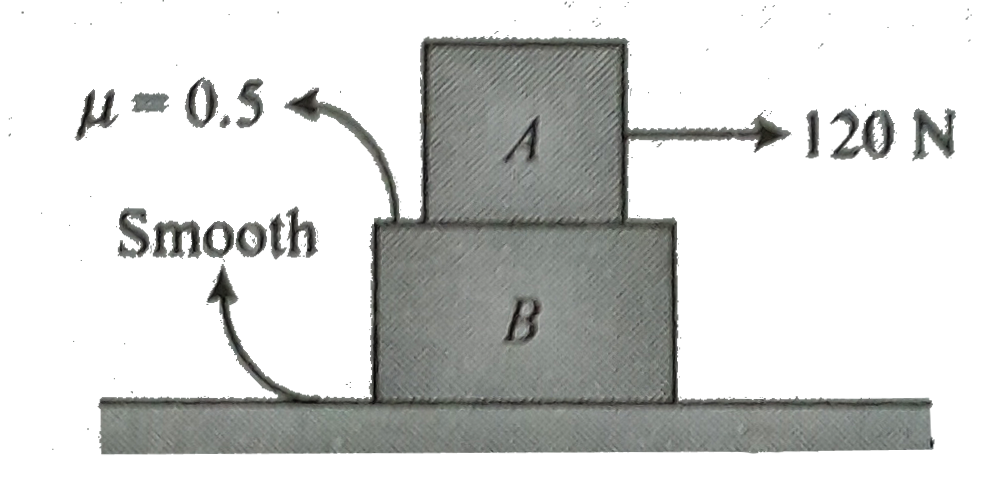
Find the acceleration of the two blocks ...

Find the acceleration of the two blocks . The system is initialy at rest and the friction are as shown in fig .Given `m_(A) = m_(B) = 10 kg`

Promotional Banner

Similar Questions

Explore conceptually related problems

Find the acceleration of the two blocks The system is initaily at rest the friction coefficient are as in fig 7.138 Given m_(A) = m_(B) = 10 kg

Find the acceleration of the two blocks. The system is initially at rest and the friction coefficient are as shown in the figure?

Find the acceleration of the two blocks. The system is initially at rest and the friction coefficient are as shown in the figure?

Find the acceleration of the two blocks The system initally at rest and the friction coefficient are as shown in fig 7.140? Also find maximum F for which two blocks will move togather Given m_(A) = 10 kg and m_(B) = 20 kg

Find the acceleration of the two blocks The system initally at rest and the friction coefficient are as shown in fig 7.140? Also find maximum F for which two blocks will move togather Given m_(A) = 10 kg and m_(B) = 20 kg

Given the setup shown in Fig Block A, B and C have masses m_(A)= M and m_(B) =m_(C) = m . The strings are assumed maseless and unstreichable, and the pulleys frictionless .There is no friction between block B and the support table, but there is friction between blocks B and C , denoted by a given coefficient mu a . In terms the given find (i) the acceleration of block A and B b. Suppose the system is released from rest with block C near the right end of block B as shown in the above figure. If the the length L of block B is given, what is the speed of block C as it reached the left end of block B ? Tear the size of C as small c. If the mass of block A is less then some critical value, the blocks will not accelerate when released from rest. Write down as expression for that critical mass.

Given the setup shown in Fig Block A, B and C have masses m_(A)= M and m_(B) =m_(C) = m . The strings are assumed maseless and unstreichable, and the pulleys frictionless .There is no friction between block B and the support table, but there is friction between blocks B and C , denoted by a given coefficient mu a . In terms the given find (i) the acceleration of block A and B b. Suppose the system is released from rest with block C near the right end of block B as shown in the above figure. If the the length L of block B is given, what is the speed of block C as it reached the left end of block B ? Tear the size of C as small c. If the mass of block A is less then some critical value, the blocks will not accelerate when released from rest. Write down as expression for that critical mass.

In figure shown if m_(A) = 20 kg and m_(B) = 80 kg. The acceleration of block A if the system is set free to move is beta m//s^(2) . Find the value of beta . (Take g = 10 ms^(-2) )