

Home
Class 11
PHYSICS
A plank is moving along a smooth surface...

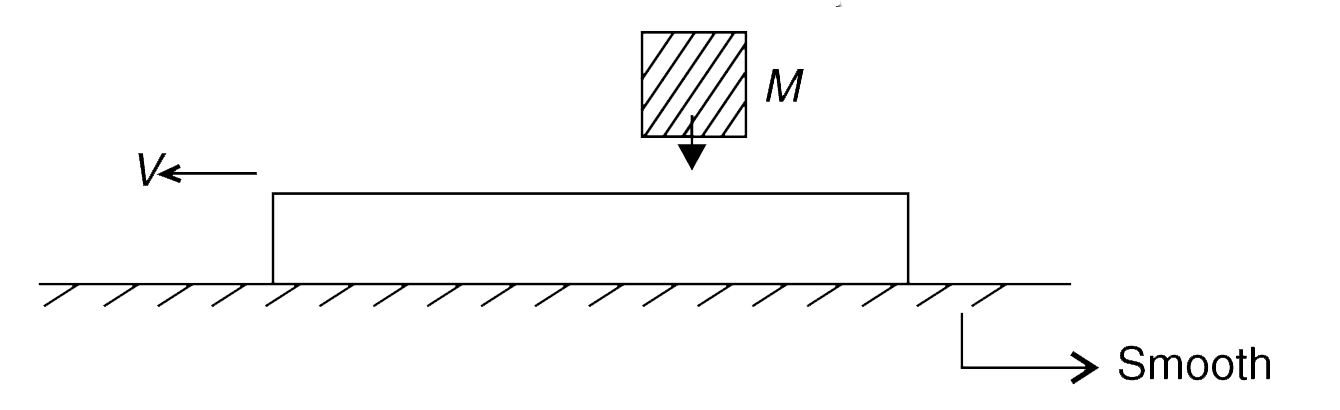
A plank is moving along a smooth surface with a constant speed V. A block of mass M is gently placed on it. Initially the block slips and then acquires the constant speed (V) same as the plank. Throughout the period, a horizontal force is applied on the plank to keep its speed constant. (a) Find the work performed by the external force. (b) Find the heat developed due to friction between the block and the plank.

Promotional Banner

Similar Questions

Explore conceptually related problems

A plank of mass M is moving on a smooth horizontal surface with speed 'v_(0)' . At t=0 a sphere of mass 'm' and radius 'r' is gently placed on it and simultaneously a constant horizontal force 'F' is applied on the plank in the opposite direction of v_(0) . Find the time at which sphere starts rolling on the plank. The coefficient of friction between the plank and the sphere is mu .

A plank of mass m_1 with a uniform sphere of mass m_2 placed on it rests on a smooth horizontal plane. A constant horizontal force F is applied to the plank. With what acceleration will the plank and the centre of the sphere move provided there is no sliding between the plank and the sphere?

A sphere of mass m and radius r is placed on a rough plank of mass M . The system is placed on a smooth horizontal surface. A constant force F is applied on the plank such that the sphere rolls purely on the plank. Find the acceleration of the sphere.

A sphere of mass m and radius r is placed on a rough plank of mass M . The system is placed on a smooth horizontal surface. A constant force F is applied on the plank such that the sphere rolls purely on the plank. Find the acceleration of the sphere.

A block of mass m is revolving in a smooth horizontal plane with a constant speed v.If the radius of the circle path is R find the total contact force received by the block

A block of mass m is revolving in a smooth horizontal plane with a constant speed v.If the radius of the circle path is R find the total contact force received by the block

A wooden block is kept on a polished wooden plank and the inclination of the plank is gradually increased. It is found that the block starts slipping when the plank makes an angle of 18^@ with the horizontal. However, once started the block can continue with uniform speed if the inclination is reduced to 15^@ . Find the coefficients of static and kinetic friction between the block and the plank.

A wooden block is kept on a polished wooden plank and the inclination of the plank is gradually increased. It is found that the block starts slipping when the plank makes an angle of 18^@ with the horizontal. However, once started the block can continue with uniform speed if the inclination is reduced to 15^@ . Find the coefficients of static and kinetic friction between the block and the plank.

A plank of mass M and length L is placed at rest on a smooth horizontal surface. A small block of mass m is projected with a velocity v_0 from the left end of it as shown in figure. The coefficient of friction between the block and the plank is m, and its value is such that the block becomes stationary with respect to the plank before it reaches the other end. a. Find the time and common velocity when relative sliding between the block and the plank stops. b. Find the work done by the friction force on the block during the period it slides on the plank. Is the work positive or negative? c. Calculate the work done on the plank during the same period. Is the work positive or negative? d. Also, determine the net work done by friction, Is it positive or negative?