Home
Class 12
PHYSICS
The coefficient of static friction, mu(s...

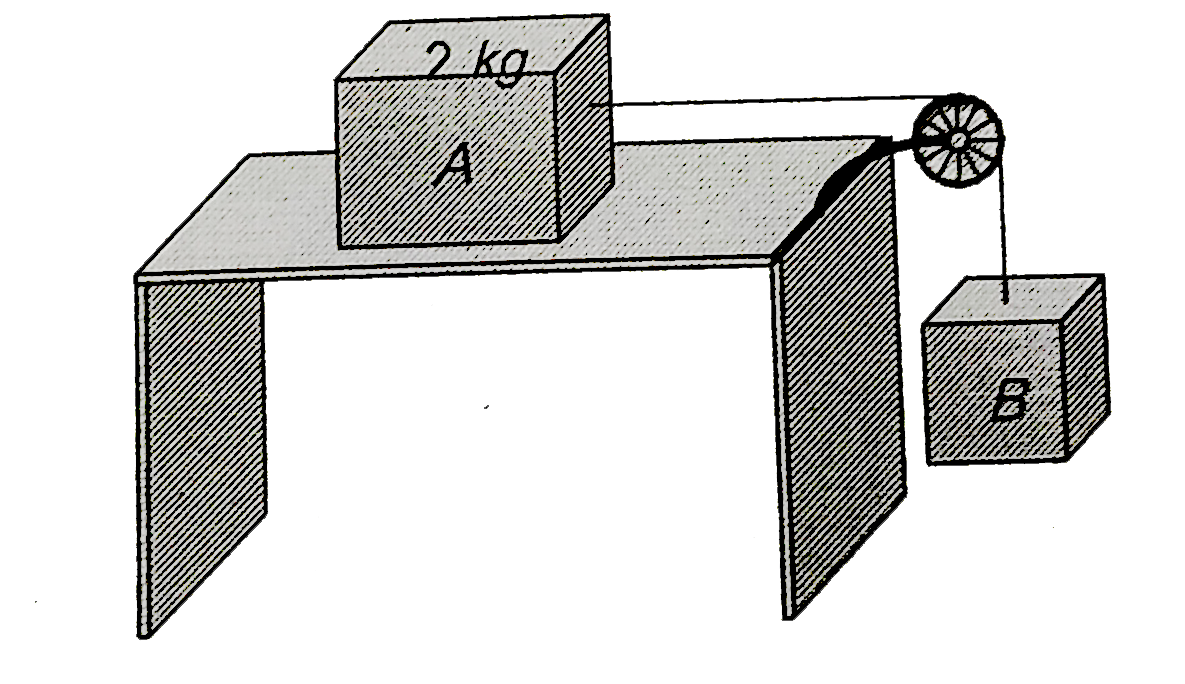
The coefficient of static friction, `mu_(s)` between block A of mass 2 kg and the table as shown in the figure is 0.2. What would be the maximum mass value of block B so that the two blocks do not move? The string and the pulley are assumed to be smooth and massless.`(g=10m//s^(2))`

A

4.0kg.

B

0.2kg.

C

0.4kg.

D

2.0kg.

Text Solution

Verified by Experts

The correct Answer is:

C

`T=M_(B)g=mu_(s)M_(A)g`
`therefore M_(B)=mu_(s)M_(A)=0.2xx2=0.4kg`
Promotional Banner

Topper's Solved these Questions

  • NEWTONS LAWS OF MOTION

    ALLEN|Exercise EXERCISE-II|112 Videos
  • NEWTONS LAWS OF MOTION

    ALLEN|Exercise EXERCISE-III|28 Videos
  • NEWTONS LAWS OF MOTION

    ALLEN|Exercise SWOE|44 Videos
  • NEWTON'S LAWS OF MOTION & FRICTION

    ALLEN|Exercise EXERCISE (JA)|4 Videos
  • RACE

    ALLEN|Exercise Basic Maths (Wave Motion & Dopplers Effect) (Stationary waves & doppler effect, beats)|25 Videos

Similar Questions

Explore conceptually related problems

The coefficient of static friction, mu_(s) between block A mass 2kg and the table as shown in the figure, is 0.2. What would be the maximum mass value of block B, so that the two blocks do not move ? The string and the pulley are asseumed to be smooth and massless ( g=10m//s^(2) )

The coefficient of static friction mu_(s) between block A of mass 2kg and the table as shown in is 0.1 What would be the maximum mass value of blocks B so that the two bloks do not move ? The string and the pulley are assumed to be smooth and massless (g = 10m//s^(2)) .

The coefficient of static friction between the block of 2 kg and the table shown in figurwe is mu_s=02. What should be the maximum value of m so tht the blocks do not move? Take g=10 m/s^2. The string and the pulley are light and smooth.

In the figure shown, the coefficient of static friction between the block A of mass 20 kg and horizontal table is 0.2. What should be the minimum mass of hanging block just beyond which blocks start moving?

The coefficient of static friction between the two blocks shown in figure is mu and the table is smooth. What maximum horizontal forced F can be applied to he block of mass M so that the block move together?

If coeffiecient of friction between the block of mass 2kg and table is 0.4 then out acceleration of the system and tension in the string. (g=10m//s^(2))

If the mass of the block A = 10 kg and the coefficient of static and kinetic friction is 0.2, then the mass of block B to start the motion is

A 'block' of mass 10 kg is suspended with string as shown in figure. Find tension in the string. (g=10m//s^(2))

Block B of mass 2kg rests on block A of mass 10kg . All surfaces are rought with the value of coefficient of friction as shown in the figure. Find the minimum force F that should be applied on block A to cause relative motion between A and B . (g=10m//s^(2))

In the arrangement shown in figure pulley P can move whereas other two pulleys are fixed. All of them are light. String is light and inextensible. The coefficient of friction between 2 kg and 3 kg block is mu = 0.75 and that between 3 kg block and the table is mu = 0.5 . The system is released from rest (i) Find maximum value of mass M, so that the system does not move. Find friction force between 2 kg and 3 kg blocks in this case. (ii) If M = 4 kg, find the tension in the string attached to 2 kg block. (iii) If M = 4 kg and mu_(1) = 0.9 , find friction force between the two blocks, and acceleration of M. (iv) Find acceleration of M if m_(1) = 0.75, m_(2) = -0.9 and M = 4 kg.

ALLEN-NEWTONS LAWS OF MOTION-EXERCISE-I
  1. A man weighs 80kg . He stands on a weighing scale in a lift which is m...

    Text Solution

    |

  2. A block of mass m is placed on a smooth wedge of inclination theta. T...

    Text Solution

    |

  3. The coefficient of static friction, mu(s) between block A of mass 2 k...

    Text Solution

    |

  4. A cyclist on the ground goes round a ciruclar path of circumference 34...

    Text Solution

    |

  5. Two particles of masses m and M(Mgtm) are connected by a cord that pas...

    Text Solution

    |

  6. Two forces vecF(1)=(3N)hati-(4N)hatj and vecF(2)=-(1N)hati-(2N)hatj ac...

    Text Solution

    |

  7. A horizontal force of 10N is necessary to just hold a block stationary...

    Text Solution

    |

  8. In the figure given below, the position time graph of a particle of ma...

    Text Solution

    |

  9. A person is standing in an elevator. In which situation he finds his w...

    Text Solution

    |

  10. Two weights w(1) and w(2) are suspended from the ends of a light strin...

    Text Solution

    |

  11. A particle is moving under the influence of a force which is fixed in ...

    Text Solution

    |

  12. A force of 10 Newton acts on a body of mass 20 kg for 10 seconds. Cha...

    Text Solution

    |

  13. A rocket of mass 1000 kg is to be projected vertically upwards. The ga...

    Text Solution

    |

  14. Three blocks of masses m(1),m(2)and m(3) are connected by massless str...

    Text Solution

    |

  15. A 0.5 kg ball moving with a speed of 12 m//s strikes a hard wall at an...

    Text Solution

    |

  16. A person used force (F) , shown in figure to move a load with constant...

    Text Solution

    |

  17. The ratio of gravitational mass to inertial mass is equal to:

    Text Solution

    |

  18. A given object takes n times as much time to slide down a 45^(@) rough...

    Text Solution

    |

  19. The figure shows a horizontal force vecF acting on a block of mass M o...

    Text Solution

    |

  20. A 150 g tenins ball coming at a speed of 40m/s is hit straight back by...

    Text Solution

    |
