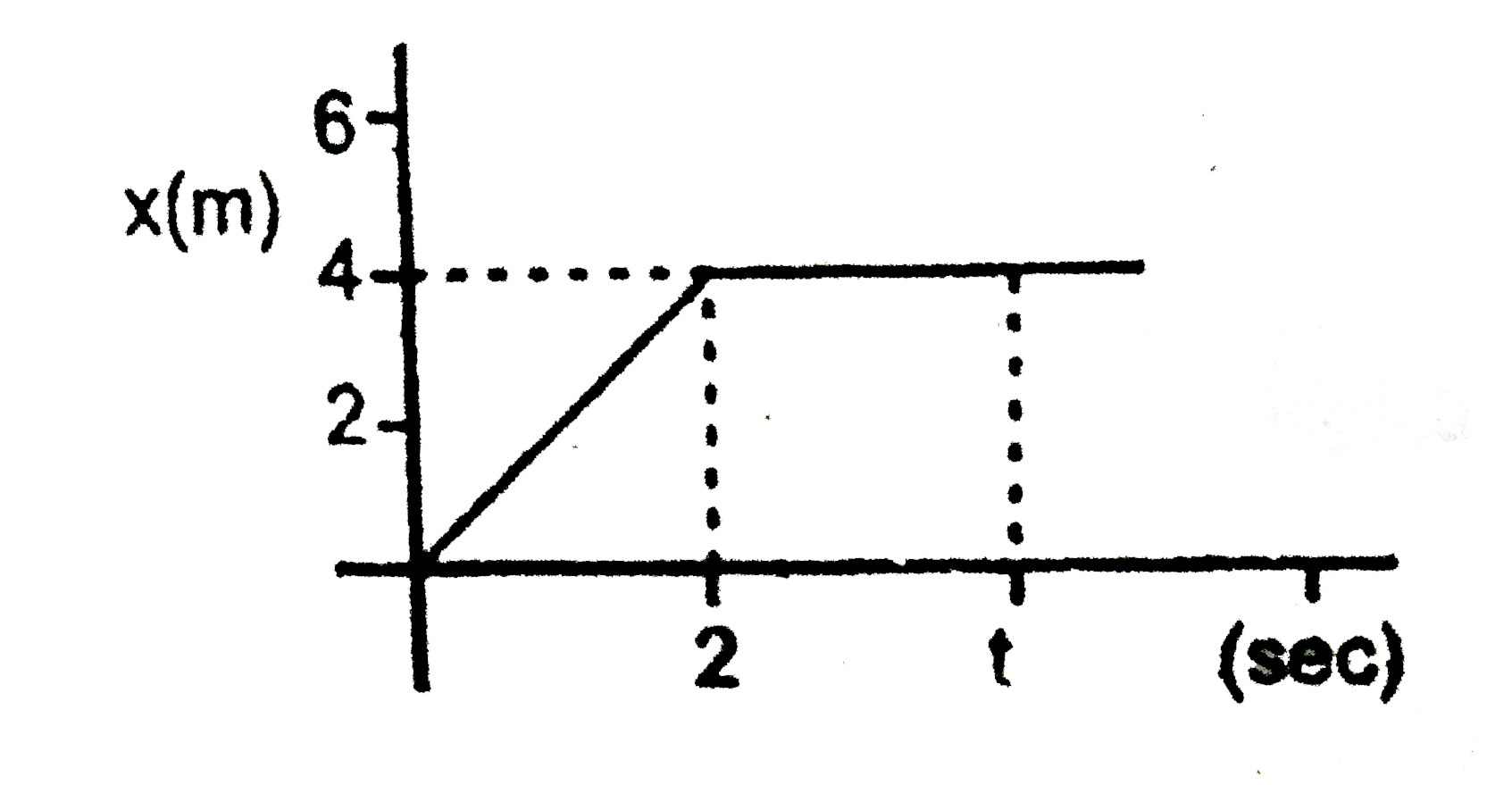
A
B
C
D
Text Solution
Verified by Experts
The correct Answer is:



Topper's Solved these Questions
NEWTONS LAWS OF MOTION
ALLEN|Exercise EXERCISE-II|112 VideosNEWTONS LAWS OF MOTION
ALLEN|Exercise EXERCISE-III|28 VideosNEWTONS LAWS OF MOTION
ALLEN|Exercise SWOE|44 VideosNEWTON'S LAWS OF MOTION & FRICTION
ALLEN|Exercise EXERCISE (JA)|4 VideosRACE
ALLEN|Exercise Basic Maths (Wave Motion & Dopplers Effect) (Stationary waves & doppler effect, beats)|25 Videos
Similar Questions
Explore conceptually related problems
ALLEN-NEWTONS LAWS OF MOTION-EXERCISE-I
- Two forces vecF(1)=(3N)hati-(4N)hatj and vecF(2)=-(1N)hati-(2N)hatj ac...
Text Solution
|
- A horizontal force of 10N is necessary to just hold a block stationary...
Text Solution
|
- In the figure given below, the position time graph of a particle of ma...
Text Solution
|
- A person is standing in an elevator. In which situation he finds his w...
Text Solution
|
- Two weights w(1) and w(2) are suspended from the ends of a light strin...
Text Solution
|
- A particle is moving under the influence of a force which is fixed in ...
Text Solution
|
- A force of 10 Newton acts on a body of mass 20 kg for 10 seconds. Cha...
Text Solution
|
- A rocket of mass 1000 kg is to be projected vertically upwards. The ga...
Text Solution
|
- Three blocks of masses m(1),m(2)and m(3) are connected by massless str...
Text Solution
|
- A 0.5 kg ball moving with a speed of 12 m//s strikes a hard wall at an...
Text Solution
|
- A person used force (F) , shown in figure to move a load with constant...
Text Solution
|
- The ratio of gravitational mass to inertial mass is equal to:
Text Solution
|
- A given object takes n times as much time to slide down a 45^(@) rough...
Text Solution
|
- The figure shows a horizontal force vecF acting on a block of mass M o...
Text Solution
|
- A 150 g tenins ball coming at a speed of 40m/s is hit straight back by...
Text Solution
|
- Three solids of masses m(1),m(2) and m(3) are connected with weightles...
Text Solution
|
- Two blocks of masses M(1)=4 kg and M(2)=6kg are connected by a string ...
Text Solution
|
- Three masses M(1), M(2) and M(3) are lying on a frictionless table. Th...
Text Solution
|
- In Newton's second vecF=mveca (for constant mass m), veca is the accel...
Text Solution
|
- A man of mass 90kg is standing in an elevator whose cable broke sudden...
Text Solution
|