Home
Class 12
PHYSICS
Suppose 0.5 moles of an ideal gas underg...

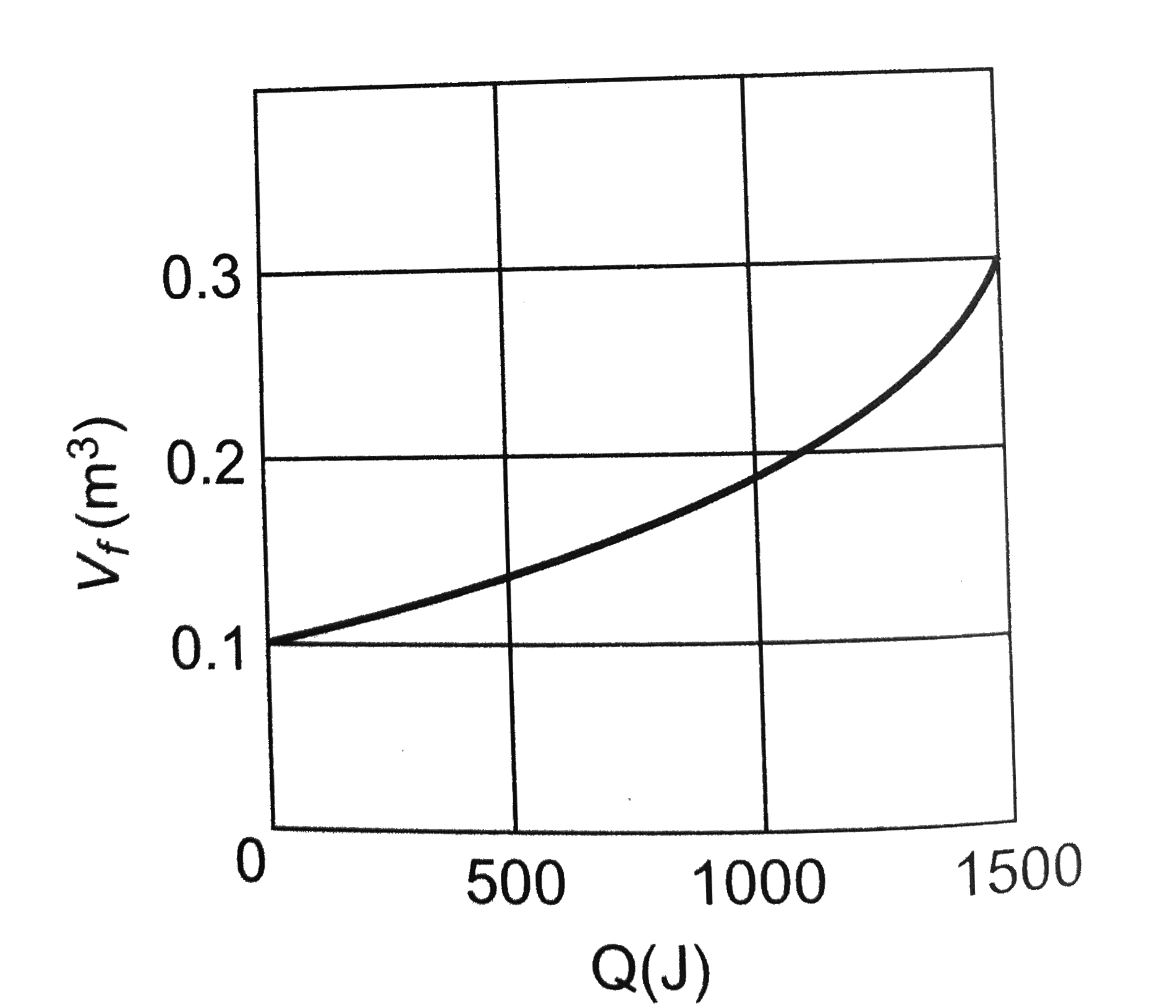
Suppose `0.5` moles of an ideal gas undergoes an isothermal expansion as energy is added to it as heat Q. graph shows the final volume `V_(f)` versus Q. the temperature of the gas is `(use In 9 = 2 and R = (25)/(3) J//mol-K)`

A

`293K`

B

`360 K`

C

`386 K`

D

`412 K`

Text Solution

Verified by Experts

The correct Answer is:

B

` Q=W= nRT ln"(V_(f))/(V_(i)), T = (Q)/(nRlnV_(t)//V_(i)) = (1500)/(0.5 xx 25//3 xxln3) = (1500)/(0.5 xx 25//3 xx1)= 360K`
Promotional Banner

Topper's Solved these Questions

  • GEOMETRICAL OPTICS

    ALLEN|Exercise EXERCISE -01|65 Videos
  • GEOMETRICAL OPTICS

    ALLEN|Exercise EXERCISE -02|82 Videos
  • GEOMETRICAL OPTICS

    ALLEN|Exercise subjective|14 Videos
  • CURRENT ELECTRICITY

    ALLEN|Exercise All Questions|427 Videos
  • GRAVITATION

    ALLEN|Exercise EXERCISE 4|9 Videos

Similar Questions

Explore conceptually related problems

Suppose 0.825 mol of an ideal gas undergoes an isothermal expansion as energy is added to it as heat Q. If Fig. 21-30 shows the final volume V_f versus Q, what is the gas temperature? The scale of the vertical axis is set by V_(fs ) = 0.30 m^3 and the scale of the horizontal axis is set by Q_s = 1800 J .

Consider isothermal expansion of 0.5 mole of an ideal gas when Q amount of heat is added to it. Following graph shows variation in volume V with Q. Find the temperature of the gas ("ln "3~~10, R=(25)/(3)J//"mole"-K)

The entropy of v = 4.0 moles of an ideal gas increases by Delta S = 23 J//K due to the isothermal expansion. How many times should the volume v = 4.0 moles of the gas be increased ?

One mole of an ideal gas undergoes a process P=P_(0)-alphaV^(2) where alpha and P_(0) are positive constant and V is the volume of one mole of gas Q. When temperature is maximum, volume is

Entrolpy change in isothermal expansion work of one mole of an ideal gas from volume V_(1) and V_(2) is given by

One mole of an ideal gas requires 207 J of heat to raise the temperature. If the same gas is heated at constant volume to raise the temperature by the same range, the heat required will be [R=8.3 J/mole K]

One mole of an ideal gas undergoes a process P=P_(0)-alphaV^(2) where alpha and P_(0) are positive constant and V is the volume of one mole of gas Q. The maximum attainable temperature is

ALLEN-GEOMETRICAL OPTICS-SOME WORKED OUT EXAMPLES
  1. Figure demonstrates a polytropic process (i.e.PV^(n) = constant ) for ...

    Text Solution

    |

  2. A vessel contains 14 g (7 moles ) of hydrogen and 96 g (3moles) of oxy...

    Text Solution

    |

  3. Suppose 0.5 moles of an ideal gas undergoes an isothermal expansion as...

    Text Solution

    |

  4. The respective speeds of five molecules are 2,1.5,1.6,1.6 and 1.2 km/s...

    Text Solution

    |

  5. When water is boiled at 2 atm pressure the latent heat of vaporization...

    Text Solution

    |

  6. Given T-p curve for three processes. Work done in process 1, 2 and 3 (...

    Text Solution

    |

  7. Figure shows the variations of the internal energy U With density rho ...

    Text Solution

    |

  8. One mole of an ideal gas undergoes a process whose molar heat capacity...

    Text Solution

    |

  9. An irregular rod of same uniform material as shown in figure is condu...

    Text Solution

    |

  10. A gas undergoes an adiabatic process in which pressure becomes ((8)/(3...

    Text Solution

    |

  11. Following graph shows the correct variation in intensity of heat radia...

    Text Solution

    |

  12. The temperature drop through a two layer furnace wall is 900^@C. Each ...

    Text Solution

    |

  13. 5g of steam at 100^(@)C is mixed with 10g of ice at 0^(@)C. Choose cor...

    Text Solution

    |

  14. Water contained in a jar at room temperature (20^(@)C) is intended to ...

    Text Solution

    |

  15. n moles of an ideal triatomic linear gas undergoes a process in which ...

    Text Solution

    |

  16. An ideal gas expands in such a way that PV^2 = constant throughout the...

    Text Solution

    |

  17. Which of the following processes must violate the first law of thermod...

    Text Solution

    |

  18. For an ideal gas of fixed amount, the initial pressure and volume are...

    Text Solution

    |

  19. In Newton's law of cooling (d theta)/(dt)=-k(theta-theta(0)) the const...

    Text Solution

    |

  20. The graph below shows V-p curve for three processes. Choose the correc...

    Text Solution

    |
