Home
Class 12
PHYSICS
Two moles of helium gas undergo a cyclic...

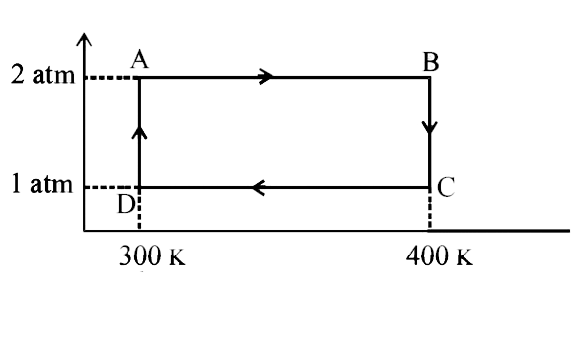
Two moles of helium gas undergo a cyclic process as shown in Fig. Assuming the gas to be ideal, calculate the following quantities in this process

(a) The net change in the heat energy
(b) The net work done
(c) The net change in internal energy

Text Solution

Verified by Experts

The correct Answer is:
(i) `1152 J (ii) 1152J (iii) zero`

`V_(A) = V_(0) = (nRT_(A))/(P_(A)) = (2R xx 300)/(2) = 300R`
`V_(B) = (nRT_(B))/(P_(B)) = (2R xx 400)/(2) = 400R = (4)/(3)V_(0)`
`V_(C) = (nRT_(C))/(P_(C)) = (2R xx 400)/(1) = 800R = (8)/(3)V_(0)`
`V_(D) = (nRT_(D))/(P_(D)) = (2R xx 300)/(1) = 600R = 2V_(0)`
For cyclic process `DeltaU = 0 , Q=W`
`W_(A rarr B) = P_(A) (V_(B) - V_(A)) = 2((4V_(0))/(3) - V_(0)) xx 10^(5) = (2V_(0))/(3) xx 10^(5)`
`W_(B rarrC) = P_(B) V_(B) ln2 = 2 xx 10^(5) xx (4V_(0))/(3)ln2 = (8V_(0))/(3)ln2 xx 10^(5)`
`W_(CrarrD) = P_(C)(V_(D) - V_(C)) = 10^(5) (2V_(0) - (8V_(0))/(3)) = (2V_(0))/(3)xx 10^(5)`
`W_(DrarrA) =-P_(D)V_(D).ln2 = -10^(5)xx 2 xxln2`
`therefore W = W_(ArarrB) + W_(BrarrC) + W_(CrarrD) + W_(DrarrA) = 1152J`
(i) `therefore Q= 1152J` (ii) `W=1152J` (iii) `DeltaU = 0`
Promotional Banner

Topper's Solved these Questions

  • GEOMETRICAL OPTICS

    ALLEN|Exercise EXERCISE - 04 (B)|15 Videos
  • GEOMETRICAL OPTICS

    ALLEN|Exercise EXERCISE - 05 (A)|73 Videos
  • GEOMETRICAL OPTICS

    ALLEN|Exercise Comprehension Based Questions|66 Videos
  • CURRENT ELECTRICITY

    ALLEN|Exercise All Questions|427 Videos
  • GRAVITATION

    ALLEN|Exercise EXERCISE 4|9 Videos

Similar Questions

Explore conceptually related problems

Two moles of helium gas undergo a cyclic process as shown in figure. Assuming the gas to be ideal. The net work done by the gas is

Two moles of Helium gas undergo a reversible cyclic process as shown in figure. Assuming gas to be ideal, what is the net work involved in the cyclic process ?

In a cyclic process, the internal energy of the gas

ALLEN-GEOMETRICAL OPTICS-EXERCISE - 04 (A)
  1. One gram mole of oxygen at 27^@ and one atmospheric pressure is enclos...

    Text Solution

    |

  2. An ideal gas in enclosed in a tube and is held in the vertical positio...

    Text Solution

    |

  3. Two moles of helium gas undergo a cyclic process as shown in Fig. Assu...

    Text Solution

    |

  4. Examine the following plots and predict whether in (i) P(1) lt P(2) "a...

    Text Solution

    |

  5. A sample of 2 kg monoatomic helium (assumed ideal ) is taken from A to...

    Text Solution

    |

  6. In the given figure an ideal gas changes its state from A to state C b...

    Text Solution

    |

  7. The pressure in monoatomic gas increases linearly from =4xx10^(5) Nm^...

    Text Solution

    |

  8. On mole of a monoatomic ideal gas is taken through the cycle shown in ...

    Text Solution

    |

  9. At 27^@C two moles of an ideal monoatomic gas occupy a volume V. The g...

    Text Solution

    |

  10. Three moles of an ideal gas (Cp=7/2R) at pressure, PA and temperature ...

    Text Solution

    |

  11. An ideal gas having initial pressure p, volume V and temperature T is ...

    Text Solution

    |

  12. Two moles of helium gas (gamma = 5 / 3) are initially at 27^@C and occ...

    Text Solution

    |

  13. An ideal gas has a specific heat at constant pressure CP=(5R)/2. The g...

    Text Solution

    |

  14. Calculate the work done when one mole of a perfect gas is compressed a...

    Text Solution

    |

  15. A gaseous mixture enclosed in a vessel of volume V consists of one gra...

    Text Solution

    |

  16. An ideal gas is taken through a cyclic thermodynamic process through f...

    Text Solution

    |

  17. A gas has molar heat capacity C = 37.55 J "mole"^(-1)K^(-1), in the pr...

    Text Solution

    |

  18. One mole of monoatomic ideal gas undergoes a process ABC as shown in f...

    Text Solution

    |

  19. An ideal monoatomic gas occupies volume 10^(-3)m^(3) at temperature 3K...

    Text Solution

    |

  20. P-V graph for an ideal gas undergoing polytropic process PV^(m) = cons...

    Text Solution

    |

