Home
Class 12
PHYSICS
In Fig., a container is shown to have a ...

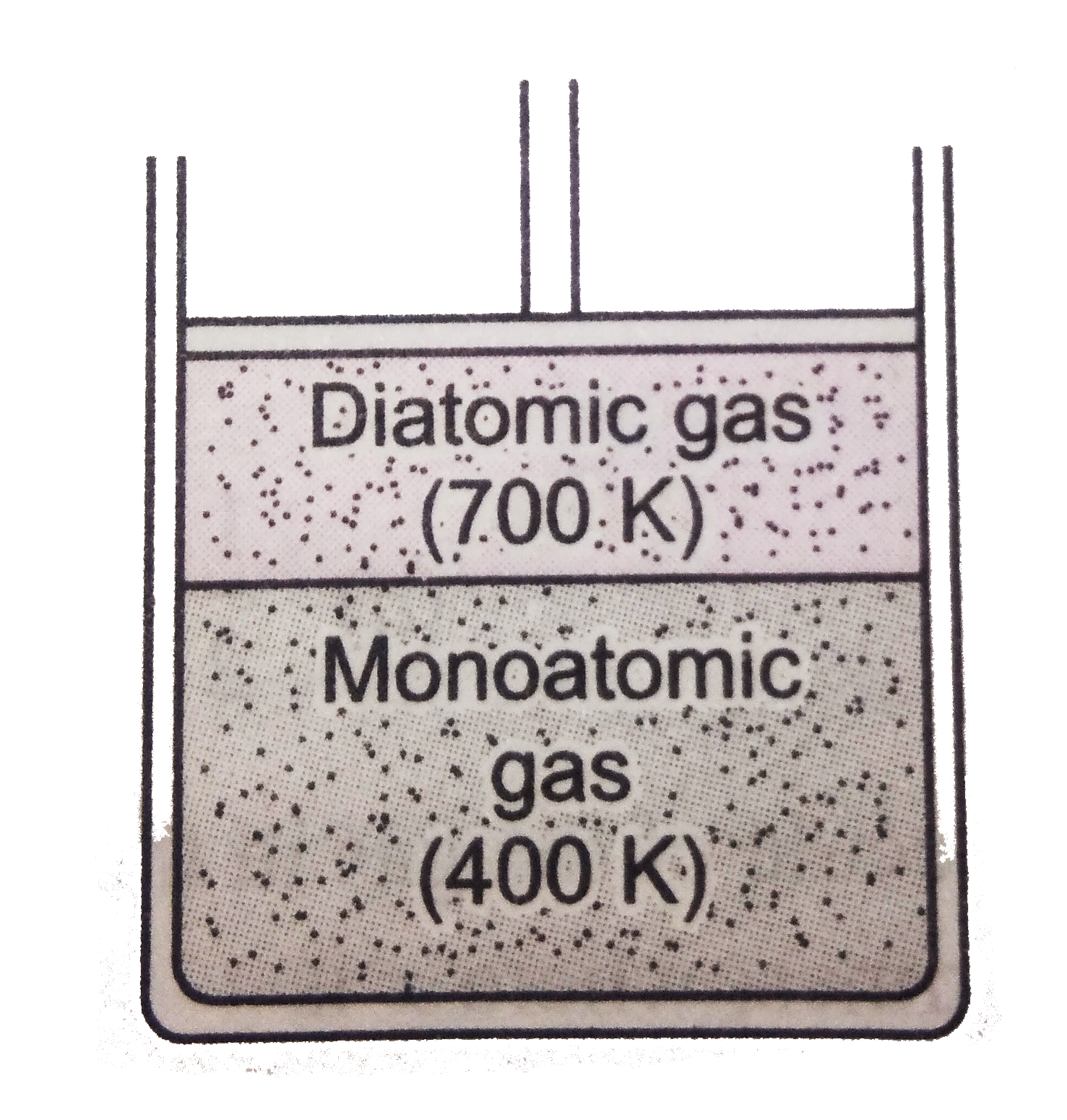
In Fig., a container is shown to have a movable (without friction) piston on top. The container and the piston are all made of perfectly insulating material allowing no heat transfer between outside and inside the container. The container is divided into two compartments by a rigid partition made of a thermally conducting material that allows slow transfer of heat. the lower compartment of the container is filled with 2 moles of an ideal monoatomic gas at 700 K and the upper compartment is filled with 2 moles of an ideal diatomic gas at 400 K. the heat capacities per mole of an ideal monoatomic gas are `C_(upsilon) = (3)/(2) R and C_(P) = (5)/(2) R`, and those for an ideal diatomic gas are `C_(upsilone) = (5)/(2) R and C_(P) = (7)/(2) R.`
Consider the partition to be rigidly fixed so that it does not move. when equilibrium is achieved, the final temperature of the gases will be

A

`550K`

B

`525K`

C

`513K`

D

`490K`

Text Solution

Verified by Experts

The correct Answer is:
D

`theta_(A) = theta_(B)`
Process in A is isobaric and Process in B is isochoric
`nC_(P) (T -400) = nC_(V) (700-T)`
`2(7)/(2)R (T-400) = 2 xx (5)/(2)R (700-T)`
`7T - 2800 = 2100 - 3T`
`T = 490`
Promotional Banner

Topper's Solved these Questions

  • GEOMETRICAL OPTICS

    ALLEN|Exercise EXERCISE- 01|45 Videos
  • GEOMETRICAL OPTICS

    ALLEN|Exercise EXERCISE-2|44 Videos
  • GEOMETRICAL OPTICS

    ALLEN|Exercise EXERCISE - 05 (B) (MATCH THE COLUMN)|3 Videos
  • CURRENT ELECTRICITY

    ALLEN|Exercise All Questions|427 Videos
  • GRAVITATION

    ALLEN|Exercise EXERCISE 4|9 Videos

Similar Questions

Explore conceptually related problems

In Fig., a container is shown to have a movable (without friction) piston on top. The container and the piston are all made of perfectly insulating material allowing no heat transfer between outside and inside the container. The container is divided into two compartments by a rigid partition made of a thermally conducting material that allows slow transfer of heat. the lower compartment of the container is filled with 2 moles of an ideal monoatomic gas at 700 K and the upper compartment is filled with 2 moles of an ideal diatomic gas at 400 K. the heat capacities per mole of an ideal monoatomic gas are C_(upsilon) = (3)/(2) R and C_(P) = (5)/(2) R , and those for an ideal diatomic gas are C_(upsilone) = (5)/(2) R and C_(P) = (7)/(2) R. Now consider the partition to be free to move without friction so that the pressure of gases in both compartments is the same. the total work done by the gases till the time they achieve equilibrium will be

In the figure, a container is shown to have a movable (without friction) piston on top. The container and the piston are all made of perfectly insulated material allowing no heat transfer between outside and inside the container. The container is divided into two compartments by a rigid partition made of a thermally conducting material that allows slow transfer of heat. The lower compartment of the container is filled with 2 moles of an ideal monatomic gas at 700K and the upper compartment is filled with 2 moles of an ideal diatmoic gas at 400K. The heat capacities per mole of an ideal monatomic gas are C_V=3/2R, C_P=5/2R, and those for an ideal diatomic gas are C_V=5/2R, C_P=7/2R, Consider the partition to be rigidly fixed so that it does not move. When equilibrium is achieved, the final temperature of the gasses will be

In the figure, a container is shown to have a movable (without friction) piston on top. The container and the piston are all made of perfectly insulated material allowing no heat transfer between outside and inside the container. The container is divided into two compartments by a rigid partition made of a thermally conducting material that allows slow transfer of heat. The lower compartment of the container is filled with 2 moles of an ideal monatomic gas at 700K and the upper compartment is filled with 2 moles of an ideal diatmoic gas at 400K. The heat capacities per mole of an ideal monatomic gas are C_V=3/2R, C_P=5/2R, and those for an ideal diatomic gas are C_V=5/2R, C_P=7/2R, Now consider the partition to be free to move without friction so that the pressure of gasses in both compartments is the same. The total work done by the gases till the time they achives equilibrium will be

Thermal Properties - Heat Transfer - Conduction

A box is divided into two equal compartments by a thin partition and they are filled with gases X and Y respectively. The two compartments have a pressure of 250 torr each. The pressure after removing the partition will be equal to:

A rigid and insulated tank of 3m^(3) volume is divided into two compartments. One compartment of volume of 2m^(3) contains an ideal gas at 0.8314 Mpa and 400 K while the second compartment of volume of 1m^(3) contains the same gas at 8.314 Mpa and 500 K. If the partition between the two compartments is rptured, the final temperature of the gas is :

