Home
Class 12
PHYSICS
A beam of light consisting of red, green...

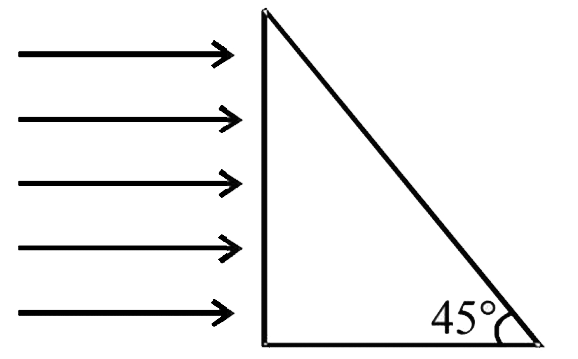
A beam of light consisting of red, green and blue colours is incident on a right angled prism, fig. The refractive indices of the material of the prism for the above red, green and blue wavelengths are 1.39, 1.44 and 1.47 respectively. The prism will `

A

separate part of the red color from the green and blue colors

B

separate part of the blue from the red and green colors

C

separate all the three colors from the other two colors

D

not separate even partially , any colors from the other two colors

Text Solution

Verified by Experts

The correct Answer is:
A

`mu_(red)"sin"I = 1 "sin"r`
`1.39 xx (1)/(1.414) = "sin"r`
`"sin"r lt ` implies` possible(refraction is possible)

`mu_("green")xx "sin"I implies 1.44 xx (1)/(1.41) gt 1 implies "not possible"`
Same for blue `1.47xx (1)/(1.41)gt1`
`implies` It also not possible.
Promotional Banner

Topper's Solved these Questions

  • GEOMETRICAL OPTICS

    ALLEN|Exercise EXERCISE-2|44 Videos
  • GEOMETRICAL OPTICS

    ALLEN|Exercise EXERCISE-3|12 Videos
  • GEOMETRICAL OPTICS

    ALLEN|Exercise EXERCISE - 05 (B) (ASSERTION & REASON )|9 Videos
  • CURRENT ELECTRICITY

    ALLEN|Exercise All Questions|427 Videos
  • GRAVITATION

    ALLEN|Exercise EXERCISE 4|9 Videos

Similar Questions

Explore conceptually related problems

A beam of light consisting of red, green and blue colours is incident on right angled prism. The refractive indices of the material of the prism for the above red, green and blue wavelengths are 1.39,1.44 and 1.47 respectively. The prism will. .

A beam of light consisting of red, green, and blue colors is incident on a right-angled prism. The refractive indices of the material of the prism for the above red, green and blue wavelengths are 1.39, 1.44 and 1.47, repectively. The prism will

A beam of light consisting of red, green and blue colours is incident on a right angled prism. The refractive index of the material of the prism for the above red, green and blue wavelengths are 1.39, 1.44 and 1.47, respectively.

Three light rays red (R), green (G) and blue (B) are incident on a right angled prism 'abc' at face 'ab'. The refractive indices of the material of the prism for red, green and blue wavelengths are 1.39 , 1.44 and 1.47 respectively. Out of the time three which colour ray will emerge out of face 'ac' ? Justify your answer. Trace the path of these rays after passing through face 'ab'

Three rays of light, namely red (R), green (G) and blue (B) are incident on the face PQ of a right angled prism PQR as showns in the figure. The refractive indices of the material of the prism for red green and blue wavelength are 1.27, 1.42 and 1.49 respectively. The colour of the ray(s) emerging out of the face PR is:

Figure shows a mixture of blue, green and red coloured rays incident normally on a right angled prism. The critical angles of the material of the prism for red, green and blue are 46^@ , 44^@ and 43^@ respectively. The arrangement will separate

A ray of light containing both red and blue colours is incident on the refracting surface of a prism. Then.

A thin glass prism has a refracting angle 6^(@) . The refractive indices of the material of the prism for red and violet colours are 1.56 and 1.6 respectively . What is the angular dispersion ?

If the refractive indices of a prism for red, yellow and violet colours be 1.61, 1.63 and 1.65 respectively, then the dispersive power of the prism will be

ALLEN-GEOMETRICAL OPTICS-EXERCISE- 01
  1. A paraxial beam is incident on a glass (n=1.5) hemisphere of radius R=...

    Text Solution

    |

  2. A concave spherical surface of radius of curvature 10 cm separates two...

    Text Solution

    |

  3. A double convex lens, lens made of a material of refractive index mu(1...

    Text Solution

    |

  4. Optic axis of a thin equiconvex lens is the x-axis. The co-rodinates o...

    Text Solution

    |

  5. A converging lens of focal length 20 cm and diameter 5 cm is cut along...

    Text Solution

    |

  6. Look at the ray diagram shown ,what will be th focal length of th e1^(...

    Text Solution

    |

  7. A diverging lens of focal length 10cm is placed 10cm in front of a pla...

    Text Solution

    |

  8. A point object O moves from the principal axis of a converging lens in...

    Text Solution

    |

  9. A point object O is placed at a distance of 20 cm from a convex lens o...

    Text Solution

    |

  10. A point source of light is placed on the principal axis between F and ...

    Text Solution

    |

  11. A man washign to get a picture of a Zebra photographed a white donkey ...

    Text Solution

    |

  12. A lens if placed between a source of light and a wall. It forms images...

    Text Solution

    |

  13. In the displacement method , a convex lens is placed in between an obj...

    Text Solution

    |

  14. A beam of light consisting of red, green and blue colours is incident ...

    Text Solution

    |

  15. A ray of light is incident normally on the first refracting face of th...

    Text Solution

    |

  16. A horizontal ray of light passes through a prism of index 1.50 and ape...

    Text Solution

    |

  17. The curve of angle of incidence versus angle of deviaton wshown has be...

    Text Solution

    |

  18. A beam of monochromatic light is incident at i= 50^(@) on one face of ...

    Text Solution

    |

  19. A parallel of white light falls on a concave lens , Image of blue , re...

    Text Solution

    |

  20. Which of the following quantities related to a lens does not depend on...

    Text Solution

    |

