Home
Class 12
PHYSICS
Two blocks of masses 3 kg and 6kg rest o...

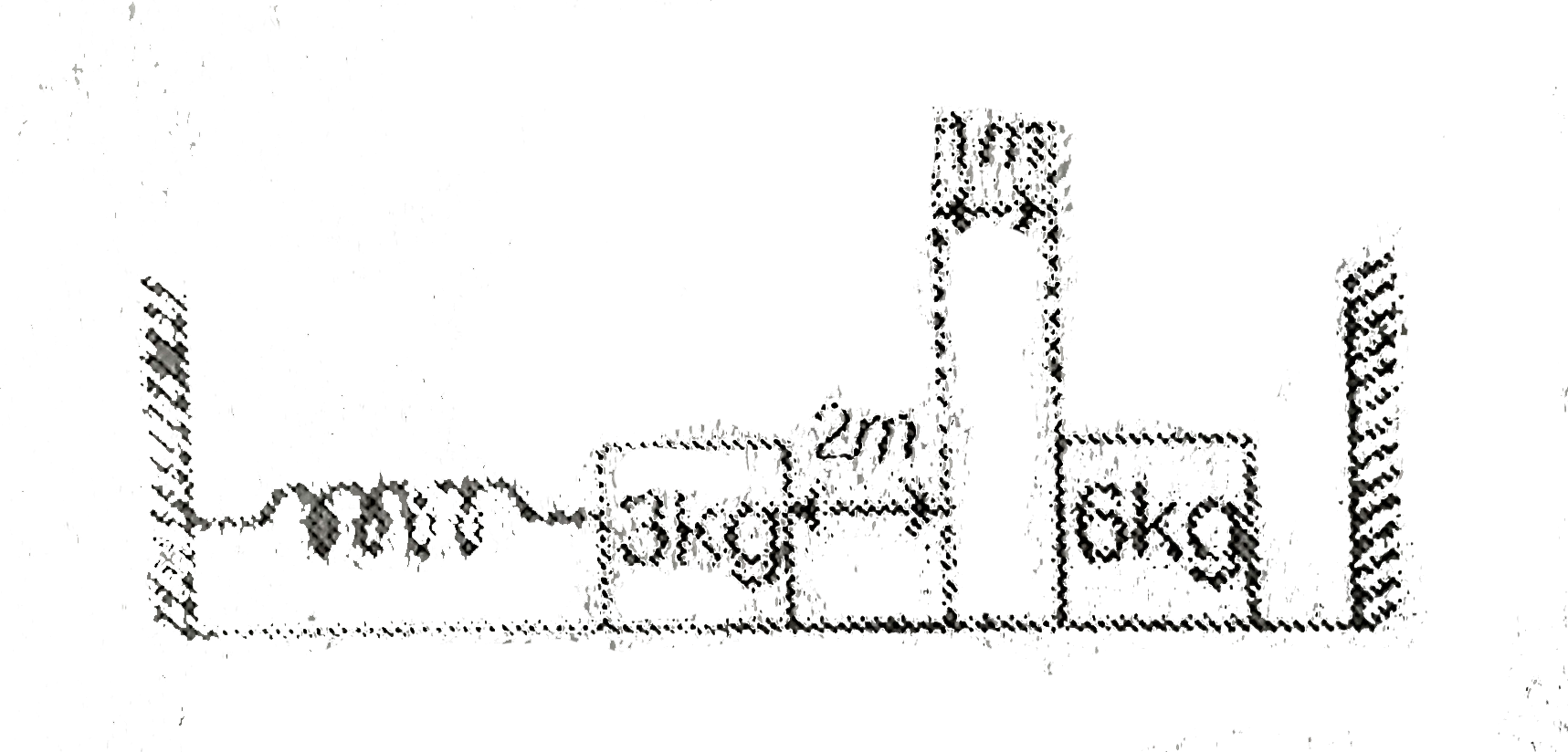
Two blocks of masses 3 kg and 6kg rest on horizontal smooth surface. The 3 kg block is attached to a spring with a long constant `k=900Nm^(-1)` which is compressed 2m from beyond 1m from mean position. 3kg mass strikes the 6 kg mass and the two stick together.

A

velocity of the combined masses immediately after the collision is `10 ms^(-1)`

B

velocity of the combined masses imeediately after the collsion is `5 ms^(-1)`

C

amplitude of the resulting oscillation is `sqrt(2) m`

D

amplitude of the resulting oscillation is `sqrt(5)//2 m`

Text Solution

Verified by Experts

The correct Answer is:

A, C

Velocity of 3kg block just before collision
`= omegasqrt(a^(2) - x^(2)) = sqrt((k/m)(a^(2)-x^(2))`
`=sqrt((900/3)(2^(2) - 1^(2))) = 30 m//s`
Velocity of combined masses immediately after the collision
`= ((3)(30))/(3+6) = 10 m//s`
New angular frequency
`omega' = sqrt(k/m) = sqrt(900/9) = 10`
Therefore `v' = omega'sqrt(a'^(2) - x^(2))`
`rArr 10 = 10sqrt(a'^(2) - 1^(2)) rArr a' = sqrt(2m)`
Promotional Banner

Topper's Solved these Questions

  • SIMPLE HARMONIC MOTION

    ALLEN|Exercise Exercise- 3 Match The Column|1 Videos
  • SIMPLE HARMONIC MOTION

    ALLEN|Exercise Asseration & Reason|7 Videos
  • SIMPLE HARMONIC MOTION

    ALLEN|Exercise Exercise-01|117 Videos
  • RACE

    ALLEN|Exercise Basic Maths (Wave Motion & Dopplers Effect) (Stationary waves & doppler effect, beats)|25 Videos
  • TEST PAPER

    ALLEN|Exercise PHYSICS|4 Videos

Similar Questions

Explore conceptually related problems

Two blocks of masses 3kg block is attached to a spring with a force constant, k k = 900N//ma which is compressed 2m initially from its equilibrium position. When 3kg mass is released, it strikes the 6kg mass and the two stick togther in an inelastic collision. The velocities of a particle executing S.H.M. are 30cm//s and 16 cm//s when its displacements are 8cm and 15cm from the equilibrium position. then its amplitude of oscillation in cm is:

Two blocks of masses 3kg block is attached to a spring with a force constant, k k = 900N//ma which is compressed 2m initially from its equilibrium position. When 3kg mass is released, it strikes the 6kg mass and the two stick togther in an inelastic collision. The common velocity of the blocks after collision is

Two blocks of masses 3kg block is attached to a spring with a force constant, k k = 900N//ma which is compressed 2m initially from its equilibrium position. When 3kg mass is released, it strikes the 6kg mass and the two stick togther in an inelastic collision. The amplitude of resulting oscillation after the collision is:

Two blocks of masses 4 kg and 6 kg are kept on a rough horizontal surface as shown. If the acceleration of 6 kg block is 5n , then n is :

Two blocks of masses 3kg and 6kg respectivley are placed on a smooth horizontal surface. They are connected by a light spring of force constant k=200N//m . Initially the spring is unstretched. The indicated velocities are imparted to the blocks. Find the maximum extension of the spring.

Two blocks of masses m = 2 kg and m = 8 kg are connected to a spring of force constant K = 1 kN//m . The spring is compressed by 20 cm and the two blocks are held in this position by a string. The system is placed on a horizontal smooth surface and given a velocity u = 3 m//s perpendicular to the spring. The string snaps while moving. Find the speed of the block of mass m when the spring regains its natural length.

Two blocks of masses 3 kg and 6 kg are connected by a string as shown in the figure over a frictionless pulley. The acceleration of the system is

Two blocks of masses 6 kg and 3 kg are attached to the two ends of a massless spring of spring constant 2 pi^(2) N//m . If spring is compressed and released on a smooth horizontal surface then find the time period (in seconds) of each block.

Two blocks of masses 1 kg and 2 kg are placed in contact on a smooth horizontal surface as shown in fig. A horizontal force of 6N is applied d(a) on a 1-kg block. Find the force of interaction of the blocks. .

ALLEN-SIMPLE HARMONIC MOTION-Exercise-02
  1. A mass M is performing linear simple harmonic motion. Then correct gra...

    Text Solution

    |

  2. A uniform cylinder of length (L) and mass (M) having cross sectional a...

    Text Solution

    |

  3. Two identical springs are fixed at one end and masses 1kg and 4kg are ...

    Text Solution

    |

  4. A cylindrical block of the density rho is partically immersed in a liw...

    Text Solution

    |

  5. A mass of 0.2 hg is attached to the lower end of a massles spring of f...

    Text Solution

    |

  6. A horizontal plank has a rectangular block placed on it. The plank sta...

    Text Solution

    |

  7. A particle is subjected to two simple harmonic motions along x and y d...

    Text Solution

    |

  8. A particle moves in the x-y the accoding to the equatio, r = (hati + 2...

    Text Solution

    |

  9. Two blocks A and B, each of mass m, are connected by a masslesss sprin...

    Text Solution

    |

  10. A solid uniform cylinder of mass M attached to a massless spring of fo...

    Text Solution

    |

  11. A ball is suspended by a thread of length l at the point O on an incl...

    Text Solution

    |

  12. A cage of mass M hangs from a light spring of force constant k. A body...

    Text Solution

    |

  13. In the above problem, the frequnecy of oscillations of the cage will b...

    Text Solution

    |

  14. The amplitude of a particle executing SHM about O is 10 cm. Then

    Text Solution

    |

  15. The angular frequency of a spring block system is omega(0). This syste...

    Text Solution

    |

  16. The x-coordinate of a particle moving on x-axis is given by x = 3 sin...

    Text Solution

    |

  17. Two blocks of masses 3 kg and 6kg rest on horizontal smooth surface. T...

    Text Solution

    |

  18. A disc of mass 3 m and a disc of mass m are connected by a massless sp...

    Text Solution

    |

  19. The displacement-time graph of a particle executing SHM is shown in fi...

    Text Solution

    |
