Home
Class 12
PHYSICS
The fig. shows the variation of photon c...

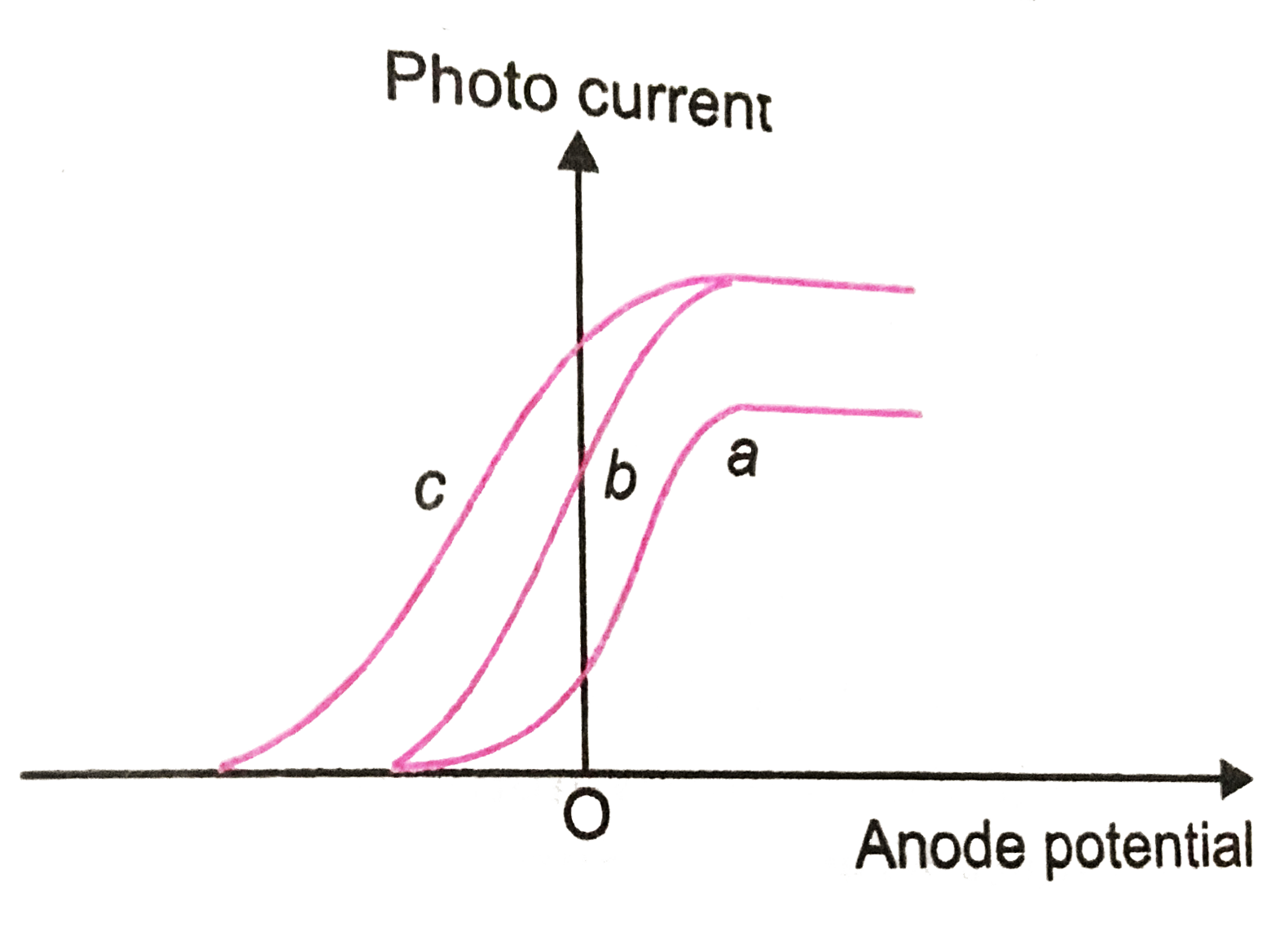
The fig. shows the variation of photon current with anode potential for a photo-sensitive surface for three different radiation. Let `I_(a), I_(b) and I_(c)` be the intensities and `f_(a), f_(b) and f_(c)` be the frequency for the curves a,b and c respectively.

A

`f_(a) = f_(b)`

B

`I_(a) lt I_(b)`

C

`f_(c) lt f_(b)`

D

`I_(c) gt I_(b)`

Text Solution

Verified by Experts

The correct Answer is:

C

Here `I_(B) = I_(C) gt I_(a)` and `f_(c) gt f_(a) = f_(b)`
Promotional Banner

Topper's Solved these Questions

  • SIMPLE HARMONIC MOTION

    ALLEN|Exercise Exercise - 02|1 Videos
  • SIMPLE HARMONIC MOTION

    ALLEN|Exercise Exercise - 03|2 Videos
  • SIMPLE HARMONIC MOTION

    ALLEN|Exercise Radioactivity : Solved Example|6 Videos
  • RACE

    ALLEN|Exercise Basic Maths (Wave Motion & Dopplers Effect) (Stationary waves & doppler effect, beats)|25 Videos
  • TEST PAPER

    ALLEN|Exercise PHYSICS|4 Videos

Similar Questions

Explore conceptually related problems

In the following figure shows the variation of photocurrent with potential of the collector plate for a photosensitive surface for three different radiations. Let I_(a), I_(b) and I_(c) be the intensities and f_(a), f_(b) and f_(c) be the frequencies for the curves a, b, and c, respectively.

The figure shows the variation of photocurrent with anode potential for a photosensitve surface for three different radiations. Let l_a, l_b and l_c be the curves a, b and c, respectively (a) f_a = f_b and l_a != l_b (b) f_a = f_c and l_a = l_c (c ) f_a = f_b and l_a = l_b (d) f_b = f_c and l_b = l_c

The figure shows a plot of photo current versus anode potential for a photosensitive surface for three different radiations. Which one of the following is a correct statement ?

The Fig shows a plot of three curves a, b, c showing the variation of photocurrent versis collector plate potential for the different intensities I_1, I_2 and I_3 having frequencies v_1, v_2 and v_3 respectively, incident on a photosensitive surface. Point out the two curves for which the incident radiation have same frequency but different intensities.

If f is a bijection and g is the inverse of f ,then fog=I_(B and gof=I_(A) where I_(A) and I_(B) are ) the identively. respectively.

In a plot of photoelectric current versus anode potential, how does (i) the saturation current vary with anode potential for incident radiations of different frequencies but same intensity? (ii) the stopping potential vary for incident radiations of different intensities but the same frequency? (iii) Photoelectric current vary of different intensities but same frequency of incident radiation? justify your answer is each case.

ALLEN-SIMPLE HARMONIC MOTION-SOME WORKED OUT EXAMPLES
  1. The probaility that a certaun radioactive atom would get disintefrated...

    Text Solution

    |

  2. Figure shows the graph of stopping potential verus that frequency of a...

    Text Solution

    |

  3. Consider a hydrogen-like atom whose energy in nth excited state is giv...

    Text Solution

    |

  4. The positions of .(1)^(2)D,.(2)^(4)He and .(3)^(7)Li are shown on the ...

    Text Solution

    |

  5. How many head-on elastic collisions must a neutron have with deuterium...

    Text Solution

    |

  6. The fig. shows the variation of photon current with anode potential fo...

    Text Solution

    |

  7. Radioactive nuclei emit beta^-1 particles. Electrons exist inside th...

    Text Solution

    |

  8. A vessel of 831 cc contains .(1)^(3)H atm and 27^(@)C. If half life of...

    Text Solution

    |

  9. Choose the CORRECT statement(s)

    Text Solution

    |

  10. Einstein in 1905 proppunded the special theory of relativity and in 19...

    Text Solution

    |

  11. Einstein in 1905 proppunded the special theory of relativity and in 19...

    Text Solution

    |

  12. Einstein in 1905 proppunded the special theory of relativity and in 19...

    Text Solution

    |

  13. A meacury arec lamp provides 0.1 watt of ultra-violet radiation at a w...

    Text Solution

    |

  14. A point source is emitting 0.2 W of ultravio- let radiation at a wavel...

    Text Solution

    |

  15. A mercury arc lamp provides 0.10 W of UV radiation at a wavelength of ...

    Text Solution

    |

  16. With respect to photoelectric experiment, match the entries of Column ...

    Text Solution

    |

  17. A sample of hydrogen gas is excited by means of a monochromatic radiat...

    Text Solution

    |

  18. An electron collides with a dfixed hydrogen atom in its ground stat. H...

    Text Solution

    |

  19. Neutron in thermal ewuilibrium with matter at 27^(@)C can be throught ...

    Text Solution

    |

  20. Electromagnetic waves of wavelenglth 1242 Å are indicdent on a metal o...

    Text Solution

    |
