Home
Class 12
PHYSICS
Suppose we consider friction between str...

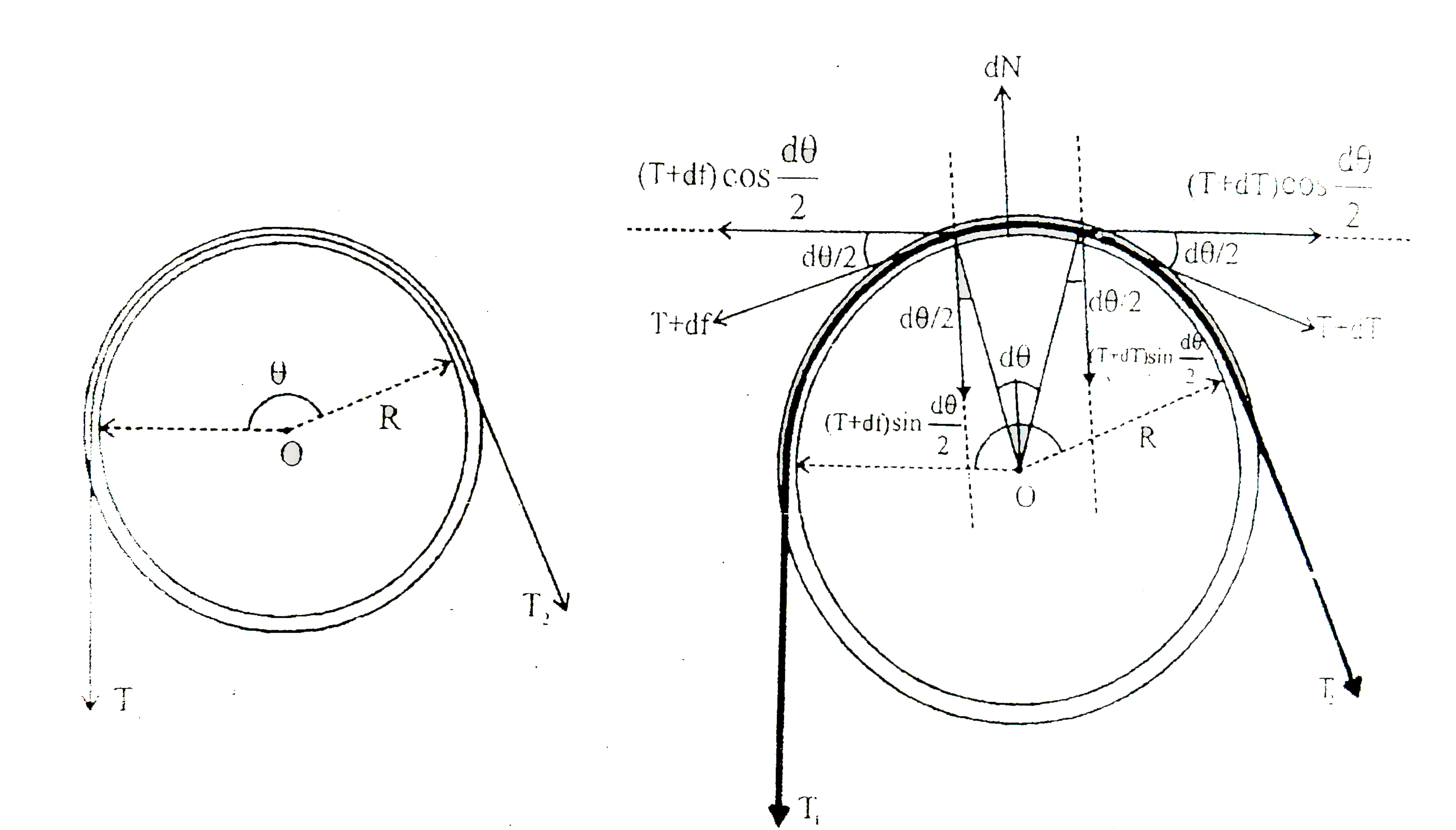
Suppose we consider friction between string and the pulley while still considering the string to be massless. So, in such a theoretical case, the tension in the string in contant with the pulley will not be constant and its variation is calculated as follows.
If the string is just on the verge of slipping on the pulley, then friction acting is limiting and if `T_(2) gt T_(1)` then friction will act towards `T_(1)` in tangential direction as shown.

`d N = (T + df) sin (d theta//2) + (T + dT) sin (d theta//2)`
`dN = T sin (d theta//2) + df sin (d del//2) + T sin (d theta//2) + d T sin (d theta//2)`
`dN ~~ 2T sin (d theta//2)`
`d N ~~ 2T (d theta)/(2)`
`d N = T d theta` ........(1)
Alsso, `(T + df) cos ((d theta)/(2)) = (T + d T) cos ((d theta)/(2))`
`T cos ((d theta)/(2)) + df cos ((d theta)/(2)) = T cos ((d theta)/(2)) 1 dT cos ((d theta)/(2))`
`df = dT = mu d N`.........(2)
from (1) & (2)
`dT = mu T d theta`
`int_(T_(1))^(T_(2)) (dT)/(T) = mu int_(0)^(theta) d theta`
`ln ((T_(2))/(T_(1))) = mu theta`
`T_(2) = T_(1) e^(mu theta)`, where `theta` is the angle of contact between the string and the pulley Based on above information, answer the following questions.
Two masses `m_(1) kg` and `m_(2) kg` passes over an atwood machine. Find the ratio of masses `m_(1)` and `m_(2)` so that string passing over the pulley will just start slipping over its surface. The friction coefficient between the string and pulley surface is 0.2.

A

`e^(0.2 pi)`

B

`e^(0.2)`

C

`0.2`

D

`e^(0.4 pi)`

Text Solution

Verified by Experts

The correct Answer is:

A

For a simple at wood's machine we can write for the two masses
`m_(1) g - T_(1) = m_(1)a`
and `T_(2) - m_(2) g = g = m_(2) a`
and if string starts slipping, we have
`T_(1) = T_(2) e^(mu pi)`
or `m_(1) (g - a) = m_(2) (g + a) e^(mu pi)`
If sting just slips. we can use `a = 0`, thus we have
`(m_(1))/(m_(2)) = e^(0.2 pi)`
Promotional Banner

Topper's Solved these Questions

Similar Questions

Explore conceptually related problems

Suppose we consider friction between string and the pulley while still considering the string to be massless. So, in such a theoretical case, the tension in the string in contant with the pulley will not be constant and its variation is calculated as follows. If the string is just on the verge of slipping on the pulley, then friction acting is limiting and if T_(2) gt T_(1) then friction will act towards T_(1) in tangential direction as shown. d N = (T + df) sin (d theta//2) + (T + dT) sin (d theta//2) dN = T sin (d theta//2) + df sin (d del//2) + T sin (d theta//2) + d T sin (d theta//2) dN ~~ 2T sin (d theta//2) d N ~~ 2T (d theta)/(2) d N = T d theta ........(1) Alsso, (T + df) cos ((d theta)/(2)) = (T + d T) cos ((d theta)/(2)) T cos ((d theta)/(2)) + df cos ((d theta)/(2)) = T cos ((d theta)/(2)) 1 dT cos ((d theta)/(2)) df = dT = mu d N .........(2) from (1) & (2) dT = mu T d theta int_(T_1)^(T_2) (dT)/(T) = mu int_(0)^(theta) d theta ln ((T_(2))/(T_(1))) = mu theta T_(2) = T_(1) e^(mu theta) , where theta is the angle of contact between the string and the pulley Based on above information, answer the following questions. Figure shows a cylinder mounted on an horizontal axle. A massless string is wound on it with two and a half turns and connected to two masses m and 2m. If the system is in limiting equilibrium, find the coefficient of friction between the string and the pulley surface.

The tension in the string in the pulley system shown in .

Calculate the tension in the string shown in (a) The pulleys and the string are light and all surfaces are frictionless. (g=10m//s^(2))

String Rod, Pulley Constraints

Study in fig. and answer the following questions accordingly. Neglect all friction and masses of the pulleys. What is the tension in the string?

In the system shown in fig the pulley is frictionless and the string massless if m_(1)=m_(2) thrust on the pulley will be:

Consider the system as shown in the figure. The pulley and the string are light and all the surfaces are frictionless. The tension in the string is (=g10m//s^(2)) .
