

Home
Class 11
CHEMISTRY
The Schrodinger wave equation for H-atom...

The Schrodinger wave equation for H-atom is
`nabla^(2) Psi = (8pi^(2)m)/(h^(2)) (E-V) Psi = 0`
Where `nabla^(2) = (del^(2))/(delx^(2)) +(del^(2))/(dely^(2)) +(del^(2))/(delz^(2))`
E = Total energy and V=potential energy wave function `Psi_(((r, theta,phi)))R_((r))Theta_((theta))Phi_((phi))`
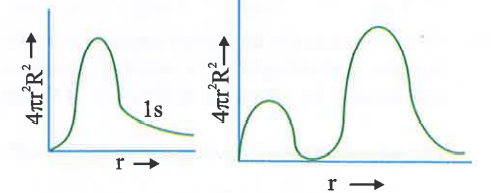
R is radial wave function which is function of ''r'' only, where r is the distance from nucleus. `Theta` and `Phi` are angular wave function. `R^(2)` is known as radial probability density and `4pir^(2)R^(2)dr` is known as radial probability function i.e., the probability of finding the electron is spherical shell of thickness dr.
Number of radial node =n -l - 1
Number of angular node = l
For hydrogen atom, wave function for 1s and 2s-orbitals are:
`Psi_(1s) = sqrt((1)/(pia_(0)^(a)))e^(-z_(r)//a_(0))`
`Psi_(2s) = ((Z)/(2a_(0)))^(½) (1-(Zr)/(a_(0)))e^(-(Zr)/(a_(0)))`
The plot of radial probability function `4pir^(2)R^(2)` aganist r will be:

Answer the following questions:
What will be number of angular nodes and spherical nodes for 4f atomic orbitals respectively.

A

0,0

B

1,3

C

3,0

D

0,3

Text Solution

Verified by Experts

The correct Answer is:
C

no of angular nodes = 1
Promotional Banner

Topper's Solved these Questions

Similar Questions

Explore conceptually related problems

The Schrodinger wave equation for H-atom is nabla^(2) Psi = (8pi^(2)m)/(h^(2)) (E-V) Psi = 0 Where nabla^(2) = (del^(2))/(delx^(2)) +(del^(2))/(dely^(2)) +(del^(2))/(delz^(2)) E = Total energy and V=potential energy wave function Psi_(((r, theta,phi)))R_((r))Theta_((theta))Phi_((phi)) R is radial wave function which is function of ''r'' only, where r is the distance from nucleus. Theta and Phi are angular wave function. R^(2) is known as radial probability density and 4pir^(2)R^(2)dr is known as radial probability function i.e., the probability of finding the electron is spherical shell of thickness dr. Number of radial node =n -l - 1 Number of angular node = l For hydrogen atom, wave function for 1s and 2s-orbitals are: Psi_(1s) = sqrt((1)/(pia_(0)^(a)))e^(-z_(r)//a_(0)) Psi_(2s) = ((Z)/(2a_(0)))^(½) (1-(Zr)/(a_(0)))e^(-(Zr)/(a_(0))) The plot of radial probability function 4pir^(2)R^(2) aganist r will be: Answer the following questions: The following graph is plotted for ns-orbitals The value of 'n' will be:

The Schrodinger wave equation for H-atom is nabla^(2) Psi = (8pi^(2)m)/(h^(2)) (E-V) Psi = 0 Where nabla^(2) = (del^(2))/(delx^(2)) +(del^(2))/(dely^(2)) +(del^(2))/(delz^(2)) E = Total energy and V=potential energy wave function Psi_(((r, theta,phi)))R_((r))Theta_((theta))Phi_((phi)) R is radial wave function which is function of ''r'' only, where r is the distance from nucleus. Theta and Phi are angular wave function. R^(2) is known as radial probability density and 4pir^(2)R^(2)dr is known as radial probability function i.e., the probability of finding the electron is spherical shell of thickness dr. Number of radial node =n -l - 1 Number of angular node = l For hydrogen atom, wave function for 1s and 2s-orbitals are: Psi_(1s) = sqrt((1)/(pia_(0)^(a)))e^(-z_(r)//a_(0)) Psi_(2s) = ((Z)/(2a_(0)))^(½) (1-(Zr)/(a_(0)))e^(-(Zr)/(a_(0))) The plot of radial probability function 4pir^(2)R^(2) aganist r will be: Answer the following questions: The value of radius 'r' for 2s atomic orbital of H-atom at which the radial node will exist may be given as:

Select the correct plot of radial probability function (4pir^(2)R^(2)) for 2s - orbital.

In schrodinger wave equation grad^(2)psi+?(pi^(2)m)/(h^(2))(E-V)psi=0 ? is- "

If u = (x^2+y^2+z^2)^(-1/2) then prove that (del^2u)/(delx^2)+(del^2u)/(dely^2)+(del^2u)/(delz^2) =0

R(r) is the radial part of the wave function and r is the distance of electron from the nucleus.

For s-orbitals, since ( Psi orbitals wave function) is independent of angles, the probability density (Psi^2) is

NARAYNA-ATOMIC STRUCTURE-All Questions
  1. The Schrodinger wave equation for H-atom is nabla^(2) Psi = (8pi^(2)...

    Text Solution

    |

  2. The Schrodinger wave equation for H-atom is nabla^(2) Psi = (8pi^(2)...

    Text Solution

    |

  3. The Schrodinger wave equation for H-atom is nabla^(2) Psi = (8pi^(2)...

    Text Solution

    |

  4. The hydrogen -like species Li^(2+) is in a spherically symmetric stat...

    Text Solution

    |

  5. The hydrogen -like species Li^(2+) is in a spherically symmetric stat...

    Text Solution

    |

  6. The hydrogen -like species Li^(2+) is in a spherically symmetric stat...

    Text Solution

    |

  7. In a hydrogen like ion, nucleus has a positive charge Ze, Bohr's quant...

    Text Solution

    |

  8. In a hydrogen like ion, nucleus has a positive charge Ze, Bohr's quant...

    Text Solution

    |

  9. In a hydrogen like ion, nucleus has a positive charge Ze, Bohr's quant...

    Text Solution

    |

  10. The value of 'n' of the highest excited state that an electron of hydr...

    Text Solution

    |

  11. A hydrogen like species (atomic number Z) is present in a higher excit...

    Text Solution

    |

  12. If the lowest energy X-rays have lambda=3.055xx10^(-8) m, estimate the...

    Text Solution

    |

  13. Electron in a sample of H- atoms make transitions from state n=x to so...

    Text Solution

    |

  14. Aphoton of energy 4.5 eV strikes on a metal surface of work function 3...

    Text Solution

    |

  15. Not considering the electronic spin, the degeneracy of the second exci...

    Text Solution

    |

  16. In Bohr's model, r(n,z)= radius of n^(th) orbit with atomic number Z ...

    Text Solution

    |

  17. {:(Column I,Column II),((A)H,(p)"Radius of"4^(th)"orbit"0.53 xx 4overs...

    Text Solution

    |

  18. Match the entries in Column I with the correctly related quantum numbe...

    Text Solution

    |

  19. {:(,"ColumnI",,"ColumnII"),((A),"The d-orbital which has two angular n...

    Text Solution

    |

  20. Match the following columns

    Text Solution

    |