Home
Class 12
CHEMISTRY
The substance undergoes first order deco...

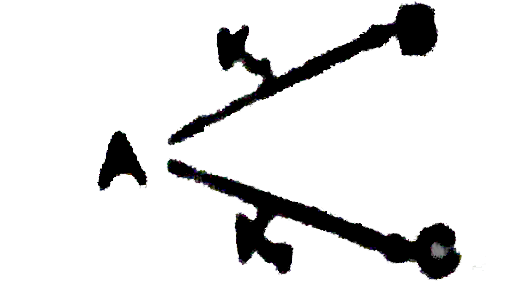
The substance undergoes first order decomposition.The decomposition follows two parallel first order reactons as :

`K_1=10^(-2) sec^(-1) and K_2=10^(-2)sec^(-1)`
If the corresponding activation energies of parallel reaction are 100 and 120 kJ `"mol"^(-1)` then the net activation energy of A is/are:

A

120 kJ `"mol"^(-1)`

B

116 kJ `"mol"^(-1)`

C

100 kJ `"mol"^(-1)`

D

150 kJ `"mol"^(-1)`

Text Solution

Verified by Experts

The correct Answer is:

B

`E=(k_1E_1+k_2E_2)/(k_1+k_2)=(10^(-2)xx100+120xx4xx10^(-2))/(10^(-2)+4xx10^(-2))=116 kJ mol^(-1)`
Promotional Banner

Topper's Solved these Questions

  • QUALITATIVE ANALYSIS PART 1

    RESONANCE|Exercise A.L.P|39 Videos
  • SOLID STATE

    RESONANCE|Exercise PHYSICAL CHEMITRY (SOLID STATE)|45 Videos

Similar Questions

Explore conceptually related problems

The substance undergoes first order decomposition. The decomposition follows two parallel first order reactions as : K_(1)=1.26xx10^(-4) sec^(-1) and K_(2) =3.8xx10^(-5) sec^(-1) The percentage distribution of B and C

A substance undergoes first order decomposition. The decomposition follows two parallel first order reactions as , k_(1)=1.26xx10^(-4)" sec"^(-1) and k_(2)=3.6xx10^(-5)" sec"^(-1) Calculate the % distribution of B & C.

A substance undergoes first order decomposition. The decomposition follows two parallel first order reaction as: and KP_(1)=1.26xx10^(-4)sec^(-1) K_(2)=3.80xx10^(-5)sec^(-1) The percentage distribution of B and C are:

A substance undergoes first order decomposition. The decomposition follows two parallel first order reactions as : k_(1) =1.26xx10^(-4)s^(-1), k_(2) =3.8xx10^(-5) s^(-1) The percentage distribution of B and C are :

A substance undergoes first order decomposition. The decomposition follows two parallel first order reaction as : The precentage distribution of B and C are :

A subtance undergoes first order decomposition involving two parallel first order reaction as : The mole percent of B in the products is :

A substance undergoes first order decomposition. The decomposition follows two parallel first order reactions as The % distribution of B and C is ................ and .................. respectively.

RESONANCE-RANK BOOSTER-All Questions
  1. For the reaction 2A+BtoC with the rate low (d[C])/(dt)=k[A]^(1)[B]^(-1...

    Text Solution

    |

  2. The half-period T for the decomposition of ammonia on tungsten wire, w...

    Text Solution

    |

  3. The substance undergoes first order decomposition.The decomposition fo...

    Text Solution

    |

  4. A certain reaction obeys the rate equation (in the integrated form) [C...

    Text Solution

    |

  5. A certain reaction A rarr B follows the given concentration (Molarity)...

    Text Solution

    |

  6. Consider the following case of competing 1^(st) order reactions. ...

    Text Solution

    |

  7. Assertion (A) : If the activation energy of a reaction is zero, temper...

    Text Solution

    |

  8. The rate law expresses the relationship of the rate of a reaction to t...

    Text Solution

    |

  9. The rate law expresses the relationship of the rate of a reaction to t...

    Text Solution

    |

  10. The following data were observed for the following reaction at 25^(@)C...

    Text Solution

    |

  11. The following data were observed for the following reaction at 25^(@)C...

    Text Solution

    |

  12. The following data were observed for the following reaction at 25^(@)C...

    Text Solution

    |

  13. Match the following columns

    Text Solution

    |

  14. Match order of the reaction (in List-I) with the corresponding rate co...

    Text Solution

    |

  15. For the reaction Ato prouducts, the following data is given for a part...

    Text Solution

    |

  16. If (dx)/(dt)=k[H(3)O^(+)]n and rate becomes 100 times when pH change...

    Text Solution

    |

  17. The gas phase decomposition of dimethyl ether follows first order kine...

    Text Solution

    |

  18. 105 mL of pure water at 4^(circ)C saturated with NH(3) gas yielded a s...

    Text Solution

    |

  19. Volume V(1)mL of 0.1 M K(2)Cr(2)O(7) is needed for complete oxidation ...

    Text Solution

    |

  20. 100 ml of 0.1 M NaAl(OH)(2)CO3 is neutralised by 0.25 N HCl to form Na...

    Text Solution

    |
