Home
Class 12
CHEMISTRY
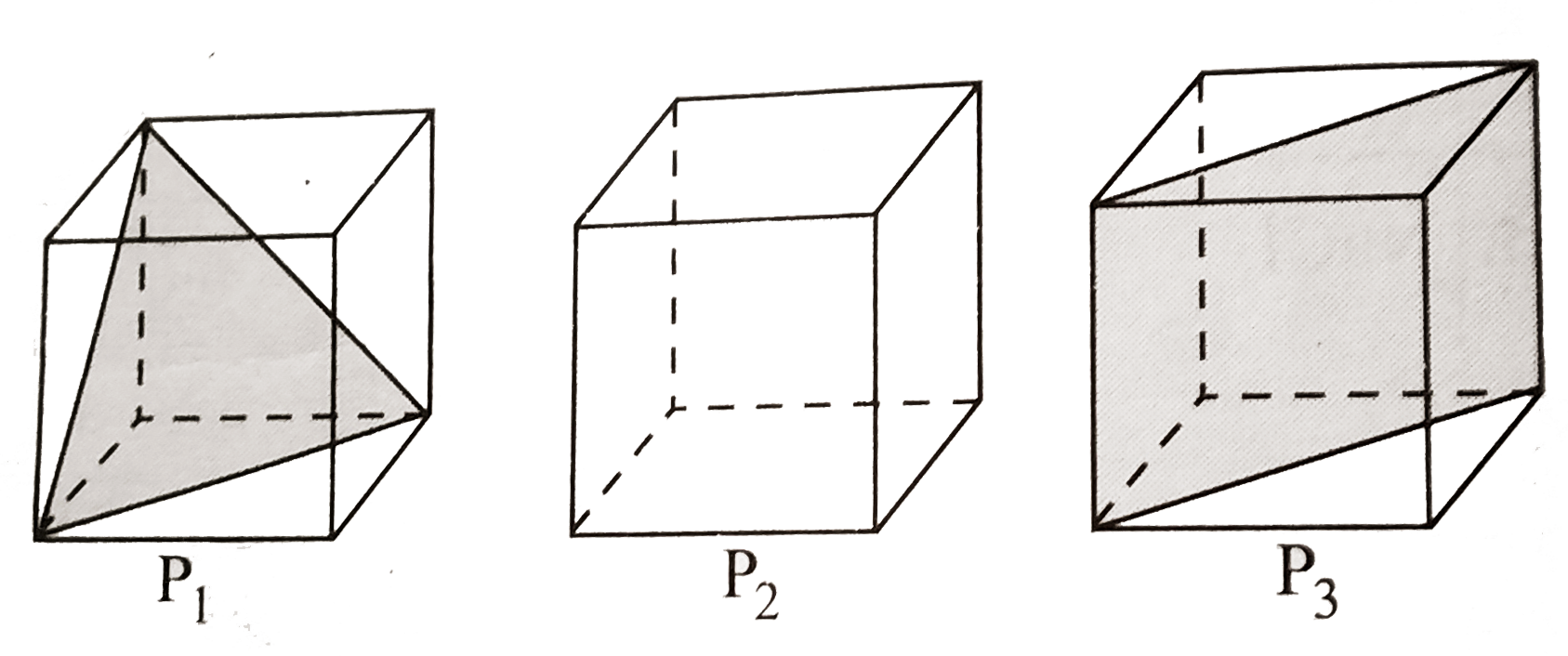
Following three planes (P(1), P(2), P(3)...

Following three planes `(P_(1), P_(2), P_(3))` in an fcc unit cell are shown in the figure below. Consider the following statements and choose the correct option/options that follow:

A

`P_1` contains no three dimensional voids

B

`P_2` contains only octahedral voids

C

`P_3` contains both octahedral and tertahedral voids

D

All are true

Text Solution

Verified by Experts

The correct Answer is:

ABCD

In an FCC, Octahedral voids lies on the edges & in centre of unit cell & tetrahedral voids on the body diagonal
Promotional Banner

Topper's Solved these Questions

  • QUALITATIVE ANALYSIS PART 1

    RESONANCE|Exercise A.L.P|39 Videos
  • SOLID STATE

    RESONANCE|Exercise PHYSICAL CHEMITRY (SOLID STATE)|45 Videos

Similar Questions

Explore conceptually related problems

Read the following statement and choose the correct option.

Read the following statements and choose the correct option :

Consider the following arrangement and choose the correct options

Consider the following fcc unit cells choose the correct option

Following three planes (P_(1), P_(2), P_(3)) in an FCC unit cell are shown. Consider the following statements and choose the corrct option that follow: (P) P_(1) contains no voids three dimensions. (Q) P_(2) contains only octahedral voids. (R) P_(3) contains both octahedral and tetrahedral voids.

Following three planes (P_(1),P_(2),P_(3)) in an FCC unit cell are shown : Consider the following statement and choose the correct option that follow : (i) P_(1) contains no voids of three dimensions. (ii) P_(2) contains only Octahedral voids. (iii) P_(3) contains both Octahedral and Tetrahedral voids.

Read the following statement and choose the CORRECT option.

Following three planes (P1, P2, P3) in an FCC unit cell are shown. Consider the following statements and choose the correct option that follow :

Match followings and choose the correct option form below:

Consider the diagram given below and choose the correct option.

RESONANCE-RANK BOOSTER-All Questions
  1. Analysis show that nickel oxide consists of nickel ion with 96% ions h...

    Text Solution

    |

  2. In an fcc crystal, which of the following shaded planes contain the gi...

    Text Solution

    |

  3. Following three planes (P(1), P(2), P(3)) in an fcc unit cell are show...

    Text Solution

    |

  4. In a AB unit cell (Rock salt type) assuming A^(+) forming fcc :

    Text Solution

    |

  5. In the fluorite structure if the radius ratio is (sqrt(3)/(2)-1) how m...

    Text Solution

    |

  6. The co-ordination number of FCC structure for metals is 12, since:

    Text Solution

    |

  7. An hcp and a ccp structure for a given element would be expected to ha...

    Text Solution

    |

  8. Assertion : An important feature of fluorite structure is that cations...

    Text Solution

    |

  9. Assertion :In NaCIcrystal each Na^(+) ion is tourching 6 CI^(-) ion bu...

    Text Solution

    |

  10. When an atom or an ion is missing from its nomal lattice site a lattic...

    Text Solution

    |

  11. Column-I and Column-II contains four entries each.Entries of Column-I ...

    Text Solution

    |

  12. A(2)B molecules(" molar mass " = 259.8 g//"ml") crystallises in a hex...

    Text Solution

    |

  13. In F.C.C. arrangement of identical spheres, distance between two neare...

    Text Solution

    |

  14. N2 and H2 are taken in 1:3 molar ratio in a closed vessel to attained ...

    Text Solution

    |

  15. The unit of equilibrium constant KC of a reaction is "mol"^(-2) boat^2...

    Text Solution

    |

  16. NH4COONH2 (s) hArr 2NH3(g)+CO(2)(g) If equilibrium pressure is 6 atm...

    Text Solution

    |

  17. A 10 litre box contains O3 and O2 at equilibrium at 2000 K. Kp=4xx10^(...

    Text Solution

    |

  18. The following two reactions: i. PCl(5)(g) hArr PCl(3)(g)+Cl(2)(g) ...

    Text Solution

    |

  19. For the chemical reaction 3X(g)+Y(g) hArr X(3)Y(g), the amount of ...

    Text Solution

    |

  20. What is the minimum mass of CaCO3(s), below which it decomposes comple...

    Text Solution

    |
