Home
Class 12
CHEMISTRY
A hydrogen like atom (atomic number z) i...

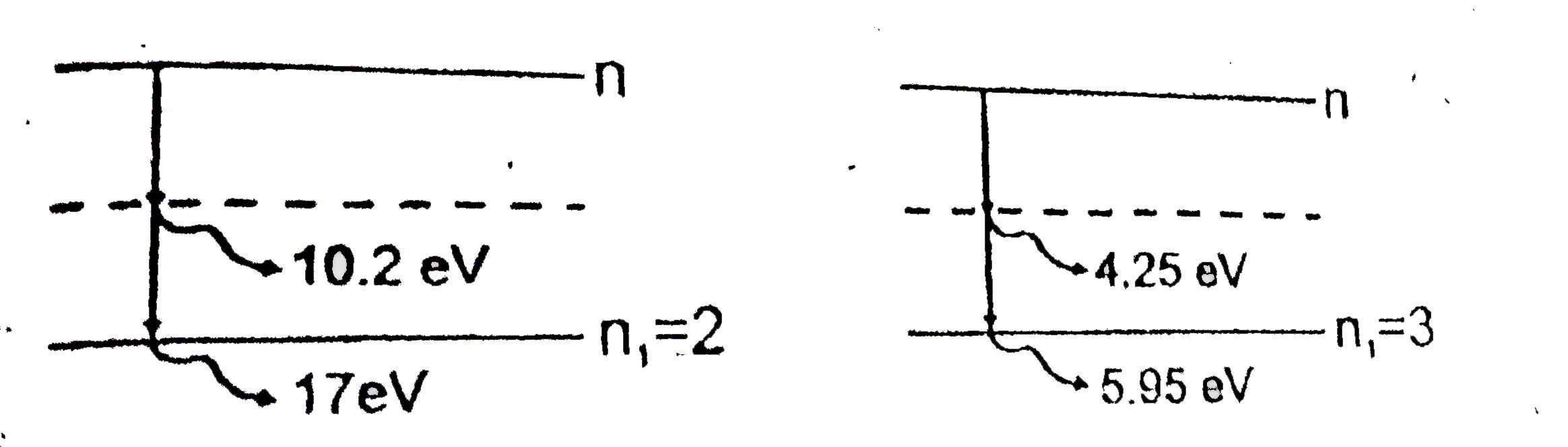
A hydrogen like atom (atomic number `z`) is in a higher excited state of quantum number `n`. This excited atom can make a transition to the first excited state by successively emitting two photons of energies `10.2 eV` and `17.0 eV` respectively. Alternatively the atom from the same excited state can make a transition to the second excited state by successively emitting 2 photons of energy `4.25 eV` and`5.95 eV` respectively. Determine the value of `(n+z)`

Text Solution

Verified by Experts

The correct Answer is:
9


`10+2+17=13.6 Z^2(1/2^2-1/n^2) and 4.25+5.95=13.6 Z^2(1/3^2-1/n^2)`
solving the above two equations we get, Z=3,n=6
Promotional Banner

Topper's Solved these Questions

  • QUALITATIVE ANALYSIS PART 1

    RESONANCE|Exercise A.L.P|39 Videos
  • SOLID STATE

    RESONANCE|Exercise PHYSICAL CHEMITRY (SOLID STATE)|45 Videos

Similar Questions

Explore conceptually related problems

A hydrogen like atom (atomic number Z) is in a higher excited state of quantum number n. The excited atom can make a transition ot the first excited state by successively emitting two photons of energy 10.2 eV and 17.0 eV, respectively. Alternatively, the atom from the same excited state can make a transition to the second excited state by successively emitting two photons of energies 4.25 eV and 5.95 eV, respectivley Determine the values of n and Z. (lonization energy of H-atom = 13.6 eV)

A hydrogen-like atom (aatomic number Z ) is in a hight excited state of quantum number n . This excited atom can make a transition to the first excited state by successively emitting two proton of energy 10.20 e V and 17.00 e V , respectively. Alternatively , the atom from the same excited state can make a transition to the second excited state by successively emitting two proton of energy 4.25 e V and 5.954 e V , respectively. Determine the value of n and Z (ionization energy of hydrogen atom = 13.6 eV)

A hydrogen like species (atomic number Z) is present in a higher excited state of quantum number n. This excited atom can make a transitionn to the first excited state by successive emission of two photons of energies 10.20 eV and 17.0 eV respectively. Altetnatively, the atom from the same excited state can make a transition to the second excited state by successive of two photons of energy 4.25 eV and 5.95 eVv respectively. Determine the value of Z.

A hydrogen like atom (atomic number Z) is in a higher excited satte of quantum number n .This excited atom can make a transition to the first excited state by succesively emitting two photon of energies 10.20 eV and 17.00 eV .Alternatively, the atom from the same excited state can make a transition to the second excited state by successively emitting twio photon of energy 4.25 ev and 5.95 eV Determine the followings: The value of atomic number (Z) is

A hydrogen like atom (atomic number Z) is in a higher excited satte of quantum number n .This excited atom can make a transition to the first excited state by succesively emitting two photon of energies 10.20 eV and 17.00 eV .Alternatively, the atom from the same excited state can make a transition to the second excited state by successively emitting twio photon of energy 4.25 ev and 5.95 eV Determine the followings: The excited sate (n) of the atom is

A hydrogen like atom (atomic number Z) is in a higher excited satte of quantum number n .This excited atom can make a transition to the first excited state by succesively emitting two photon of energies 10.20 eV and 17.00 eV .Alternatively, the atom from the same excited state can make a transition to the second excited state by successively emitting twio photon of energy 4.25 ev and 5.95 eV Determine the followings: The hydrogen -like atom in the question is

A hydrogen like atom (atomic number Z) is in a higher excited satte of quantum number n .This excited atom can make a transition to the first excited state by succesively emitting two photon of energies 10.20 eV and 17.00 eV .Alternatively, the atom from the same excited state can make a transition to the second excited state by successively emitting twio photon of energy 4.25 ev and 5.95 eV Determine the followings: The atom during transition from n = 1 to n = 2 emit radiation in the region of

A Li^(2+) ion is in a higher excited state of quantum number 'n' This excited ion can make a transition to the first excited state by successively emitting two photons of energies 10.2 eV and 17.0 eV respectivley . The value of 'n' is :

RESONANCE-RANK BOOSTER-All Questions
  1. If n(1) and n(2) are the boundary value principal quantum numbers of a...

    Text Solution

    |

  2. Electrons in a sample of H-atoms make transition from state n=x to som...

    Text Solution

    |

  3. A hydrogen like atom (atomic number z) is in a higher excited state of...

    Text Solution

    |

  4. In a sample of H-atoms in ground state electrons make transition from ...

    Text Solution

    |

  5. When a graph is plotted between log x//m and log p, it is striaght lin...

    Text Solution

    |

  6. Which of the following statements about physical adsorption is correct...

    Text Solution

    |

  7. Following is the variation of physical adsorption with temperature.

    Text Solution

    |

  8. Finely divided catalyst has greater surface area and has greater catal...

    Text Solution

    |

  9. Gold number of a lyphilic sol is such property that:

    Text Solution

    |

  10. For the coagulation of 200 mL of As(2)S(3) solution, 10 mL of 1 M NaCl...

    Text Solution

    |

  11. At CMC, the surfactant molecules :

    Text Solution

    |

  12. Which of the following ions will be most effective in coagulating the ...

    Text Solution

    |

  13. Coagulation value of the electrolytes AlCl(3) and NaCl for As(2)S(3) s...

    Text Solution

    |

  14. Which of the following is wrong :

    Text Solution

    |

  15. Gold number of haemoglobin is 0.03. Hence 100 ml of gold sol will requ...

    Text Solution

    |

  16. Oil-soluble dye is mixed with water-in-oil emulsion, then

    Text Solution

    |

  17. Which can absorb large volume of hydrogen gas ?

    Text Solution

    |

  18. The correct statement (S) pertaining to the adsorption of a gas on a s...

    Text Solution

    |

  19. In the aqueous solution of soaps above :

    Text Solution

    |

  20. Which of the following statements are true for physisoption?

    Text Solution

    |

