A
B
C
D
Text Solution
Verified by Experts
The correct Answer is:



Topper's Solved these Questions
Similar Questions
Explore conceptually related problems
RESONANCE-RANK BOOSTER-All Questions
- All the following complexes show decrease in their weights when placed...
Text Solution
|
- Which of the following statements is most likely to be incorrect ?
Text Solution
|
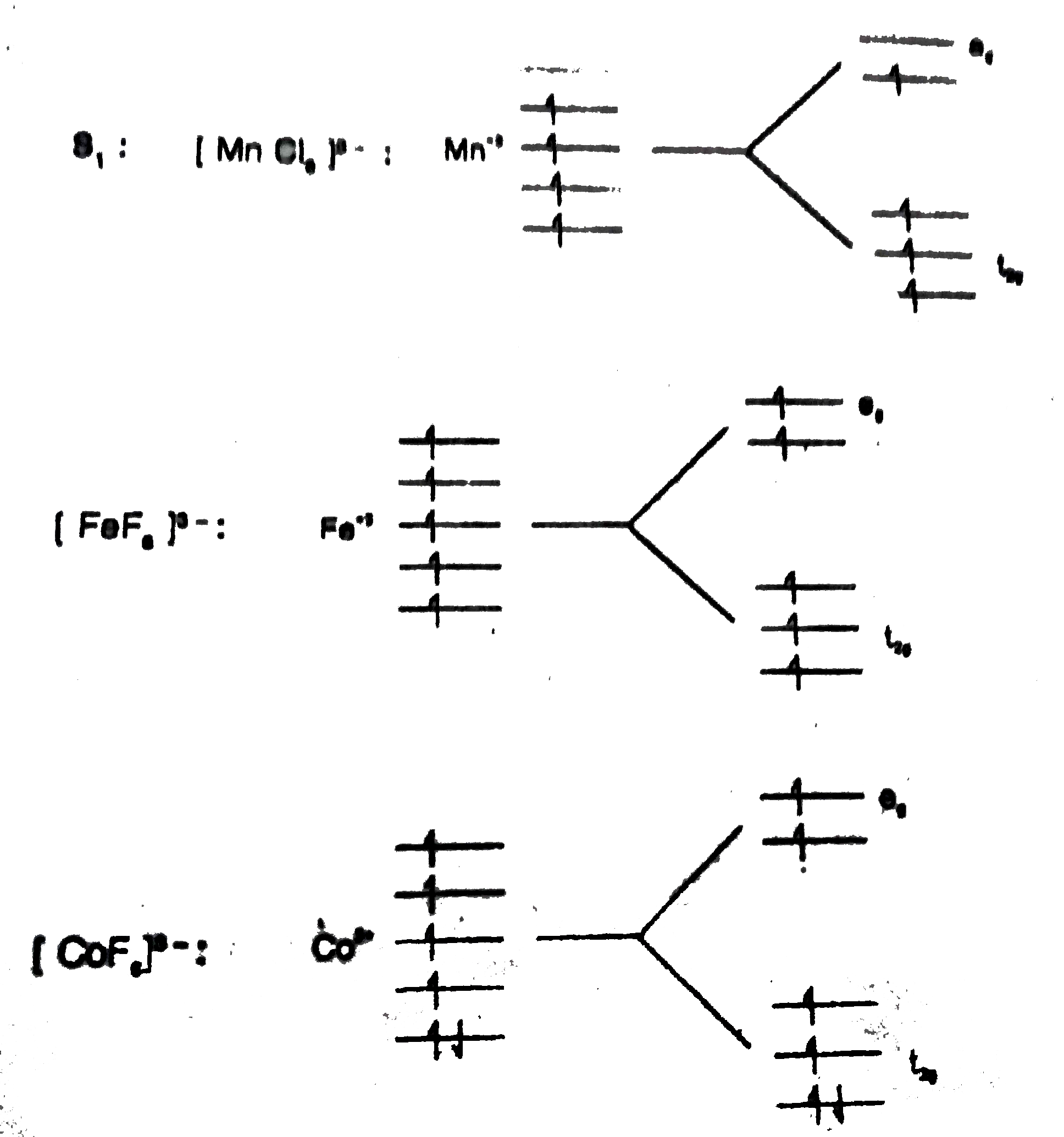
- s-1: [MnCl(6)]^(3),[FeF(6)]^(3-) and [CoF(6)]^(-3) are paramagnetic ha...
Text Solution
|
- Consider the following satements : S(1): Generally square planare c...
Text Solution
|
- Consider the following statements and arrange in the order of the true...
Text Solution
|
- Which of the following complexes is(are) paramagnetic ?
Text Solution
|
- For Mn^(+3) pairing energy is 28000 cm^(-1) , Delta0 for [Mn(CN)6]^(3-...
Text Solution
|
- Which of the following complex (s) is/are correctly matched with their...
Text Solution
|
- In which of the following pairs both the complexes do not show optical...
Text Solution
|
- The question consist of two statements each, printed as Assertion and ...
Text Solution
|
- The question consist of two statements each, printed as Assertion and ...
Text Solution
|
- In coordination chemistry there are a variety of methods applied to fi...
Text Solution
|
- The brown ring complex compound of iron is formulated as [Fe (H(2)O)(5...
Text Solution
|
- The volume (in mL) of 1.0 M AgNO3 required for complete precipitation ...
Text Solution
|
- Which of the following statement(s) is (are) incorrect ?
Text Solution
|
- The process of removing lighter gangue particles by washing in a curre...
Text Solution
|
- Main source of lead is galena (PbS). It is converted to Pb by : S...
Text Solution
|
- Which of the following is not correctly matched with respect to the pr...
Text Solution
|
- Which of the following statement is incorrect about the extractive met...
Text Solution
|
- An ore of tin containing FeCrO(4) is concentrated by
Text Solution
|