

Home
Class 12
CHEMISTRY
Crystal field theory views the bonding i...

Crystal field theory views the bonding in complexes as arising from electrostatic interaction and considers the effect of the ligand charges on the energies of the metal ion d-orbitals
In this theory, a ligand lone pair is modelled as a point negative charge that repels electrons in the d-orbitals of the central metal ion.The theory concentrated on the resulting splitting of the d-orbitals in two groups with different energies and used that splitting to rationalize and correlate the optical spectra,thermodynamic stability, and magnetic properties of complexes.This energy splitting between the two sets of d-orbitals is called the crystal field splitting `Delta`.
In general, the crystal field splitting energy `Delta` corresponds to wavelenght of light in visible region of the spectrum, and colours of the complexes can therefore be attributed to electronic transition between the lower and higher energy sets of d-orbitals.
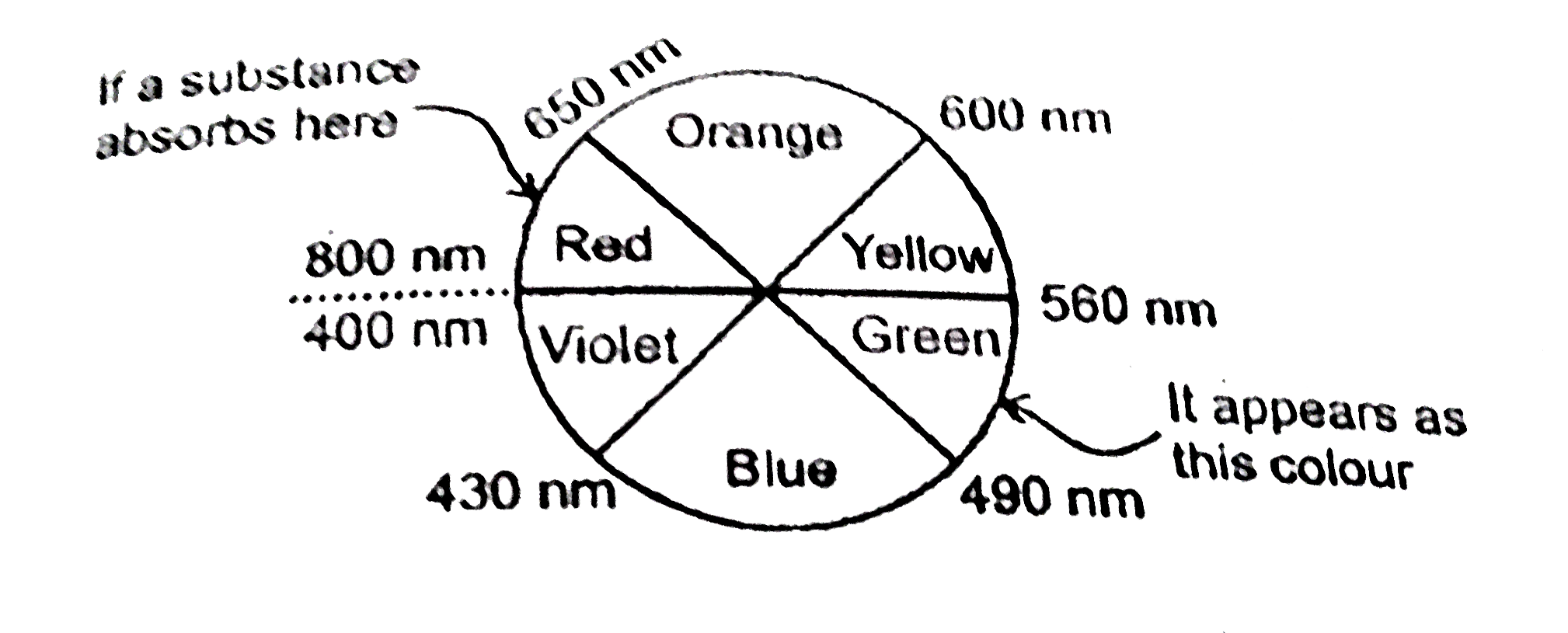
In general, the colour that we see is complementry to the colour absorbed.

Different metal ions have different value of `Delta`, which explains why their complexes with the same ligand have different colour.
Similarly the crystal field splitting also depends on the nature of ligands and as the ligand for the same metal varies from `H_2O` to `NH_3` to ethylenediamine, `Delta` for complexes increase.Accordingly, the electronic transition shifts to higher energy (shorter wavelength) as the ligand varies from `H_2O` from `NH_3` to en, thus accounting for the variation in colour.
Crystal field theory accounts for the magnetic properties of complexes in terms of the relative values of `Delta` and the spin pairing energy P. Small `Delta` values favour high spin complexes, and large `Delta` values favour low spin complexes.
Which of the following statements is incorrect ?

A

The `Ni^(2+)` (aq) cation is coloured because `Ni^(2+)` ion can absorb light, which promotes electrons from the filled d-orbitals to the higher energy half filled d-orbitals

B

The `Zn^(2+)` (aq) cation is colourless because the d-orbitals are completely filled and no electrons can be promoted, so no light is absorbed

C

A complex which has just one absorption band at 455 nm, must be red coloured

D

None

Text Solution

Verified by Experts

The correct Answer is:
C

As it absorbs blue colour light (`lambda`=455 nm), the colour of the complex must be orange.
Promotional Banner

Topper's Solved these Questions

  • QUALITATIVE ANALYSIS PART 1

    RESONANCE|Exercise A.L.P|39 Videos
  • SOLID STATE

    RESONANCE|Exercise PHYSICAL CHEMITRY (SOLID STATE)|45 Videos
RESONANCE-RANK BOOSTER-All Questions
  1. Crystal field theory views the bonding in complexes as arising from el...

    Text Solution

    |

  2. The reduction potential of hydrogen half cell will be negative if :

    Text Solution

    |

  3. A very thin copper plate is electro- plated with gold using gold chlor...

    Text Solution

    |

  4. We have taken a saturated solution of AgBr,K(sp) of AgBr is 12xx10^(-1...

    Text Solution

    |

  5. At what [Br^(-)]/sqrt(CO(3)^(2-)] does the following cell have its rea...

    Text Solution

    |

  6. Consider the cell Ag(s)|AgBr(s)Br^(c-)(aq)||AgCl(s),Cl^(c-)(aq)|Ag(s) ...

    Text Solution

    |

  7. For a saturated solution of AgCl at 25^(@)C,k=3.4xx10^(-6) ohm^(-1)cm^...

    Text Solution

    |

  8. With t taken in seconds and I taken in amp, the variation of I follows...

    Text Solution

    |

  9. You are given the followin cell at 298 K, Zn|(Zn^(+ +) .((aq.))),(0.01...

    Text Solution

    |

  10. A resistance of 50Omega is registered when two electrodes are suspende...

    Text Solution

    |

  11. the standard reduction potenital of a silver chloride electrode is 0.2...

    Text Solution

    |

  12. Calcualte the cell EMP in mV for Pt|H(2)(1 atm) | HCl(0.01 M)|| AgCl...

    Text Solution

    |

  13. Calculate the value of Lambda(m) ^prop for SrCl(2) in water at 25^(@)...

    Text Solution

    |

  14. Select the correct statement if- E(Mg^(2+)//Mg)^(@)=-2.4V, E(Sn^(4+)...

    Text Solution

    |

  15. For the cell (at 298K) Ag(s) | AgCl(s) | Cl^(-)(aq)|| AgNO(3)(aq) | ...

    Text Solution

    |

  16. Peroxodisulphate salts, (e.g., Na(2)S(2)O(8)) are strong oxidizing age...

    Text Solution

    |

  17. In which of the following cell(s): E("cell")=E("cell")^(@)?

    Text Solution

    |

  18. A current of 2.68A is passed for one hour through an aqeous solution o...

    Text Solution

    |

  19. Which is/are correct among the following? Given the half cell EMFs E...

    Text Solution

    |

  20. Mark out the correct statement(s) regarding electrolytic molar conduct...

    Text Solution

    |

  21. Statement-1:Zinc protect the iron better than tin even after it cracks...

    Text Solution

    |