Home
Class 12
CHEMISTRY
Nitrogen forms the largest number of oxi...

Nitrogen forms the largest number of oxides as it is capable of forming stable multiple bonds with oxygen.They range from `N_2O`(O.S of nitrogen+1) through `NO, N_2O_3,NO_2,N_2O_4` to `N_2O_5`(O.S of nitrogen +5).
Following points are important regarding the study of oxides of nitrogen.
(a)All oxides of nitrogen except `N_2O_6` and endothermic as a large amount of energy is required to dissociate the stable molecule of oxygen and nitrogen.
(b)The small electronegativity difference between oxygen and nitrogen make N-O bond easily breakable to give oxygen and hence oxides of nitrogen are said to be better oxidising agents.
(c )Except `N_2O_5`, all are gases at ordinary temperature. `N_2O_3` is stable only at lower temperature (253 K).
(d) Except `N_2O` and NO which are neutral oxides, all are acidic oxides which dissolve in water forming corresponding oxy acids.
(e)They are also good example for illustrating the concept the resonance.
Identify the incorrect statement.

A

In `N_2O_4` the N-N bond length is longer than the usual N-N single bond distance

B

`NO_2` molecule is angular with N-O distance equal to intermediate distance between a single and a double bond.

C

`N_2O` is a linear molecule and has a small dipole moment

D

None of these

Text Solution

Verified by Experts

The correct Answer is:
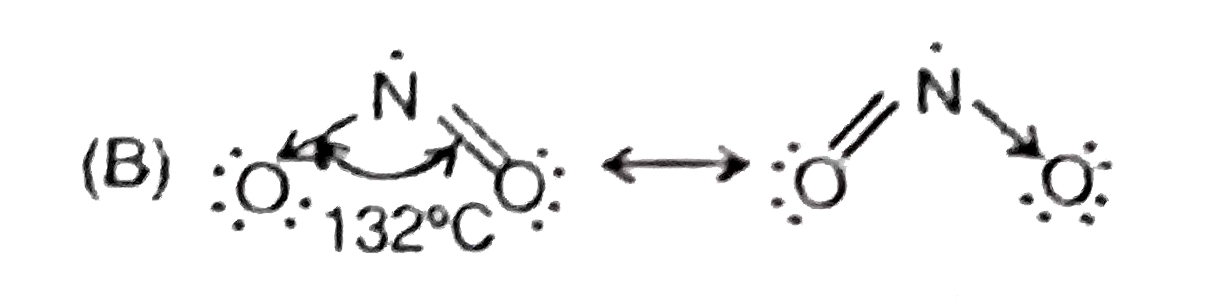
D

(A)N-N bond length (1.75 Å) is longer than usual N-N single bond length which is believed to be due to `delta^-` charge and lone pair of electrons on N atoms which causes repulsion.

(C )`:N-=underset(sp)N:tounderset(ddot)overset(ddot)O:` and the structure suggests that it will have some dipole moment.
Promotional Banner

Topper's Solved these Questions

  • QUALITATIVE ANALYSIS PART 1

    RESONANCE|Exercise A.L.P|39 Videos
  • SOLID STATE

    RESONANCE|Exercise PHYSICAL CHEMITRY (SOLID STATE)|45 Videos

Similar Questions

Explore conceptually related problems

Nitrogen forms the largest number of oxides as it is capable of forming stable multiple bonds with oxygen. They range of N_(2)O (O.S of nitrogen +1) through NO, N_(2)O_(3),NO_(2),N_(2)O_(4) "to" N_(2)O_(5) (O.S of nitrogen +5). Following points are improtant regarding the study of oxides of nitrogen. (a) All oxides of nitrogen expect N_(2)O_(5) are endothermic as a large amount of energy is required to dissociate the stable molecule of oxygen and nitrogen. (b) The small electronegativity difference between oxygen and nitrogen make N-O bond easily breakle to give oxygen and hence oxides of nitrogen are said to be better oxidising agents. (c) Expect N_(2)O_(5) , all are gases at ordinary temperature. N_(2)O_(3) is stable only at lower temperature (253K). (d) Expect N_(2)O and NO which are neutal oxides, all are acidic oxides which dissolve in water forming coresponding oxy acids. (e) They are also good example for illustrating the concept of resonance. The gas which is acidic in nature is :

The solid oxide of nitrogen is N_2 O .

All the oxides of nitrogen exhibits (between N and O )

Which of the following oxides of nitrogen contains N-O-N bond ?

RESONANCE-RANK BOOSTER-All Questions
  1. Nitrogen forms the largest number of oxides as it is capable of formin...

    Text Solution

    |

  2. The reduction potential of hydrogen half cell will be negative if :

    Text Solution

    |

  3. A very thin copper plate is electro- plated with gold using gold chlor...

    Text Solution

    |

  4. We have taken a saturated solution of AgBr,K(sp) of AgBr is 12xx10^(-1...

    Text Solution

    |

  5. At what [Br^(-)]/sqrt(CO(3)^(2-)] does the following cell have its rea...

    Text Solution

    |

  6. Consider the cell Ag(s)|AgBr(s)Br^(c-)(aq)||AgCl(s),Cl^(c-)(aq)|Ag(s) ...

    Text Solution

    |

  7. For a saturated solution of AgCl at 25^(@)C,k=3.4xx10^(-6) ohm^(-1)cm^...

    Text Solution

    |

  8. With t taken in seconds and I taken in amp, the variation of I follows...

    Text Solution

    |

  9. You are given the followin cell at 298 K, Zn|(Zn^(+ +) .((aq.))),(0.01...

    Text Solution

    |

  10. A resistance of 50Omega is registered when two electrodes are suspende...

    Text Solution

    |

  11. the standard reduction potenital of a silver chloride electrode is 0.2...

    Text Solution

    |

  12. Calcualte the cell EMP in mV for Pt|H(2)(1 atm) | HCl(0.01 M)|| AgCl...

    Text Solution

    |

  13. Calculate the value of Lambda(m) ^prop for SrCl(2) in water at 25^(@)...

    Text Solution

    |

  14. Select the correct statement if- E(Mg^(2+)//Mg)^(@)=-2.4V, E(Sn^(4+)...

    Text Solution

    |

  15. For the cell (at 298K) Ag(s) | AgCl(s) | Cl^(-)(aq)|| AgNO(3)(aq) | ...

    Text Solution

    |

  16. Peroxodisulphate salts, (e.g., Na(2)S(2)O(8)) are strong oxidizing age...

    Text Solution

    |

  17. In which of the following cell(s): E("cell")=E("cell")^(@)?

    Text Solution

    |

  18. A current of 2.68A is passed for one hour through an aqeous solution o...

    Text Solution

    |

  19. Which is/are correct among the following? Given the half cell EMFs E...

    Text Solution

    |

  20. Mark out the correct statement(s) regarding electrolytic molar conduct...

    Text Solution

    |

  21. Statement-1:Zinc protect the iron better than tin even after it cracks...

    Text Solution

    |

