Home
Class 12
CHEMISTRY
In a sample of H-atom electrons make tra...

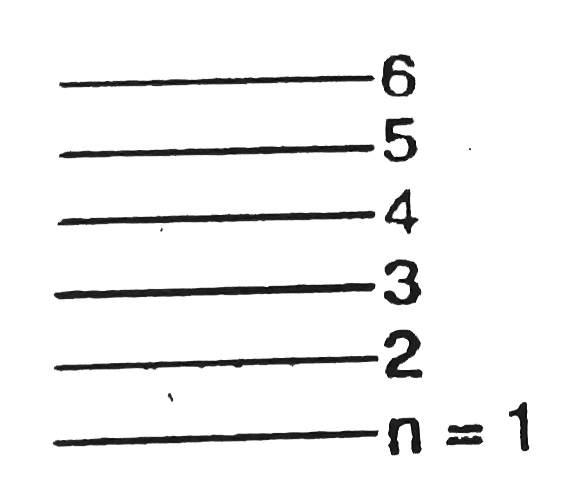
In a sample of H-atom electrons make transition from `5^(th)` excited state to ground state, producing all possible types of photons, then number of lines in infrared region are

A

4

B

5

C

6

D

3

Text Solution

Verified by Experts

The correct Answer is:
C


maximum number of lines produced =`(6(6-1))/2=15`
out of these 15 lines.
5 lines belong to ultra violet region and 4 lines are in visible region and rest are in infrared region.
Promotional Banner

Topper's Solved these Questions

  • QUALITATIVE ANALYSIS PART 1

    RESONANCE|Exercise A.L.P|39 Videos
  • SOLID STATE

    RESONANCE|Exercise PHYSICAL CHEMITRY (SOLID STATE)|45 Videos

Similar Questions

Explore conceptually related problems

In a H- like sample electron makes transition from 4th excited state of 2nd state then:

In a sample of H-atoms electrons are de-exicited from 4^(th) excited state to ground state. Which is/are correct statement ?

In a single isolated atom an electron make transition from 5th excited state to 2nd state then maximum number of different types of photons observed is

If electron make transition from 7^(th) excited state to 2^(nd) state in H atom sample find the max. number of spectral lines observed.

As an electron makes a transition from an excited state to the ground state of a hydrogen - like atom //ion

As an electron makes a transition from an excited state to the ground state of hydrogen-like atom // ion:

If an electron of hydrogen atom moves from fourth excited state to ground state in Lyman series find the total number of spectral lines?

In a sample of H-atoms in ground state electrons make transition from ground state to a particular excited state where path length is 5 times de Broglie wavelength , electrons make back transition to the ground state producing all possible photons. If photon having 2nd highest energy of this sample can be used to excite the electron in a particular excited state of Li^(2+) ion then find the final excited state of Li^(2+) ion .

RESONANCE-RANK BOOSTER-All Questions
  1. In a sample of H-atom electrons make transition from 5^(th) excited st...

    Text Solution

    |

  2. The reduction potential of hydrogen half cell will be negative if :

    Text Solution

    |

  3. A very thin copper plate is electro- plated with gold using gold chlor...

    Text Solution

    |

  4. We have taken a saturated solution of AgBr,K(sp) of AgBr is 12xx10^(-1...

    Text Solution

    |

  5. At what [Br^(-)]/sqrt(CO(3)^(2-)] does the following cell have its rea...

    Text Solution

    |

  6. Consider the cell Ag(s)|AgBr(s)Br^(c-)(aq)||AgCl(s),Cl^(c-)(aq)|Ag(s) ...

    Text Solution

    |

  7. For a saturated solution of AgCl at 25^(@)C,k=3.4xx10^(-6) ohm^(-1)cm^...

    Text Solution

    |

  8. With t taken in seconds and I taken in amp, the variation of I follows...

    Text Solution

    |

  9. You are given the followin cell at 298 K, Zn|(Zn^(+ +) .((aq.))),(0.01...

    Text Solution

    |

  10. A resistance of 50Omega is registered when two electrodes are suspende...

    Text Solution

    |

  11. the standard reduction potenital of a silver chloride electrode is 0.2...

    Text Solution

    |

  12. Calcualte the cell EMP in mV for Pt|H(2)(1 atm) | HCl(0.01 M)|| AgCl...

    Text Solution

    |

  13. Calculate the value of Lambda(m) ^prop for SrCl(2) in water at 25^(@)...

    Text Solution

    |

  14. Select the correct statement if- E(Mg^(2+)//Mg)^(@)=-2.4V, E(Sn^(4+)...

    Text Solution

    |

  15. For the cell (at 298K) Ag(s) | AgCl(s) | Cl^(-)(aq)|| AgNO(3)(aq) | ...

    Text Solution

    |

  16. Peroxodisulphate salts, (e.g., Na(2)S(2)O(8)) are strong oxidizing age...

    Text Solution

    |

  17. In which of the following cell(s): E("cell")=E("cell")^(@)?

    Text Solution

    |

  18. A current of 2.68A is passed for one hour through an aqeous solution o...

    Text Solution

    |

  19. Which is/are correct among the following? Given the half cell EMFs E...

    Text Solution

    |

  20. Mark out the correct statement(s) regarding electrolytic molar conduct...

    Text Solution

    |

  21. Statement-1:Zinc protect the iron better than tin even after it cracks...

    Text Solution

    |

