Home
Class 12
MATHS
In a dice game , a player pays a stake o...

In a dice game , a player pays a stake of ₹1 for each throw of a die. She receives ₹5, if the die shows a 3, ₹ 2, if the die shows a 1 or 6 and nothing otherwise, then what is the player's expected profit per throw over a long series of throws?

Text Solution

Verified by Experts
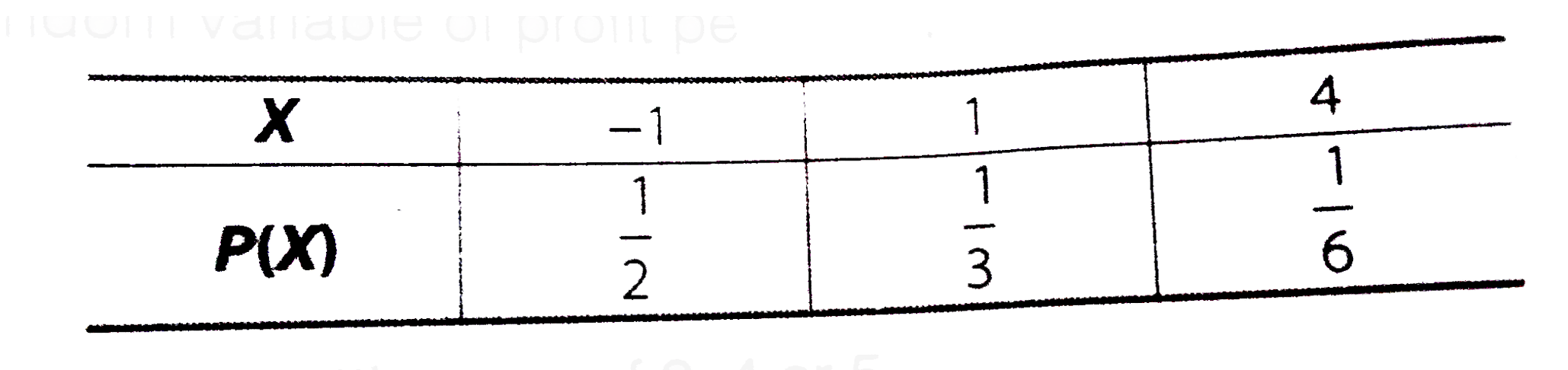
Let X is the random variable of profit per throw.

Since, she loss ₹ 1 on getting any of 2, 4 or 5
So, at X=-1 `P(X)=1/6+1/6+1/6=3/6=1/2`
Similarly, at X=1, `P(X)=1/6+1/6=1/3` [If die shows of either 1 or 6]
and at X=4, `P(X)=1/6` [if die shows a 3]
`therefore` Player's expected profit=`E(X)=sumXP(X)`
`=-1xx1/2+1xx1/3+4xx1/6`
`=(-3+2+4)/6=3/6=1/2=₹0.50`
Promotional Banner

Topper's Solved these Questions

  • MATRICES

    NCERT EXEMPLAR|Exercise Matrices|101 Videos
  • RELATIONS AND FUNCTIONS

    NCERT EXEMPLAR|Exercise Relations And Functions|62 Videos

Similar Questions

Explore conceptually related problems

In 60 throws of a die, the outcomes were noted as below: If die is thrown at random, then what is the probability that upper face of a die shows an even prime number?

A dice is thrown twice.The probability of getting 4,5 or 6 in the first throw and 1,2,3 or 4 in the second throw is

A and B throw with one die for a stake of ₨11 which is to be won by the player who first throw 6. If A has the first throw, then what are their respective expectations?

In a game, a man wins Rs 100 if he gets 5 or 6 on a throw of a fair die and loses Rs 50 for getting any other number on the die. If he decides to throw the die either till he gets a five or a six or to a maximum of three throws, then his expected gain/loss (in rupees) is: (a) 400/3 gain (b) 400/9 loss (c) 0 (d) 400/3 loss

Let two fair six-faced dice A and B be thrown simultaneously. If E_1 is the event that die A shows up four, E_2 is the event that die B shows up two and E_3 is the event that the sum of numbers on both dice is odd, then which of the following statements is NOT true ? (1) E_1 and E_2 are independent. (2) E_2 and E_3 are independent. (3) E_1 and E_3 are independent. (4) E_1 , E_2 and E_3 are independent.

NCERT EXEMPLAR-PROBABILITY-Probability
  1. Prove that (i) P(A)=P(AcapB)+P(AcapbarB) (ii) P(AcupB)=P(AcapB)+P(...

    Text Solution

    |

  2. If x is the number of tails in three tosses of a coin, then determine ...

    Text Solution

    |

  3. In a dice game , a player pays a stake of ₹1 for each throw of a die. ...

    Text Solution

    |

  4. Three dice are thrown at the same time. Find the probability of getti...

    Text Solution

    |

  5. Suppose 10000 tickets are sold in a lottery each for ₹ 1. First prize ...

    Text Solution

    |

  6. A bag contains 4 white and 5 black balls. Another bag contains 9 white...

    Text Solution

    |

  7. A bag contains 3 white and 2 black balls and another bag contains 2 ...

    Text Solution

    |

  8. A box has 5 blue and 4 red balls. One ball is drawn at random and repl...

    Text Solution

    |

  9. Four cards are successively drawn without replacement from a deck of 5...

    Text Solution

    |

  10. If a die is thrown 5 times, then find the probability that an odd numb...

    Text Solution

    |

  11. If ten coins are tossed, then what is the probability of getting atlea...

    Text Solution

    |

  12. The probability of a man hitting man hitting target is 0.25. If he sho...

    Text Solution

    |

  13. A lot of 100 watches is known to have 10 defective watches. If 8 watch...

    Text Solution

    |

  14. Consider the probability distribution of a random variable X Cal...

    Text Solution

    |

  15. The probability distribution of a random variable X is given below ...

    Text Solution

    |

  16. For the following probability distribution determine standard deviatio...

    Text Solution

    |

  17. A biased die is such that P(4)=1/10 and other scores being equally lik...

    Text Solution

    |

  18. A die is thrown three times. Let X be the number of twos seen. Find th...

    Text Solution

    |

  19. Two baised dice are thrown together. For the first die P(6)=1/2 , othe...

    Text Solution

    |

  20. Two probability distributionof the discrete random variable X and Y ar...

    Text Solution

    |

