Home
Class 10
MATHS
In a Delta ABC the value of /A is given ...

In a `Delta ABC` the value of `/_A` is given by 5 CosA - 3 = 0 then the equation whose roots are sinA and tanA is :

Text Solution

Verified by Experts
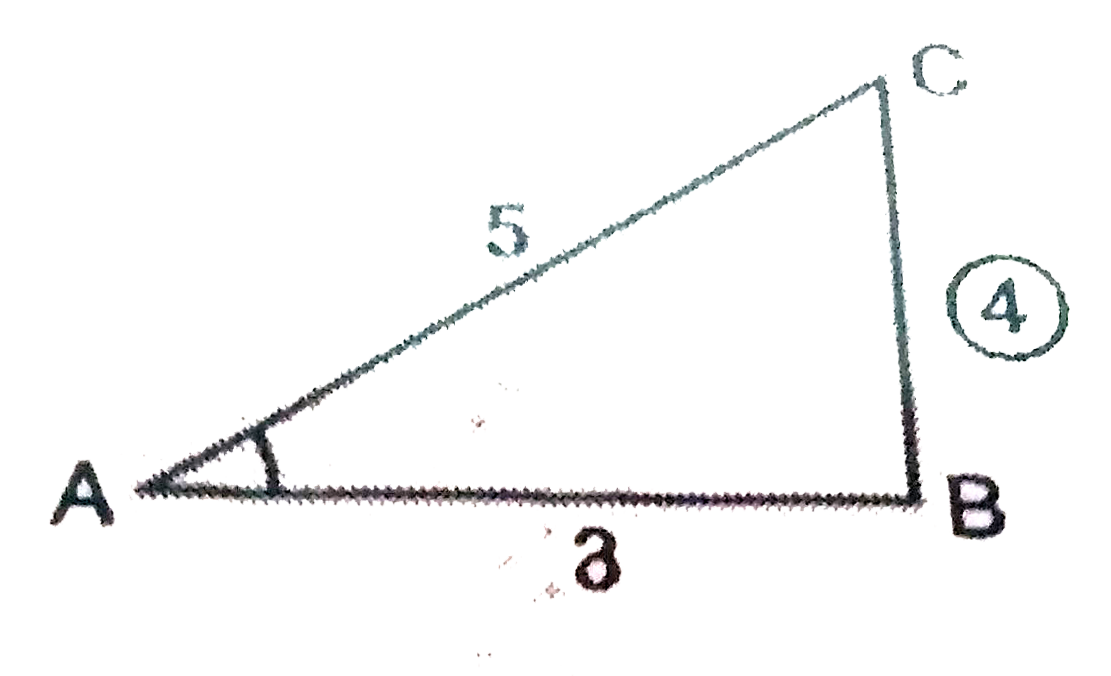
We have,
`5cosA-3=0 impliescosA=(3)/(5)=("base")/("hypotenuse")`
So `angleA` must be acute, Now make a base AB such that `angleB=90^(@)` and find the perpendicular by Pythagoras theorem.
`:.sinA(4)/(5)andtanA=(4)/(3)`
:. Quadratic equation whose roots are sin A and tan A, are
`x^(2)-(sinA+tenA)x+(sinA.tenA)=0" "(":'""equation is "x^(2)-S.x+P=0)`
`impliesx^(2)-((4)/(5)+(4)/(3))x+((4)/(5)xx(4)/(3))=0`
`impliesx^(2)-((12+20)/(15))x+(16)/(15)=0`
`implies15x^(2)-32x+16=0`
Promotional Banner

Topper's Solved these Questions

  • QUADRATIC EQUATIONS

    NAGEEN PRAKASHAN|Exercise Problems From NCERT /exemplar|17 Videos
  • QUADRATIC EQUATIONS

    NAGEEN PRAKASHAN|Exercise Exercise 4a|37 Videos
  • PROBABILITY

    NAGEEN PRAKASHAN|Exercise Revision Exercise Very Short Answer/short Answer Questions|16 Videos
  • REAL NUMBERS

    NAGEEN PRAKASHAN|Exercise Revision Exercise Long Answer Questions|5 Videos

Similar Questions

Explore conceptually related problems

In a Delta ABC the value of /_A is given by 5cos A-3=0 then the equation whose roots are sin A and tanA is :

In a Delta ABC the value of /_A is given by 5cos A-3=0 then the equation whose roots are sin A and tanA is :

In a triangle ABC,C=90^(@), then the equation whose roots are tan A, tan B is

If 90^(@) lt A lt 180^(@) and 3cosA+2=0 . Then quadratic equation whose roots are sin A and tan A, is

If ABCD, is a cycling quadrilateral such that tanA-5=0and 5cosB+3=0, then the quadratic equation whose roots are cosCand tan D, is

If alpha, beta are the roots of the equationn x^(2)-3x+5=0 and gamma, delta are the roots of the equation x^(2)+5x-3=0 , then the equation whose roots are alpha gamma+beta delta and alpha delta+beta gamma is

In triangleABC , which is not right angled, if p=sinA sinB sinC = and q=cosA. cosB. cosC. Then the equation having roots tanA,tanB and tanC is

()123 $1. In a triangle ABC, a, b and c are the sides of the triangle satisfying the relation r1 + r2 = r3-r then the perimeter of the triangle 2ab a +b-c ab a +c-b ab a-b-c bc b+c-a 62. In ?ABC, which is not right angled, if p = sinA sinB sinc and q = cosA cosB cosc. Then the equation having roots tanA, tanB and tanC is (1) qxs_px® + (1+4)x-p=0 (2) qx3 + 2px" + qx-p=0 (3) qxs_ px2 + (2 + q)x + pq = 0 (4) qxs_px2 + qx + p = 0

